
AMD has acquired Spatial Intelligence (SI) company, World Labs for $8.2 billion. The acquisition is the most significant throughout AMD’s history. AMD now has the foundation to surpass Nvidia and to become the world’s most valuable chip company. For World Labs, the acquisition represents an eight fold increase as compared to its September 2024 funding round valuation.
Most significantly, the history books will record AMD’s acquisition as THE defining moment or watershed event that:
- Signaled AI’s transformation to software (Spatial Intelligence) from hardware
- Preceded an epic U.S. and global stock market decline caused by the transformation
During 01/17/26 “Markowski on the Markets” weekly zoom session the rationale for why Spatial Intelligence (SI) was the pin that would inevitably pop the stock market’s AI bubble was explained. SI’s entering the AI narrative via AMD’s acquisition has accelerated the timetable to the inevitable.
The excerpt below from a 09/29/26 Yahoo Finance report which covered AMD’s acquisition is prolific:
“World Labs develops spatial-intelligence models that generate, reconstruct and simulate interactive 3D environments from text, image and video inputs, as well as technology for robotic learning and simulation. AMD said the acquisition will bring model research expertise into its hardware and software roadmap planning as AI expands into reasoning, robotics and physical applications.”
SPATIAL INTELLIGENCE (SI) is technology’s new frontier
Video below is Bloomberg’s interview of Ms. Fei-Fei Li about SI being technology’s new frontier. Ms. Li, the CEO of World Labs, is renown in Silicon Valley, and is considered to the “Godmother of AI”. A viewing of the four minute video is highly recommended. My prediction is that “SI” will enter into the vernacular of financial media, all analysts, and many investors by end of 2027.
“Spatial Intelligence (SI) will Change Course of AI”

The transformation to software and algorithm driven SI marks the end of the hardware powered AI era. AI began with machine learning in the 1940s. The advent of Physical AI in 2025, created the need for software powered SI to replace the existing AI hardware. What has not been discounted by professional investors and analysts is that a silk purse can-not be made from a sow’s ear. The realization that trillions have been spent on a technology (hardware), that is not scalable, will result in the coming stock market decline being epic.
The table below depicts the evolution of AI. Since 2020, NVIDIA has been the innovator for Generative AI and developer of the of the chip that powers Chat GPT. Nvidia was the first to get AI into the mass market. Prior to NVIDA, IBM had been AI’s leading innovator.
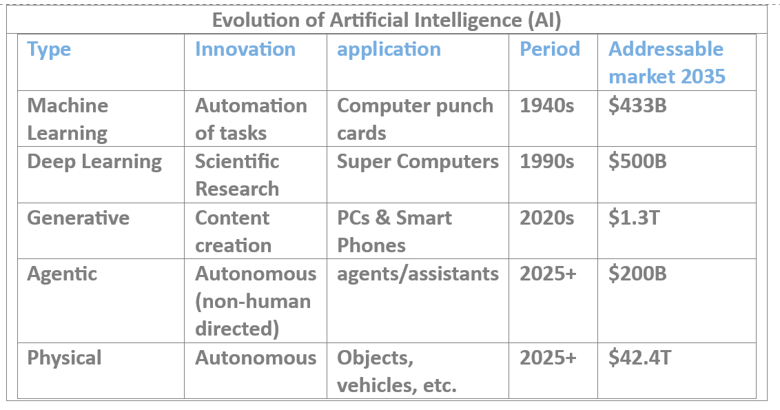
The transformation to Spatial Intelligence (SI), or software from hardware, for powering Physical AI applications, presents a HUGE risk to the U.S. and global stock markets. The indices have been bid up to exorbitant highs that are based on a very weak rationale.
Analysts and investors have incorrectly assumed that Nvidia would continue to lead in the innovation for AI. Nvidia is the world’s most valuable company. Everyone is convinced that Nvidia either has or can develop the technology to enable AI’s total addressable market to expand to $42.4 trillion by 2035. The simple evolution of the AI math enables the analysts who cover it to project that the market for Nvidia’s solutions will increase by almost 40 times when comparing Physical to Generative.
Below is an excerpt from the transcript of the comments made by NVIDIA CEO, Jensen Huang at the conclusion of his 05/20/2026, Analysts Call:
The world is rebuilding computing for agentic AI and robotic physical AI. NVIDIA sits at the center of these transitions. We built NVIDIA Compute Platform over 3 decades. 1 architecture, vast ecosystem, extreme co-design across chips, systems, networking, and software. We built it ahead of this moment so that when agentic AI arrived, NVIDIA would be ready. It has arrived. Look forward to catching up next time.” Jensen Huang 05/20/2026
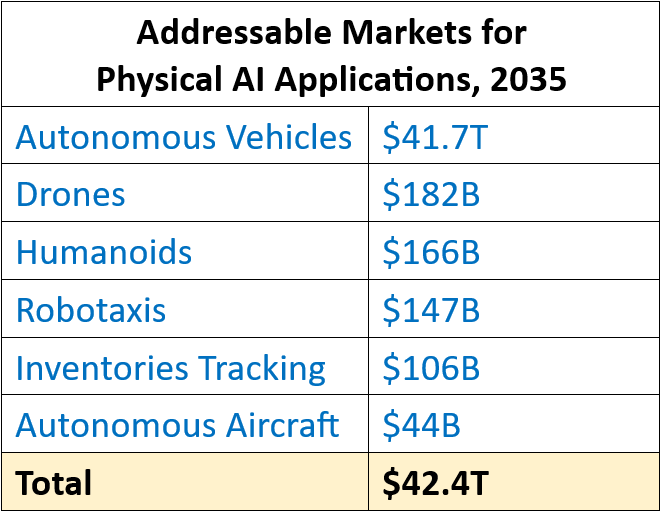
Mr. Huang’s comments (shaded areas above) excited analysts and investors. He alluded that NVIDIA was the leader for AI’s aggregate addressable market, which had grown by almost $44 trillion since NVIDI(A had led the innovation to Generative. However, any hardware including Nvidiea’s is incapable to support Huang’s “billions of autonomous and robotic systems operating” statement. The utilization of hardware, including cameras, to operate the physical AI applications, in the table below, is SIMPLY not scalable. Billions of objects operating together, and simultaneously, via cameras is also not logical.
The 8 minute video below provides details for why Nvidia and other hardware such as cameras, etc., are not a viable solution for Physical AI. Yet trillions have been, and are being, invested into systems that utilize hardware to power physical AI.
RYPPLZZ, on Leading Edge of Tech’s New Frontier – Sept 19 2026

The addressable markets for the Physical AI applications can-not reach 2035 projections via the existing AI hardware solution. Even worse, the trillions that have already been, and are projected to be, spent on hardware, including chips, cameras and data centers, will be for naught. The applications for Physical AI’s addressable market projections of $42.4 trillion are attainable, however only via SI and software. Details about why SI is the only solution are included in video above.
Due to AMD’s acquisition, analysts and investors will soon begin to learn that the existing hardware solution for physical AI is not scalable. Spatial Intelligence and SI will enter into their vocabularies and research reports. Physical’s projections, which include timetables, that are based on hardware, will have to be revised downward. The producers and manufacturers of Physical AI objects will have to redesign to integrate to SI.
Analysts will also come to the obvious conclusion that most of the money spent on the hardware needed to power physical AI will have to be written off. Upon this happening, it’s inconceivable for the US and world stock markets to continue to make new highs. Instead, the probability for significant and steady declines to begin will increase considerably.
The awareness or risk period for stocks, the coming out party for SI, will begin on or before Tuesday November 3, 2026. The date is AMD’s next scheduled earning announcement and analysts call.
AMD’s November call, and each of its quarterly calls thereafter, will enable analysts and investors to begin to get a grasp on the magnitude of the software versus hardware problem. AMD’s acquisition of World Labs, in effect, has put SPATIAL INTELLIGENCE (SI) on center stage.
There is no doubt that analysts will have to get up to speed about SI very soon because of the information and hype that AMD will be delivering via its quarterly calls. AMD, with a valuation in excess of $1.0 trillion, is one of the most visible publicly traded companies in the world. Its covered very closely because many consider AMD to be a pure AI play. Below are some of the articles which were published after AMD announced their acquisition of World Labs.
- An $8.2 Billion Reason to Buy AMD Stock, 10/02/26
- The ‘Godmother of AI’ Helped Spark Nvidia’s AI Boom. Now She’s Joining AMD., 09/30/26
- AMD takes on Nvidia with aggressive $8.2 billion bet on AI’s next era, 09/29/26
- Advanced Micro Devices (AMD) Could Be 33% Undervalued Following Its World Labs Deal”, October 1, 2026.
My prediction is for Nvidia to go from the world’s most valuable to most hated. Also predict that AMD will have a higher valuation than Nvidia by 2030 or sooner. My recommended hedge is to short NVIDA and go long AMD.
My core SI expertise evolved from my discovery of RYPPLZZ, a SI startup in 2021. Have been assisting and advising company since then. RYPPLZZ has patented IP, which is superior to its competitors, including World Labs. RYPPLZZ has backlogs for multiple verticals that will grow exponentially for the foreseeable future. Per annum revenue will easily be above $1.0 billion by 2030. Click button below for access to AlphaTack’s reports covering RYPPLZZ and 09/19/26 interview of CEO.
The disruption that SI, and SI armed AMD, will cause for chip maker Nvidia, its customers, and those who have or are integrating Nvidia chips into their models has not been discounted by the global stock markets. My projection is that the Dow Jones and S&P 500 will have declined by significant double digit percentages by end of 2027 when compared to their all-time highs.
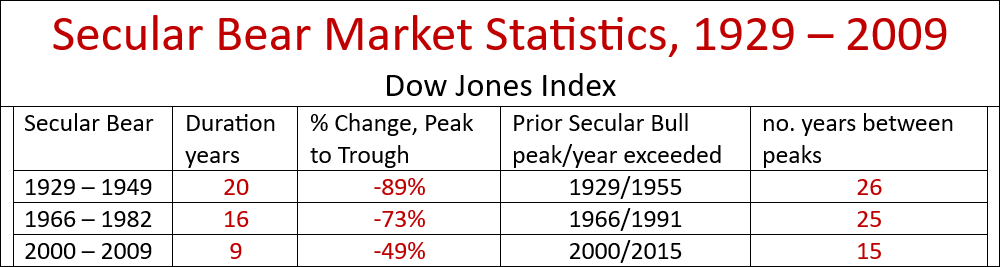
Significant downturns for stocks would increase the probability for the secular bull market, which began in 2009 to end. With the secular bull ending a new secular bear would begin in earnest. The table below depicts the performance of all secular bear markets since 1929. For more on secular markets read “2026 HIGHs for STOCKS, not Exceeded until 2051?”.
Every investor should consider to liquidate their blue chips and to utilize the proceeds to deploy a defensive growth strategy. The strategy includes allocations to asset classes that are not correlated with the S&P 500.
Under my prescribed defensive growth strategy $1.0 million in 2026, is projected to increase to $7.1 million by 2035. The appreciation projected is equivalent to a 21.5% per annum gain. For the record, the S&P 500, for the 10 years ended 2025, produced an annualized gain of 14.8%. Video below covers the defensive growth strategy and also secular markets dating back to 1810. Video also contains a summary of my track records.
AlphaTack DGIC Overview


Michael Markowski, Director of Research for DynastyWealth.com and SaveChangeWorld.com. Developer of “Defensive Growth Strategy”. Entered markets with Merrill Lynch in 1977. Named “Top 50 Investor” by Fortune Magazine. Formerly, underwriter of venture stage IPOs, including one acquired by United Health Care for 1700% gain. Since 2002 has conducted empirical research to develop algorithms which predict the negative and positive extremes for the market and stocks. Has verifiable track records for predicting (1) bankruptcies of blue chips, (2) market crashes and (3) stocks multiplying by 10X. In a 2007 Equities Magazine article predicted the epic collapses for Lehman, Bear Stearns and Merrill Lynch. Most recent algorithm developed from research of UBER and AirBnB has enabled identification of startups having 100X upside potential within 7 to 10 years. Video (3 minutes, 53 seconds) covers Mr. Markowski’s research to develop predictive algorithm methodology.