
Following our post on racial and ethnic wealth gaps, here we turn to the distribution of wealth across age groups, focusing on how the picture has changed since the beginning of the pandemic. As of 2019, individuals under 40 years old held just 4.9 percent of total U.S. wealth despite comprising 37 percent of the adult population. Conversely, individuals over age 54 made up a similar share of the population and held 71.6 percent of total wealth. Since 2019, we find a slight narrowing of these wealth disparities across age groups, likely driven by expanded ownership of financial assets among younger Americans.
Data
We use the quarterly Distributional Financial Accounts published by the Board of Governors of the Federal Reserve System. These data combine sectoral balance sheets from the Fed’s Financial Accounts and individual-level data from the Survey of Consumer Finances to estimate wealth holdings by wealth component and demographic group. We examine wealth dynamics from 2019:Q1 through 2023:Q3 for three age groups: 18-39, 40-54, and 55 and over. To calculate real wealth growth, we deflate age group wealth levels in each quarter by the age group-specific price indices developed in the Equitable Growth Indicators series.
Real wealth has increased for all three age groups since 2019, but the change has been most dramatic for younger adults (see chart below). For individuals 39 and younger, wealth increased by 80 percent. In contrast, it grew by only 10 percent for those aged 40-54 and by 30 percent for those 55 and over.
Younger Adults Far Outpace Other Groups in Wealth Growth since the Pandemic
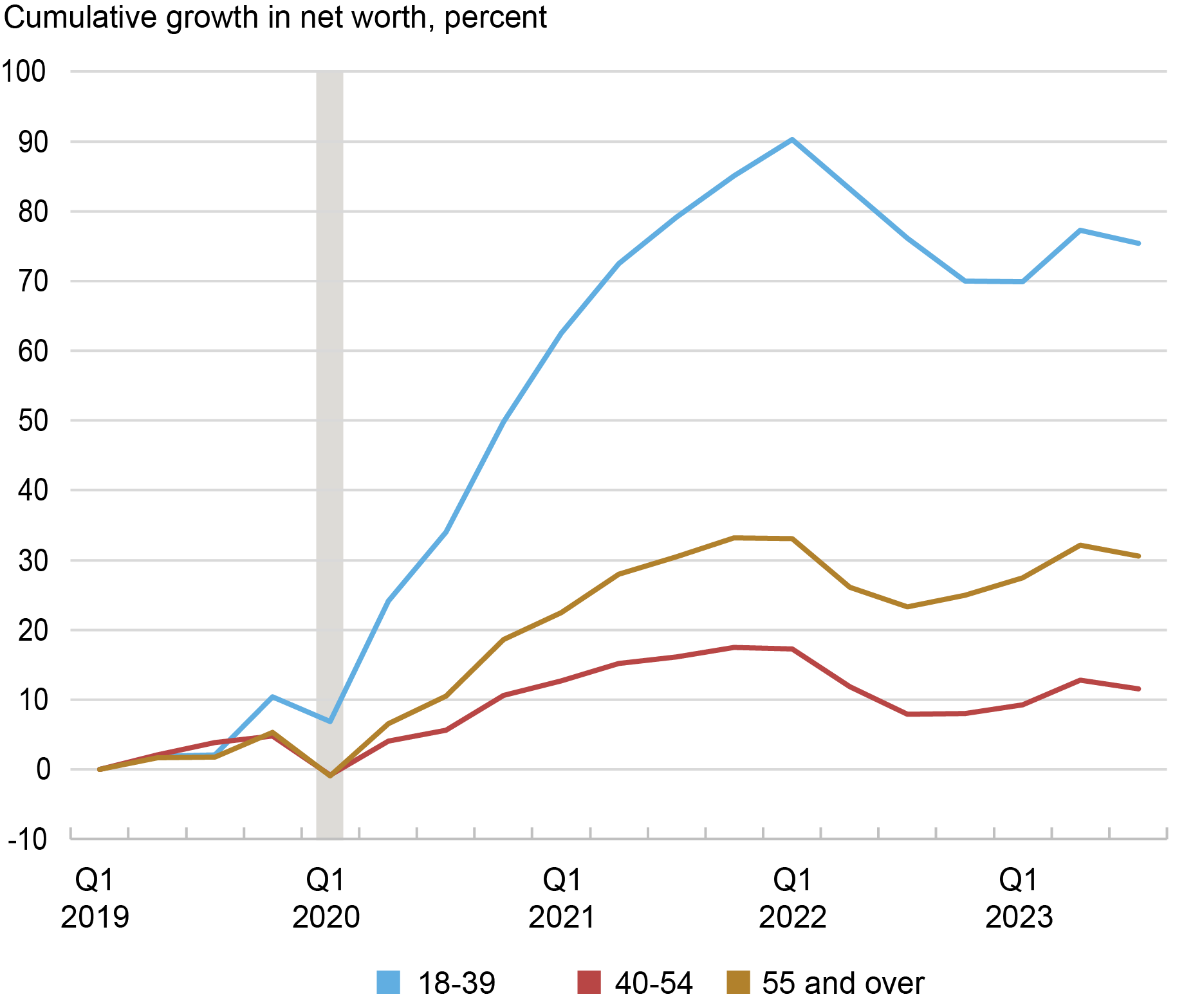
Note: Calculations are based on real (inflation-adjusted) prices.