
Customers desperate for oil are draining so much of it from giant storage tanks in Oklahoma that producers are having trouble keeping up.
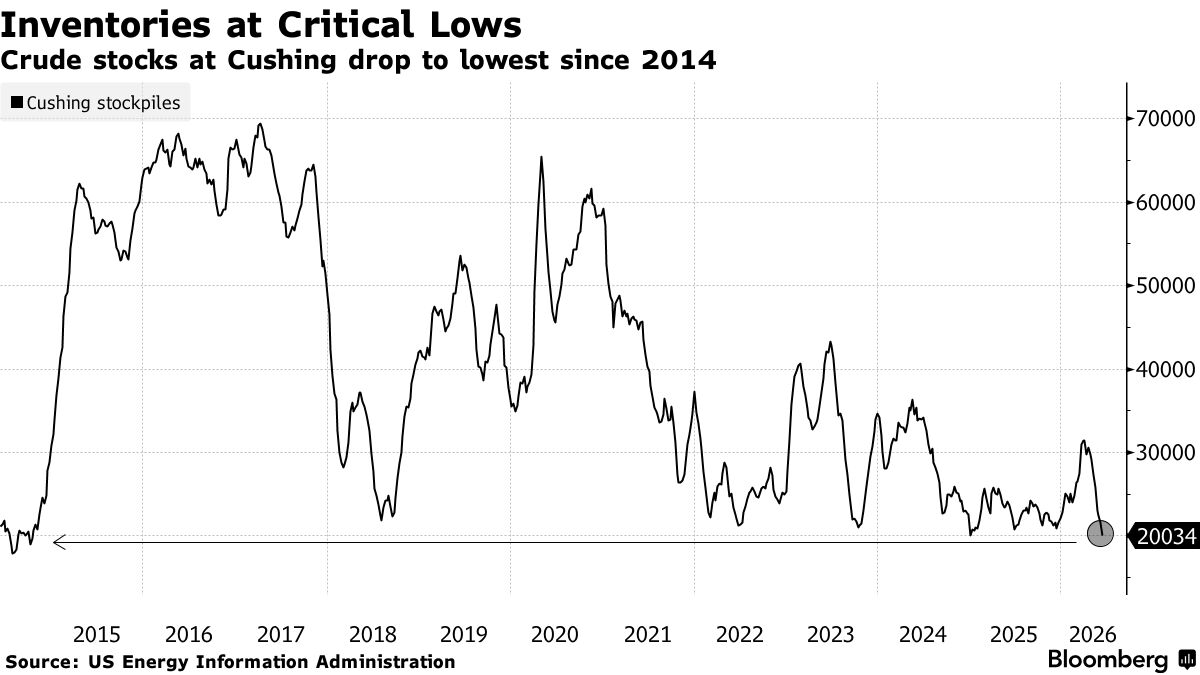
Inventories at Cushing, the largest commercial crude oil storage hub in the US, have fallen for eight weeks in a row and now stand at about 20 million barrels, according to government data published Wednesday. That’s the equivalent of less than two days of American crude production, and a level that most traders consider an operational minimum.
Even though Washington and Tehran are on the cusp of a peace accord that could fully reopen the Strait of Hormuz, the loss of so much Persian Gulf crude supply during the Iran conflict — equal to about 20% of global shipments — has left global supply chains extremely stretched.
The US has stepped in as the seller of last resort to the global oil market during the past three months and has seen its exports surge to a record. But that’s come at the cost of severely depleted domestic buffer against future supply shocks. The broadest measure of inventories in the US – a total that includes not just barrels stored in Cushing but the nation’s strategic stockpiles, plus oil that’s been refined into fuel – is now the lowest according to data going back to 1985.
Earlier this week, data showed the US Strategic Petroleum Reserve, created after the 1970s Arab oil embargo, dropped to roughly 340 million barrels, the lowest since 1983. The Trump administration is releasing 172 million barrels from the reserve to help ease fuel prices driven up by the war.
Cushing is a massive complex of oil tanks west of Tulsa that’s the most important physical storage hub in the US crude market. It sits at the confluence of dozens of inbound and outbound pipelines that fan out across North America, connecting oilfields in Canada, Texas, North Dakota and elsewhere to Gulf Coast and in Midwest refineries. Its nickname is the “Pipeline Crossroads of the World.”
Storage levels at Cushing play a crucial role for traders to determine the value of benchmark US oil futures. West Texas Intermediate futures, in turn, help underpin pricing for millions of barrels of crude traded around the Americas.
The slump in inventories at Cushing is set to take a toll on the storage facility. Pulling oil out of tanks when levels fall below the so-called “suction line” of around 20 million barrels is difficult and expensive, and the quality of crude can be compromised by water and sediment.
Cushing’s role in global oil markets has diminished since the US lifted its export ban in 2015. Barrels now flow straight from oilfields in Texas and elsewhere to the coast, where they’re shipped to overseas buyers.
Still, the drawdown in Cushing crude stockpiles helped support the spread between the nearest two US crude futures contracts. The so-called backwardation in the spread indicates near term supplies in the region remain tight.
Refineries in the Midwest, which rely on crude supplies from Cushing, processed a record volume of oil last week, according to the EIA, highlighting that demand is high domestically even if exports wane following a peace deal.
Oil futures edged higher Wednesday, after two days of stark declines, although prices are still under pressure from the pending US-Iran interim peace deal.
Written by: Devika Krishna Kumar — With assistance from Ari Natter @Bloomberg
The post “War Drains Oil Inventories to Critically Low Level at US Hub” first appeared on Bloomberg