
SpaceX (SPCX) may be one of the biggest and most important IPOs in Wall Street history. It still has to clear one of the oldest IPO problems: turning a decades-long growth story into a price investors can buy today.
That problem is as old as the stock market itself.
When the Dutch East India Company — abbreviated VOC from its Dutch name — first traded in 1602, it helped create what became the Amsterdam Stock Exchange and gave investors exposure to global trade. But the stock took roughly three decades to double, a slow grind by modern market standards.
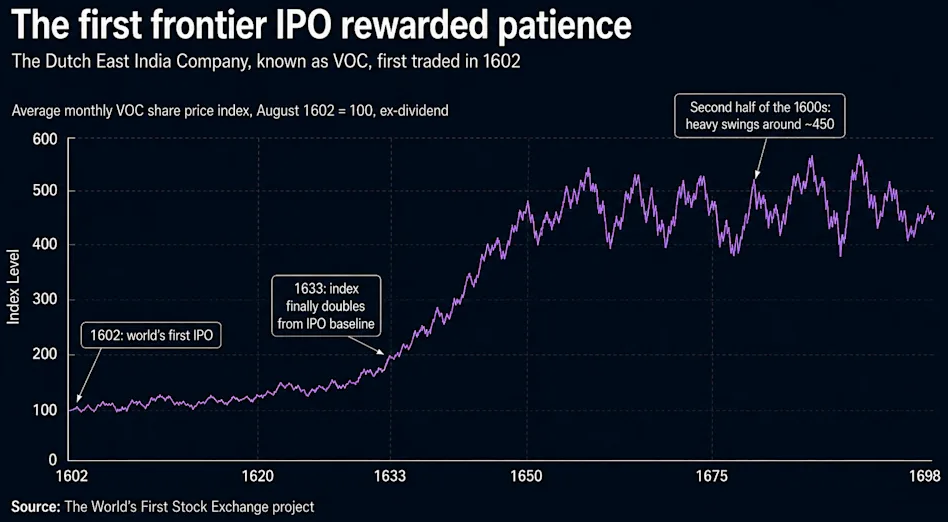
The Dutch East India Company was not just a paper promise. It was a real business tied to ships, trade routes, military power, government backing, and the opening of a massive commercial frontier.
That is why JC Parets, chartered market technician and founder of TrendLabs, recently argued that the better historical analog for SpaceX is not simply another hot tech IPO — it is VOC.
VOC sent spice fleets to Asia — a far cry from building data centers in space — but the market logic rhymes. VOC gave investors a way to buy into global trade without getting on a ship. SpaceX gives investors a way to buy into rockets, satellites, defense demand, Starlink, space infrastructure, and whatever the orbital economy becomes next.
New IPO research points to the same patience problem.
Across more than 9,000 operating-company IPOs from 1975 to 2021, 60% finished flat or lower three years after their first close, while only 16% more than doubled, according to Yahoo Finance analysis of IPO data from Jay Ritter at the University of Florida.
Kathy Donnelly, co-author of “The Lifecycle Trade: How to Win at Trading IPOs and Super Growth Stocks,” makes the tactical version of that point. Few IPOs make quick gains of 100% or more, most undercut their first-day low within three weeks, and most will trade down 10% or more within 10 weeks.
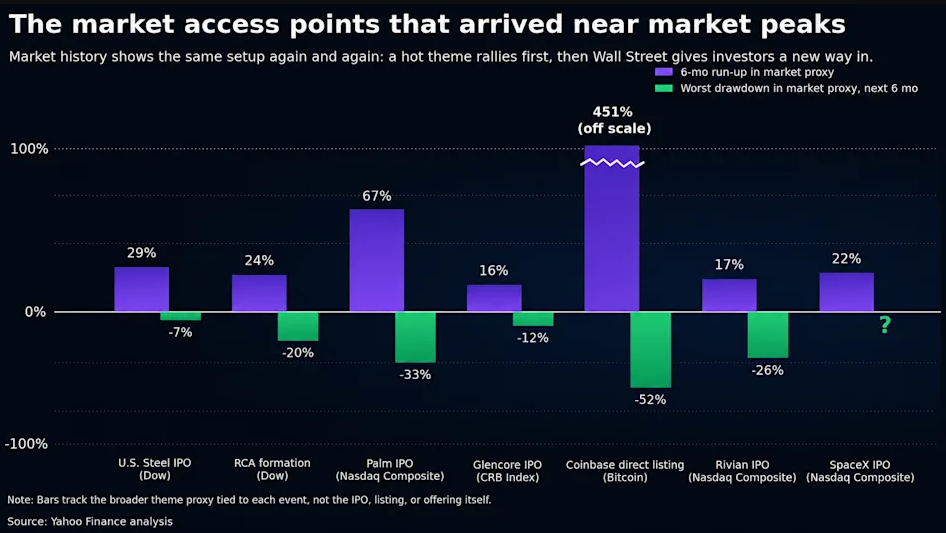
In other words, investors usually get another shot, and there’s no reason to rush in on day one. In fact, history shows that big IPOs can arrive late in a hot trade, raising the risk that new market debuts lose steam in the subsequent six months.
Parets pointed to US Steel in 1901, RCA in 1919, Ford (F) in 1956, Blackstone (BX) in 2007, Coinbase (COIN) in 2021, and Rivian (RIVN) in 2021 as giant offerings that arrived near important market turns.
US Steel and RCA arrived after Dow rallies in the early 1900s. After each, the Dow would eventually get cut in half, noted Parets.
Palm’s 2000 IPO landed just as the Nasdaq Composite (^IXIC) was topping. Coinbase (COIN) went public near a bitcoin (BTC-USD) peak, Rivian (RIVN) arrived within days of the late-2021 Nasdaq high, and Glencore’s 2011 IPO came after a commodity surge, as measured by the CRB Index.
None of this suggests SpaceX is merely hype. Its $19 billion in revenue is as real as the ships, spices, and trade routes that made the Dutch East India Company more than a story stock.
The lesson for investors is narrower. Real frontiers can still punish impatient entry points.
Written by: Jared Blikre @Yahoo Finance
The post “The 400-year-old lesson for SpaceX investors: Chart of the Day” first appeared on Yahoo Finance