
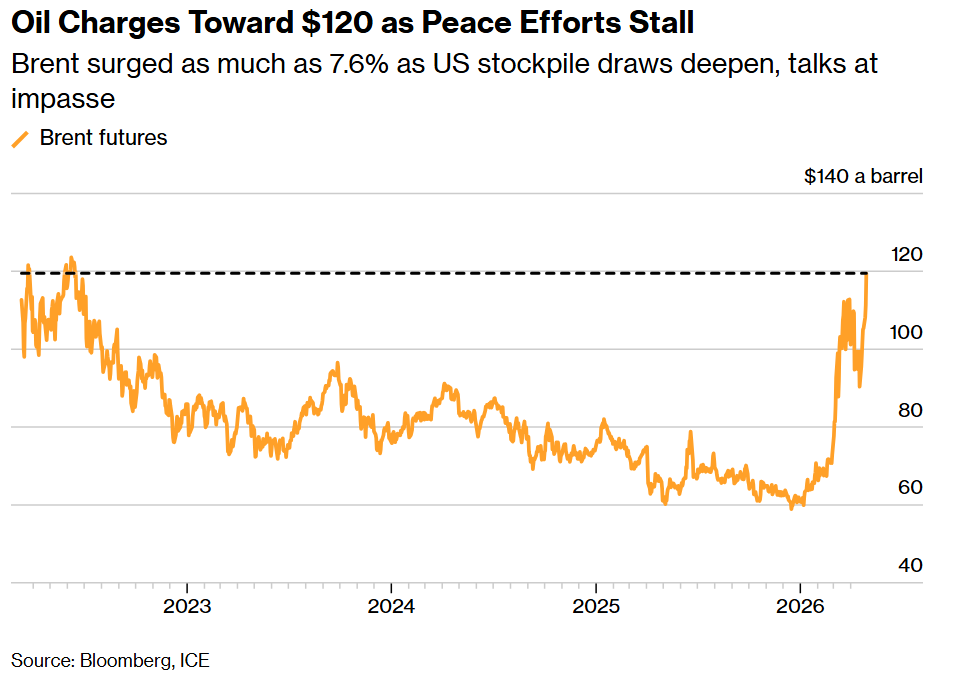
Oil surged to the highest since June 2022, with no end in sight to the US-Iran conflict or choked-off energy flows through the Strait of Hormuz, heightening concerns over a rapidly shrinking global supply cushion.
Brent, the global benchmark, rose more than 7% to trade above $119.50 a barrel before paring some gains to settle around $118 a barrel, a fresh high since the Iran war began two months ago. Traders rolled over positions ahead of the June contract’s expiry on Thursday, adding to choppy trading. West Texas Intermediate ended the day just below $107 a barrel.
Brent has now erased all losses since the US and Iran agreed to a temporary ceasefire earlier this month, with investors bracing for a protracted war and more fallout from a record supply shock and global energy crisis.
There were multiple signs that peace negotiations had fallen flat, including on Tuesday, when President Donald Trump discussed steps the US could take to prolong its naval blockade of Iran during a meeting with oil and trading industry executives. Axios reported Trump had rejected a recent proposal from Iran to reopen the Strait of Hormuz, where vital flows have come to a standstill.
“As long as there is no game plan to end this mess or at least open the Strait of Hormuz, the market will continue to tick higher,” said Robert Yawger, director of the energy futures division at Mizuho Securities USA.
A market-wide shift toward expecting a longer conflict has sharpened focus on US supplies, now all-the-more critical to offset disruptions to Middle Eastern flows. Government data published Wednesday show that domestic oil stockpiles are declining as American exports surge to record highs.
The US naval blockade is a key sticking point between Washington and Tehran, with the Islamic Republic insisting it won’t restart negotiations or reopen the Strait of Hormuz as long as the restrictions stay in place. Flows of crude, natural gas and oil products from the Persian Gulf remain effectively cut off since the conflict began in late February. The crisis has sent prices of gasoline, diesel and jet fuel surging, raising inflation fears around the world.
“The stalemate could last for weeks,” Michelle Brouhard, the head of policy and geopolitical risk at Kpler Ltd., told Bloomberg Television. “It’s either gonna be the global market tells Trump that we can’t take this shortage of oil any longer, or it’s gonna be Iran who says we want to be able to get our oil out.”
Tehran is rapidly running out of crude storage space, which is threatening to accelerate production cuts, according to Kpler.
Meanwhile, traders continued to digest the news that the United Arab Emirates will leave OPEC in a decision announced on Tuesday.
“I think it’s great,” Trump told a reporter on Tuesday, referring to UAE’s break from the alliance.“I think ultimately it’s a good thing for getting the price of gas down,” Trump added.
OPEC dynamics are likely to remain peripheral to oil prices for now, however, with Hormuz blocked and a fifth of the world’s oil and liquefied natural gas supplies unable to reach global markets.
UAE officials said the shortage caused by the war will require agility to respond to market demands without being constrained by the collective decision-making process by the wider group.
The physical market tightens by the day, said Scott Shelton, an energy specialist at TP ICAP Group Plc. “It’s not surprising to see futures rally to cash prices as the odds of a prolonged conflict becomes the reality driving forward markets.”
| Prices: |
|---|
|
Written by: Mia Gindis — With assistance from Will Kubzansky @Bloomberg
The post “Oil Charges Toward $120 With No End in Sight to US-Iran War” first appeared on Bloomberg