
An ongoing grand jury investigation of iconic multi-billionaire, Mark Walters has doomed stocks. The odds for an extremely violent 1929 or 2008 style crash by end of 2026 is at a heightened state.
The growing negative publicity surrounding the scandal have increased the probability for instant write downs of private credit assets that are held by banks and insurance companies. A video below explains why crashes that are caused by financial asset write downs and write offs are the most violent.
The Financial Statement write downs and write offs could begin to occur in reporting quarter ending on September 30. Therefore, investors should be hyper aware that October 2026, could rank as one of the most volatile months ever for the major indices, including the S&P 500.
The scandal has put a microscope on:
- Guggenheim Partners, one of the world’s largest financial services firms with $246 billion of assets under management. Walters is the CEO and founder of the firm. He was the owner of the LA Lakers and is the owner of the LA Dodgers. Read “Mark Walter’s sports empire offers a glimpse of the money machine behind private credit—and the plumbing keeping it together”, Fortune 8/23/26.
- Private credit, a relatively new credit vehicle, that has become the most controversial since subprime, which was the cause of the 2008 GREAT RECESSION.
The probability is high for financial companies, and namely bank and insurance stocks, to trigger a major correction or crash for the stock market. It’s especially because earlier this year:
- My research had uncovered that private credit was having a significant negative impact on the cash flow from operations for five of the US’ six largest banks. My research in 2007 uncovered the negative impact that subprime was having on the cash flow from operations for the five largest brokers including Lehman Brothers.
- Bloomberg reported that Lee Robinson, a professional investor, who had produced a 900% gain by shorting financials in 2008, had discovered that insurance companies had a private credit problem. Robinson was or is in the process of short selling their shares. See Bloomberg, “Investor Who Scored 900% Win in 2008 Crisis Has New Big Short Bet”, 06/24/26.
The negative publicity increases the probability that the regulators of banks and insurance companies and their auditors will take a much more conservative stance pertaining to private credit assets. How banks and insurance companies value the private credit assets on their Balance Sheets has been very controversial. Therefore, the risk for the write downs of financial or paper assets has increased significantly.
It is the high level of negative publicity directly related to “private credit” and not Walters’ predicament that has put the stock market at extreme risk. The extreme negative publicity has no doubt resulted in auditors, regulators and investors to become more scrutinizing of private credit. Whether or not Walters is criminally charged is no longer relevant. The damage has been done.
Private Credit in 2026 is on par with Subprime in 2008
Subprime and Private Credit include Payment in Kind (PIK) accounting entries. Under PIK a financial institution adds a borrower’s missed cash payment back to the principal of the outstanding note. This enables the financial institution to not have to write off the note. It also enables the lender to book the non-cash payment as income or earnings. The PIK enables a lender to produce cashless earnings. The PIKs utilized by borrowers and lenders in 2007 and 2008 ultimately led to the collapses of the five largest brokers including Lehman in September 2008. My 2007 prediction for the collapses of the brokers including Lehman in September 2007 was based on my analyses of their cashless earnings. See “Have Wall Street’s Brokers been Pigging Out?” article that contains my prediction for the brokers.
The 10 minute video below is a clip from the weekly “Markowski on the Markets” 07/11/26 Zoom session. The video which is entitled “Anatomy of a Violent Crash” provides the rationale for why 1987’s “Black Monday” was a garden variety and was not a violent crash. It also explains the extreme difference between 1987 to the violent crashes of 1929 and 2008. The video also explains PIK and its utilization for both subprime mortgages and private credit.
Anatomy of a Violent Crash – MOTM July 11 2026

The video points out that violent crashes are caused by a Sudden and Unexpected write down, or write off, of a financial or paper asset. The entire value of bond, stock or an accounts receivable can be instantly written off or discounted by an auditor or a regulator. Conversely, the value of a building or a tractor can-not be instantly written off.
The simultaneous collapses of four largest brokers on September 15, 2008 was caused by a write down of paper assets. The cause of their collapses and need for bailouts were not the mortgages that they held being in default. Chart below depicts that first time foreclosure starts began to decline steadily prior to the Summer of 2008.
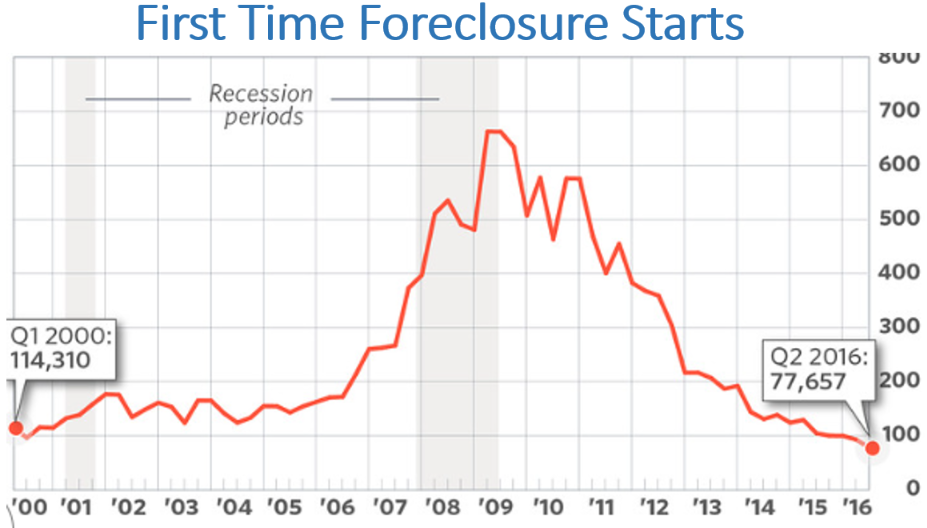
The 2008 crash was caused by a lack of confidence in those financial institutions including the banks and brokers which held subprime paper. A write down of a financial asset results in decline for the amount of assets on a Balance Sheet. It also creates a loss for the Income Statement. Therefore, the write downs significantly decreased the earnings and share prices for the brokers. The substantial share price declines deepened and lengthened the recession. The first time foreclosures accelerated after the 2008 crash and spiked in 2009.
Write downs were required for all of the subprime mortgages held by Lehman and the other brokers. Its because the junk bond ETF (JNK) reached a new 2008 low on Friday September 12, 2008. The price reduced Lehman’s available capital on its Balance Sheet to below the minimum amount that the firm needed to remain in business. The JNK price was utilized because it was the best and only instrument that could be compared to a subprime mortgage.
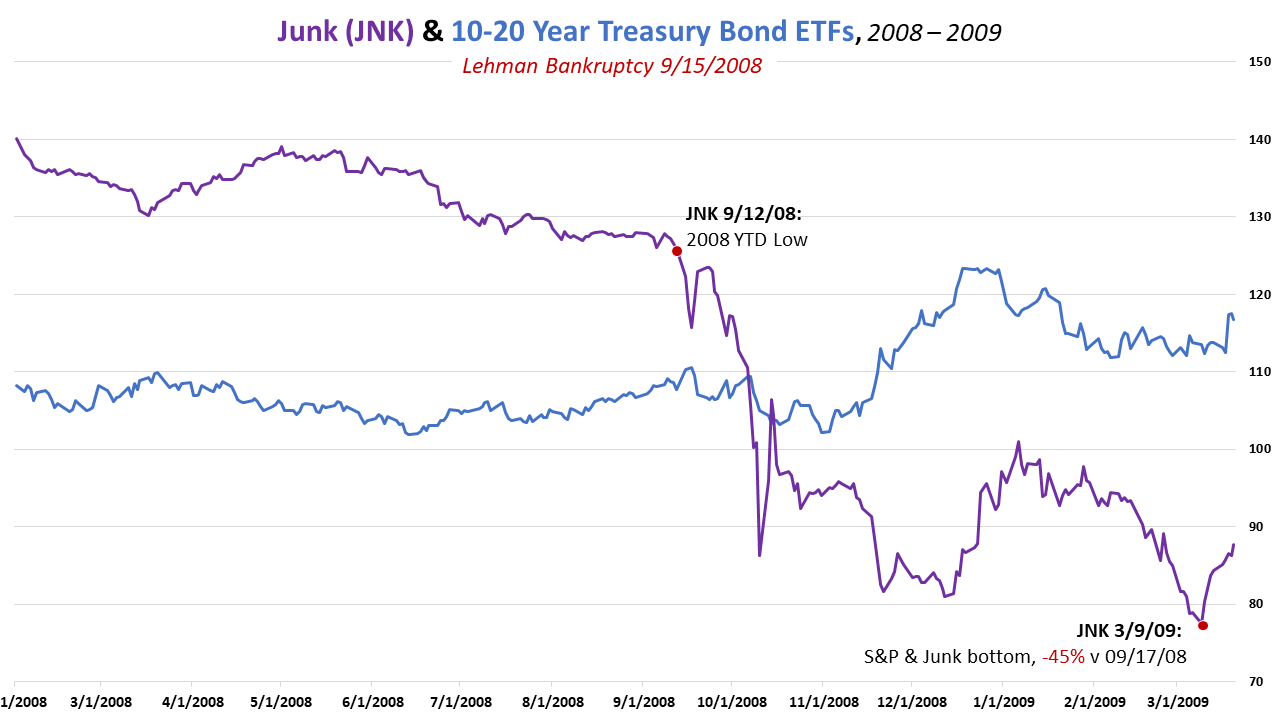
A bank or broker dealer that falls below its net capital requirements is obligated to discontinue operations. If a violation occurs and the CEO of the financial institution does not close for business and notify their regulator they have criminal liability. For two reasons all of the brokers had to be rescued along with every bank which held subprime mortgages:
1. The publication of Lehman’s 09/15/2008 notification that it had ceased operations and had filed for bankruptcy would result in a 99% probability for the price of JNK to decline substantially. The decline of the JNK price would have likely resulted in the remaining three brokers assets falling below their net capital requirements. The crass for the price of JNK is exactly what happened. From 09/17/2008 to the 03/09/2009 bottom, that coincided with the S&P 500’s low, the JNK had declined by 45%.
2. Financial institutions are required to fully disclose their financial statements quarterly. The September 30 end of quarter reports were looming and without the rescue by the US Treasury with the TARP, the entire US banking system and financial market would have likely collapsed.
The July 2026 video above explains the role the auditor plays, which provides the foundation for a violent crash. The video below, which was produced on 08/26/26 and is entitled “The Mark Walter Scandal Could Expose Billions in Private Credit Losses”, is an example of the negative publicity which is spreading fast. The negative publicity is the spark which lights the auditor’s fuse, with the result being a violent market crash.
The Mark Walter Scandal Could Expose Billions in Private Credit Losses
The above video is extremely pertinent for three reasons:
- Published on August 26, 2026
- The publisher has 225,000 YouTube subscribers
- Based on the quality of the video’s content my hunch is that most, if not all of the subscribers are discerning, and are most likely professional investors
- The video below is an August interview of Lee Robinson. He is the hedge fund manager mentioned above who produced a gain of 900% from shorting the stock market during 2008. See Bloomberg, “Investor Who Scored 900% Win in 2008 Crisis Has New Big Short Bet”, 06/24/26. Robinson’s interview is about why private credit will face heightened scrutiny that is totally unrelated to the Walter’s scandal.
Lee Robinson on Private Credit – MOTM Aug 22 2026

The video below is a 08/27/26 interview of Tom Gober. He is the professional insurance fraud investigator who blew the whistle on Walters. From my viewing the interview the probability is very high that the insurance industry is a high risk of experiencing a collapse that is on the magnitude of the collapse for the banks which caused the 2008 Great Recession.
Inside Mark Walter’s $17 Billion Insurance Scandal | With Fraud Investigator Tom Gober

To summarize. Anyone and everyone who reads the report and views the videos contained herein should conclude that the risk for a violent crash for stocks is high. The PIK for the largest US banks has weakened their cash flows. Mr. Simmons sees major problems for the US insurance companies including Berkshire Hathaway. Meanwhile, the bubble for the stock market ranks among the biggest throughout history. Additionally, a severe correction in September or October would be a confirmation that a secular bear market is underway, the ninth since 1802. My recent “2026 HIGHs for STOCKS, not Exceeded until 2051?” article provided the rationale for timing of the secular bear to replace the 2009 to 2026 secular bull. The report also explained the difference between secular and cyclical bull and bear markets.
My recommendation is for AlphaTack’s defensive growth strategy to be deployed. Under strategy, monies are invested into assets that are un correlated with S&P 500. This includes bonds (40%), hedge funds (15%), precious metals (15%), venture capital (20%) and real estate (10%). Table below contains projected nominal values at 2035 per each $1.00 invested in 2026. Table also includes nominal value of 10 year investment in S&P 500 at end of 2025.
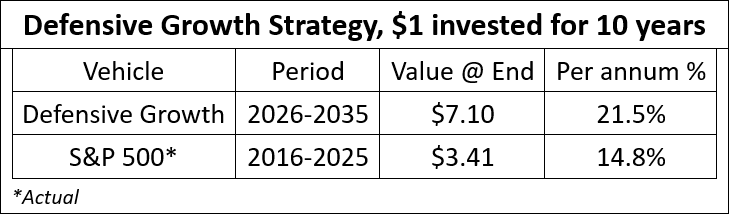
A fund is currently under construction to deploy AlphaTack’s Defensive Growth strategy. It is projected to be available by October 1, 2026. To be alerted when fund is available click here to register. Video below covers AlphaTack’s defensive growth strategy.
AlphaTack DGIC Overview


Michael Markowski, Director of Research for AlphaTack.com. Developer of “Defensive Growth Strategy”. Entered markets with Merrill Lynch in 1977. Named “Top 50 Investor” by Fortune Magazine. Formerly, underwriter of venture stage IPOs, including one acquired by United Health Care for 1700% gain. Since 2002 has conducted empirical research to develop algorithms which predict the negative and positive extremes for the market and stocks. Has verifiable track records for predicting (1) bankruptcies of blue chips, (2) market crashes and (3) stocks multiplying by 10X. In a 2007 Equities Magazine article predicted the epic collapses for Lehman, Bear Stearns and Merrill Lynch. Most recent algorithm developed from research of UBER and AirBnB has enabled identification of startups having 100X upside potential within 7 to 10 years.