
The supply buffer is becoming uncomfortably thin as summer driving season begins.
Welcome to our guide to the commodities driving the global economy. Today, Oil Trading Americas Team Leader Devika Krishna Kumar looks at the implications of declining US inventories.
If crude oil futures are your only gauge, the war between Iran and the US remains a manageable supply risk.
Prices have stayed just below $100 for almost two weeks and the extreme volatility that characterized the early weeks of the conflict has largely dissipated.
Anyone paying close attention to the picture on the ground in the world’s largest oil market has fewer reasons to be sanguine.
As the near closure of the Strait of Hormuz enters its fourth month, the war’s dire physical supply impact is increasingly evident in the US.
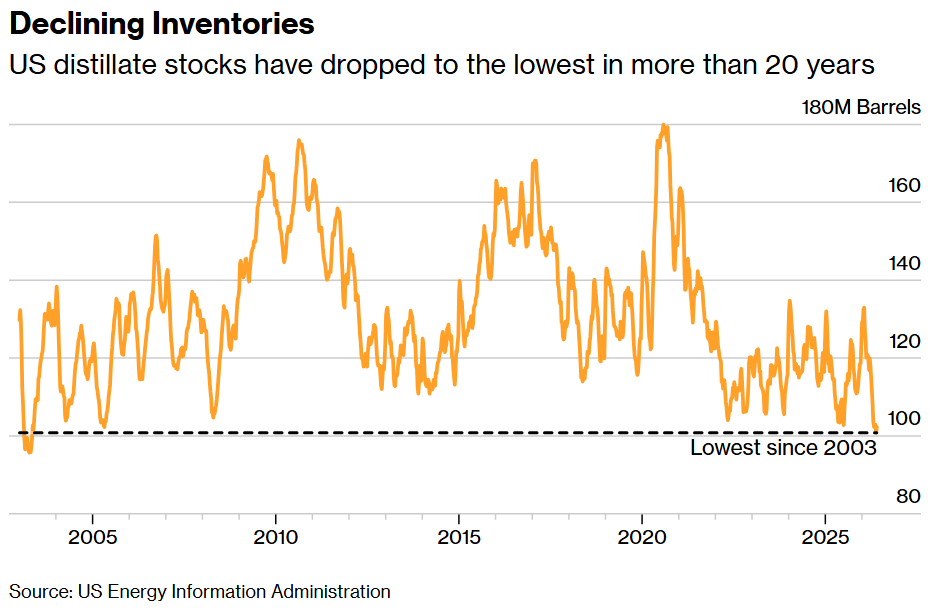
Petroleum inventories including strategic reserves have plunged for 10 straight weeks to the lowest since 2004, the latest government report showed on Wednesday. That’s the longest streak of declines since 2022, during the immediate aftermath of Russia’s full-scale invasion of Ukraine.
Oil inventories are the market’s insurance policy. When stocks are high, the system can absorb disruptions with limited impact on prices. When they’re low, there is less margin for error.
The global oil market was in a glut when the strait was initially blocked, providing a buffer against the largest disruption in history. The US was quickly able to step in as the supplier of last resort to the rest of the world, exporting at record levels.
This kept a lid on prices, at the cost of rapidly emptying the nation’s storage tanks. The pace of the drawdown has become unsustainable as summer driving demand in the US kicks into high gear.
Gasoline stockpiles, both in the US and globally, are well below seasonal norms, Vitol Group, the world’s largest energy trader, said this week.
American inventories of diesel in the are sitting near their lowest levels since 2003, government data show. They risk falling to a critical threshold of just 20 days of supply by August, Goldman Sachs Group Inc. has warned.
Hurricane season is approaching, with the potential to damage oil infrastructure along the Gulf Coast. That can be seriously disruptive even in normal times. With the supply buffer so uncomfortably thin, a major storm could send shock waves rippling across global energy markets.
In such a scenario, sub-$100 oil might not last.
—Devika Krishna Kumar, Bloomberg News
Chart of the day
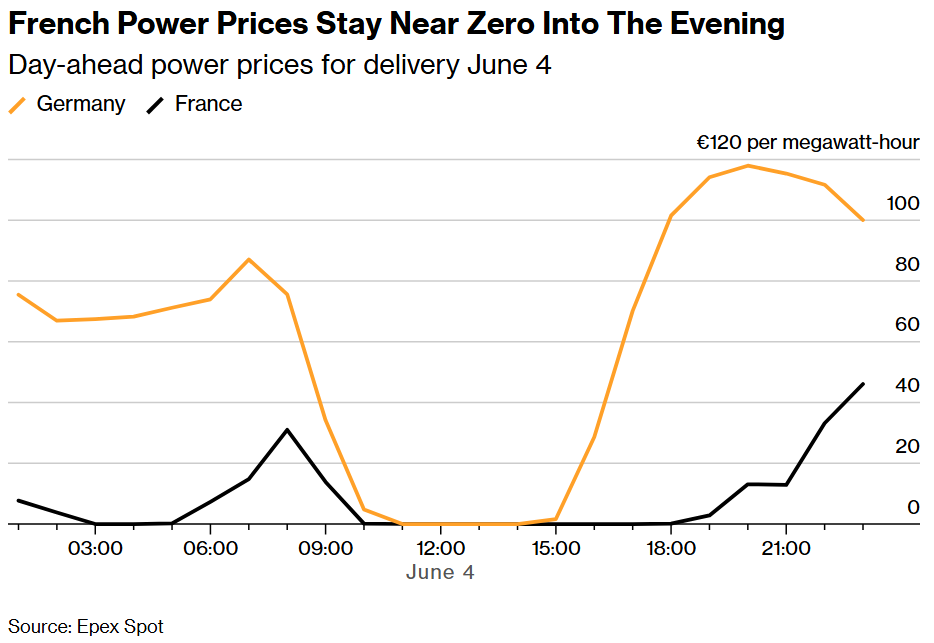
Power prices in Europe’s top two markets are diverging dramatically. German hourly costs for Thursday evening surged above €100 ($116) per megawatt-hour, while those in France will be a fraction of that. The big gap reflects the nations’ different approach to the energy transition. France has kept a large nuclear fleet, while Germany is more reliant on intermittent renewables backed by costly fossil-fuel-burning stations.
Top stories
Oil fell following three days of gains after Israel and Lebanon agreed to a ceasefire if Hezbollah also stops hostilities, which would remove a key sticking point in talks to end the Iran war.
Gold pushed higher after the possible step toward resolving the wider Middle East conflict eased inflation risks.
Severe oil shocks tend to drive profound changes to the global energy mix. This time the shift could be away from fossil fuels and internal combustion engines, and toward renewables and electric devices.
India will provide 100 billion rupees ($1 billion) to support oil retailers for capping jet fuel prices and shield local airlines from mounting cost pressures.
Trafigura Group made a record payout to its top traders and executives as the commodity trading giant reaped profits of over $4 billion in the first half of its financial year.
BNEF today
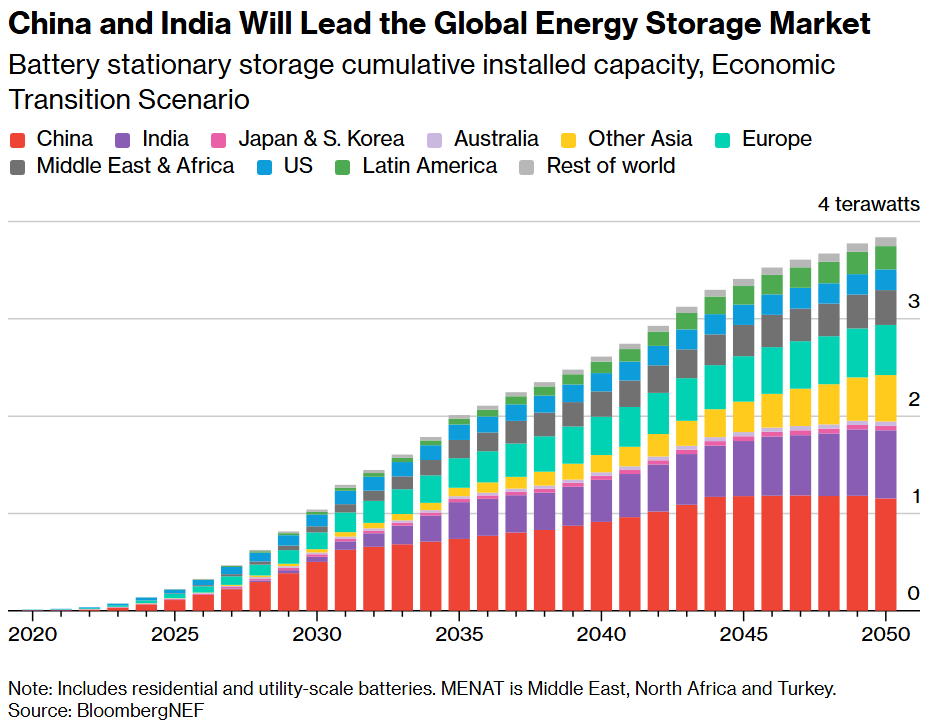
China and India will have the biggest energy storage markets in the world within the next two decades, surpassing the US and even Europe, according to BloombergNEF. Chinese companies like Contemporary Amperex Technology Co. Ltd. and BYD Co. Ltd. already have developed a lead in battery making that will be difficult for Western suppliers to match.
Coming up
Bloomberg Sustainable Business Summit: Global leaders and investors gather in Singapore on July 22 to discuss risk, energy strategy and competitive advantage in a shifting global landscape. Learn more here.
More from Bloomberg
- Economics Daily for what the changing landscape means for policymakers, investors and you
- Business of Food for a weekly look at how the world feeds itself in a changing economy and climate, from farming to supply chains to consumer trends
- Green Daily for the latest in climate news, zero-emission tech and green finance
- Supply Lines for daily insights into supply chains and global trade
Written by: Devika Krishna Kumar @Bloomberg
The post “Dwindling US Oil Inventories Are a Warning to Global Markets” first appeared on Bloomberg