
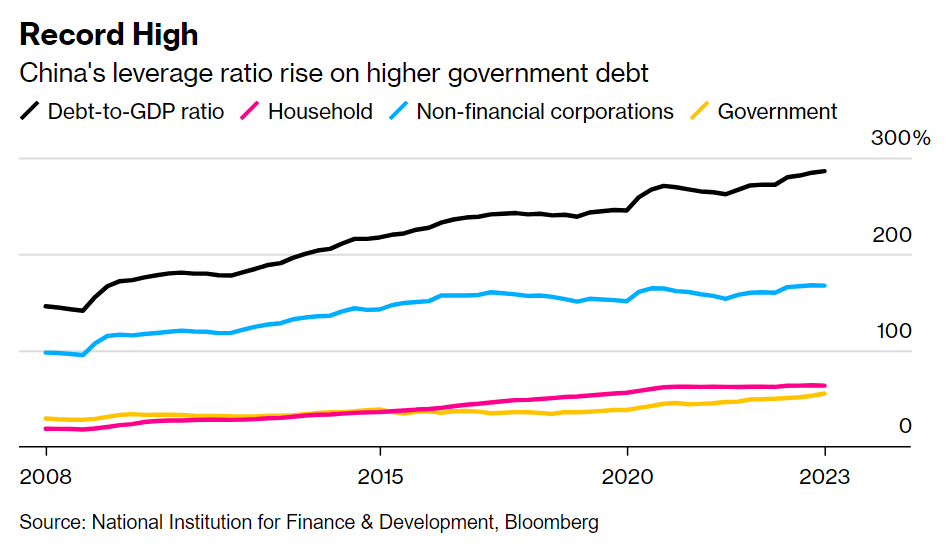
The Chinese economy’s debt ratio reached a new record high, according to central bank and statistics bureau data compiled by Bloomberg.
The macro leverage ratio — or total debt as a percentage of gross domestic product — inched up to 286.1% in the fourth quarter. The debt ratio held by household and non-financial corporates both declined, while government sector saw an increase of 2.3 percentage points.
- Leverage ratio for non-financial sectors declined to 167.3% vs 167.7% in the previous quarter
- Leverage ratio for household sector declined to 63.5% vs 63.8% in the previous quarter
- Leverage ratio for government sector rose to 55.3% vs 53.0% in the previous quarter
| Q4 | Q3 | Q2 | Q1 | Q4 | Q3 | Q2 | Q1 | 4Q | |
|---|---|---|---|---|---|---|---|---|---|
| 2023 | 2023 | 2023 | 2023 | 2022 | 2022 | 2022 | 2022 | 2021 | |
| Real economy | 286.1% | 284.5% | 281.5% | 279.7% | 272.0% | 272.1% | 271.3% | 266.7% | 262.1% |
| Household | 63.5% | 63.8% | 63.5% | 63.3% | 62.2% | 62.4% | 62.3% | 62.1% | 62.2% |
| Non-financial corporations | 167.3% | 167.7% | 166.7% | 165.7% | 159.9% | 160.3% | 159.9% | 157.7% | 153.5% |
| Government | 55.3% | 53.0% | 51.4% | 50.7% | 49.9% | 49.4% | 49.0% | 46.9% | 46.4% |
| Financial sector | |||||||||
| Asset side | 52.5% | 52.0% | 53.7% | 52.7% | 50.2% | 49.5% | 50.2% | 49.4% | 48.9% |
| Liability side | 67.2% | 65.4% | 66.7% | 65.6% | 64.7% | 64.2% | 64.2% | 62.9% | 62.7% |
Note 1: Loans to households are consumer and operating loans.
Note 2: Loans to non-financial sector include corporate bonds, entrusted loans, trust loans, undiscounted bank acceptance bills and overseas loans, but excluding loans to local government financing vehicles.
Note 3: Data are subject to revisions.
Source: National Bureau of Statistics, People’s Bank of China, Bloomberg
Written by: Myungshin Cho @Bloomberg
The post “China’s Debt-to-GDP Ratio Rises to Fresh Record of 286.1%” first appeared on Bloomberg