
Billions are flowing from firms like Blue Owl and KKR into Buy Now, Pay Later companies. It’s an untested model and skeptics are worried about what happens in a downturn.
The private credit industry was dubbed “shadow banking” as it took business away from traditional lenders. Buy Now, Pay Later companies have been referred to as hawking “phantom debt” that falls outside Wall Street’s typical tracking methods.
Now, these two more opaque corners of finance are overlapping in a big way — and catching the attention of credit raters, former regulatory chiefs and others on guard for potential risks as US consumers show mounting signs of strain.
Officially known as “forward-flow agreements,” investing heavyweights like Blue Owl Capital Inc., KKR & Co. and Elliott Investment Management are increasingly agreeing to pre-purchase billions of dollars worth of loans before they’re made, in a bet that consumer assets will outpace returns elsewhere. That’s been a boon to the likes of Klarna Group Plc, Affirm Holdings Inc. and PayPal Holdings Inc., offering fuel for the origination machines at the heart of a business more Americans are embracing.
Skeptics are anxious the model incentivizes churning out more loans to consumers, with some drawing parallels to the lead up to the subprime mortgage crisis where originate-to-sell practices detached risk from reward. But participants counter that originators can retain chunks of the loans they sell — a structure that reassures private credit buyers who see these short-term consumer assets as a way to diversify their billions of dollars of longer-term financing agreements.
This much is clear: The strategy is at the intersection of two industries navigating their own challenges.
The $1.8 trillion private credit market is facing a surge in investor withdrawals amid concerns about rising defaults, opaque valuations and AI-driven disruption to software borrowers.
The BNPL industry has had its share of hurdles, too. Top operators are contending with rising competition from banks with their own offerings, while more borrowers are failing to keep up with BNPL payments, according to one survey.
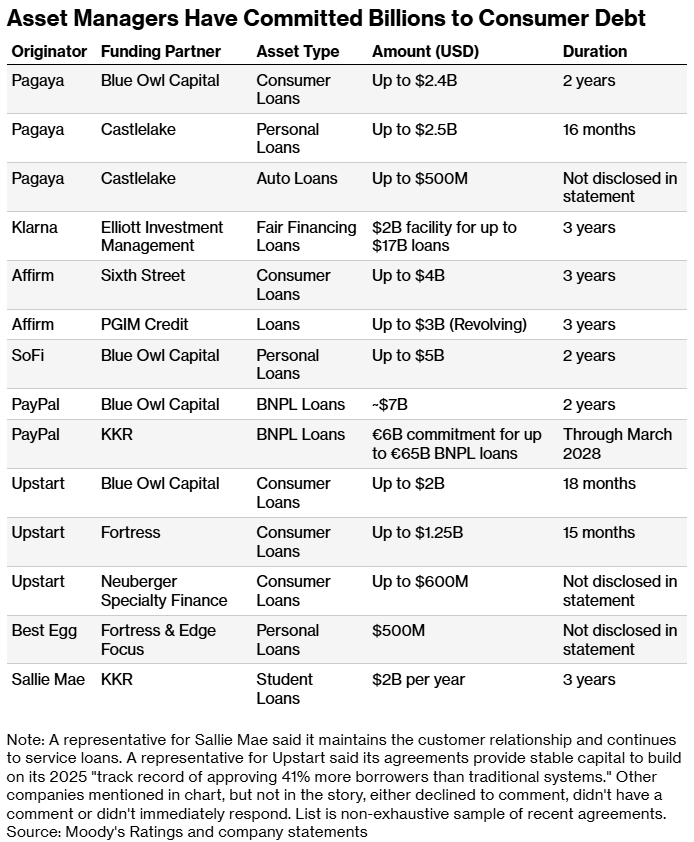
So far, the forward-flow money machine — funding everything from BNPL to auto and student loans — is working as designed. Still, Moody’s Ratings and other firms are contemplating what might happen if a recession hits consumers, or a credit event rocks the market for lending and borrowing money.
There’s not been a recent trying time that would test whether “commitments were consistently fulfilled and investors continued buying loans, which would provide confidence that this is a reliable funding source,” said Mike Taiano, a senior analyst at Moody’s. “Forward-flow agreements have existed for a long time, but not at the scale we see today,” he added, noting that the market lacks full visibility into deal terms which can vary significantly.
Recent transactions underscore the scale. Klarna doubled its existing deal with Elliott to $2 billion in March, enabling the Stockholm-based fintech to fund up to $17 billion in bigger ticket, longer-term US loans — a product it calls Fair Financing. Blue Owl and KKR struck separate deals with PayPal last year, while Affirm and PGIM Credit have a $3 billion accord.
Some fear the link between the two sectors means a stumble in one may ripple through the other.
“If there is a significant disruption in private credit, then we may see a scaling back of the backing private credit has for BNPL loans,” said Nick Maynard, vice president of research at Juniper Research.
Representatives for Elliott, Blue Owl, KKR, PGIM, Klarna and PayPal declined to comment.
“Affirm’s funding model is built to perform across cycles,” a spokesperson for Affirm said, noting its diversified funding partners, short-dated assets and ability to “adjust underwriting and volume quickly as conditions change.”
High Turnover
By immediately offloading loans to private credit, fintechs clear risk off their books, rake in fees and free up capital for new lending, a set-up that also helps shield their equity investors from the vagaries of underwriting.
Unlike traditional corporate loans, which require multi-year underwriting and are vulnerable to shocks, forward-flow deals provide private credit firms with a stream of assets that mature in as little as several weeks.
Industry participants say these portfolios are stable because they target pre-vetted consumers with established repayment histories. And because originators can retain a portion of the sold debt, they say they’re incentivized to maintain asset quality and can quickly tighten credit standards if economic conditions sour.
Privately, however, some insiders caution against viewing this “skin-in-the-game” as a panacea, warning it may not prevent severe losses in a sharp economic downturn. Another concern is the shifting regulatory landscape under President Donald Trump, whose administration has stalled efforts by the now-downsized Consumer Financial Protection Bureau to police the BNPL sector and prevent regulatory arbitrage.
“The way these loans are ultimately transmitted through the financial system can have a major effect on lenders’ incentives, and that’s what the CFPB paid close attention to,” said Rohit Chopra, the agency’s former director. “A consumer reasonably expects that if they’re getting a loan, the lender is expecting that they’re going to pay it back. But we saw in the mortgage crisis that all of those expectations broke down.”
Feeding this transmission chain are the micro-transactions by everyday consumers — people like Verdell Wright.
When the 42-year-old Washington, D.C. resident spent $168 on Amazon and Aldi using BNPL, he wasn’t splurging on luxuries. Instead, he used it to split the cost of everyday purchases like a toothbrush and bathroom cleaner alongside personal upkeep items like pre-workout supplement.
For Wright, it was a tactical way to manage his cash flow after losing his job last year — without adding expensive credit card debt.
“I’m not just some irresponsible person who wants Jordans today,” said Wright, a Rutgers University graduate with two masters degrees. “You can be making over $100,000 and it could not be enough.”
But Wright contends that relying on the debt for basic household items shouldn’t be necessary. “They are capitalizing off the fact that people cannot afford their groceries,” he added.
That sits at the crux of an industry debate: whether the influx of private credit is financing a stable, mainstream payment method, or fueling the overextension of the American consumer.
“Consumers are using it more, which some interpret as a sign of distress, but it also points to broader acceptance of the product,” said Matt Biczak, head of specialty finance for the Americas at Fortress Investment Group. “BNPL isn’t necessarily the right tool for small, everyday spending — but for larger purchases, it can be a compelling alternative to credit cards for the right consumer.”
Fortress has inked a number of forward-flow deals and has struck an agreement to purchase personal loans facilitated by Best Egg, a commitment the fintech’s Chief Executive Officer Paul Ricci said in an email supports borrowers seeking “a cost-effective solution to consolidate higher-cost debt or finance important life events.”
Robust Demand
Affirm, which just expanded a forward-flow agreement with Canada Pension Plan Investment Board, typically targets the bigger ticket, discretionary items. The firm’s loan book has an average order volume of $255 and a weighted average life of about five months, according to company presentations.
Affirm, which gets about 46% of its funding capacity from forward-flow agreements, relies on roughly 20 institutional loan buyers spanning asset managers, investment banks, insurers and pension funds. Demand from these partners remains robust, Chief Operating Officer Michael Linford said at an event following the company’s investor day in May.
“Their orientation is, ‘I have to be invested in credit. This is the kind of credit to be invested in, because I know those results are going to be in line,’” Linford said. “We’ve been very selective about who we partner with. We don’t want to do business with people who we think are taking unnecessary risks.”
6,400 Pages
For a sense of how investment firms amass thousands of consumer loans, look no further than Stone Ridge Asset Management. The firm’s Stone Ridge Alternative Lending Risk Premium Fund, known as LENDX, holds roughly 91% of its net assets in consumer debt. According to a February company report, that includes borrowings from Affirm, SoFi Technologies Inc. and Happen Bank, the fintech formerly known as LendingClub, among others.
The fund’s investments span nearly 6,400 pages of loans ranging from less than $10 to the thousands. Its prospectus reveals how it handles the volume: the fund may not analyze individual loans, but rather negotiates broad investment parameters with its platform partners beforehand, according to the document.
LENDX is in the spotlight after the Wall Street Journal reported that it has been limiting investor redemption requests amid a surge in demand. Operating as an interval fund, LENDX is required to make quarterly offers to buy back at least 5% of outstanding shares.
Some of the news had triggered a brief drop in Affirm’s stock as investors feared broader private credit jitters were spreading to fintech. Morgan Stanley labeled the concerns as overblown, citing Affirm’s “best-in-class credit performance.”
A representative for Stone Ridge didn’t have a comment.
Delinquencies Decline
For its part, Klarna said in May that delinquencies were trending down as its underwriting models matured and the consumer held “steady.” It reported a small first-quarter profit following a period of consecutive quarterly losses.
While it has primarily funded its loans with consumer deposits — which represented 90% of its total funding at the end of March — Chief Executive Officer Sebastian Siemiatkowski said it plans to pursue more forward-flow agreements to boost lending, as well as other transactions known as significant risk transfers.
Klarna traditionally focuses on high frequency, smaller transactions — averaging a $124 balance per consumer and 39-day duration — but the firm has pushed into larger purchases via its Fair Financing product. Klarna offloaded $1.2 billion of Fair Financing receivables in the first quarter, securing a $57 million gain, it said.
In March, Klarna was hit with a lawsuit in Chicago federal court alleging that the company violated laws requiring it to assess borrowers’ ability to repay their loans and that its business model encourages “overspending through non-existent underwriting.”
Though the suing borrowers don’t specifically target Klarna’s agreement to sell its Fair Financing loans, they suggest such deals allow the lender to offload risk and accused Klarna of following an originate-and-sell model that “eerily resembles the pre-Great Recession subprime mortgage strategy.”
Earlier this month, Klarna asked the court to force the borrowers to submit their claims to individual private arbitration, as per its customer agreement.
A representative for Klarna declined to comment on the lawsuit. Klarna underwrites every transaction individually, according to its first-quarter earnings report.
Deal Protections
Under terms of Klarna’s deals with Elliott, Klarna retains consumer-facing activities including underwriting and servicing. Those terms can effectively deter lenders from unloading bad debt and walking away.
And beyond the potential skin-in-the-game measures, there are other safeguards: loans are frequently purchased at a discount to face value, creating a buffer against defaults. And agreements can also put fintechs on the hook to make up any shortfalls resulting from elevated defaults.
Take the forward-flow agreements struck by funds managed by Blue Owl. The asset manager anchors its accords with provisions including frequent testing of borrower health by checking FICO scores, debt-to-income ratios and loan geography, according to a person familiar with the matter.
Blue Owl can also stop purchasing the loans if performance deteriorates, which forces originator discipline, another person said, asking not to be identified discussing private information.
Mounting Strain
BNPL drove $28.5 billion in US online spending in the first four months of the year — a 2.3% year-over-year increase — to capture 7.8% of total e-commerce sales during that period, according to data from Adobe.
But there are signs of strain within. A recent LendingTree Inc. report revealed that more borrowers are failing to keep up with BNPL payments, with 54% of those it surveyed viewing the loans as a necessity for survival rather than a convenience.
That comes as persistent inflation erodes paychecks and raises questions about how much more debt American households, already carrying a record $19 trillion, can handle.
And while short term loans help shield BNPL lenders from losses, the New York Federal Reserve noted in a report that it’s unclear how these companies will navigate a shifting economy.
Because some BNPL platforms withhold data on short-term installment — or “pay-in-four”— loans from major credit bureaus, measuring the complete picture of borrower health is difficult. Private credit meanwhile has drawn scrutiny over discrepancies in how loans are marked.
“There have been major concerns around a lack of transparency and regulation within private credit,” said Juniper’s Maynard. “Given that BNPL can be considered high risk, and with a lack of transparency, this is potentially a volatile mix.”
The foundations for this set up were laid after the financial crisis, when tighter regulation curbed some bank lending and fueled the private credit boom. Yet in a circular twist, major banks are still financing the very private funds that took their place.
“Banks fund private credit, and private credit managers then fund BNPL originators,” said Laks Ganapathi, founder and chief executive officer of Unicus Research. “There is a niche in catering to consumers living paycheck to paycheck.”
Written by: J.J. McCorvey and Rene Ismail — With assistance from Katie Meyer and Anthony Lin @Bloomberg
The post “Private Credit Is Making Bets on Consumer Debt at a Precarious Time” first appeared on Bloomberg