
The world’s biggest public investors plan to shift more capital into private and less liquid assets amid rising risks to their traditional bond-and-stock portfolios, according to an industry survey.
Roughly a third of sovereign wealth funds polled by Invesco Ltd. plan to boost allocations to private credit, private equity and infrastructure assets over 2026, while nearly a fifth want to curb exposure to equities.
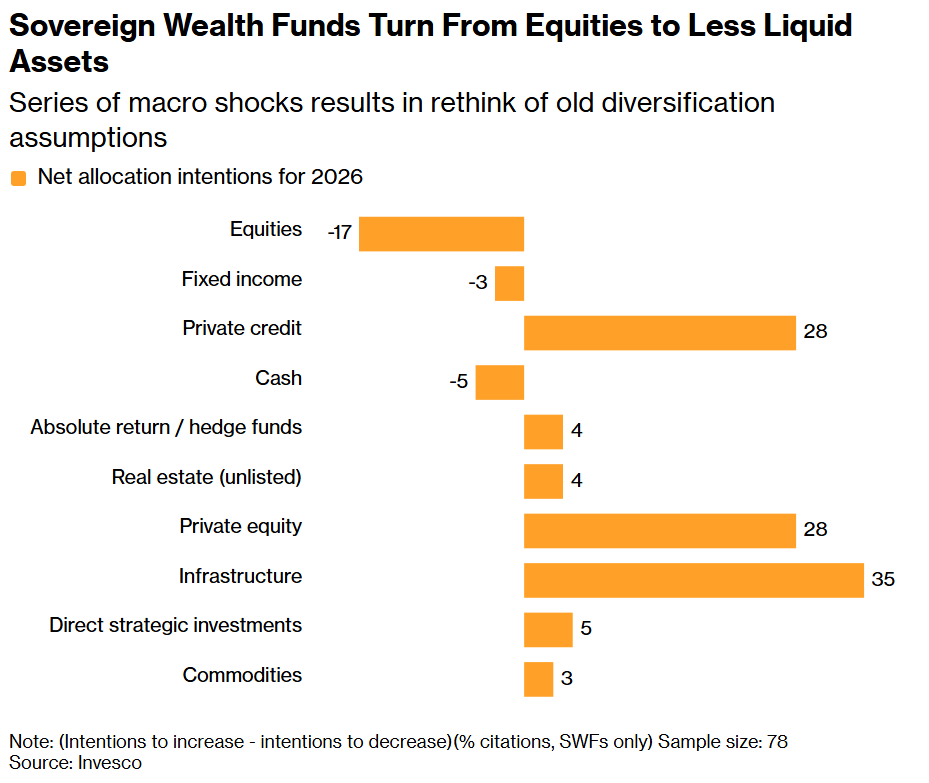
The move comes as risks ranging from inflation and geopolitics to equity market concentration challenge the long-term investors’ traditional portfolio mix and drive them further toward alternative assets.
The private credit and private equity industries, on the other hand, have been rocked by concerns about elevated valuations and outsized exposures to software firms at risk of disruption from AI. This has caused some retail investors to withdraw cash from direct lending funds.
SWFs and central banks understand that “there’s a lot of dispersion and diversity” within private assets, Benjamin Jones, global head of research at Invesco, told Bloomberg News. “Investors generally are looking very carefully at the space and doing a lot more due diligence.”
Private assets are not immune to macro shocks, but their lower liquidity can suit investors with longer time horizons — such as SWFs and central banks that manage assets worth roughly $29 trillion. Unlike public assets, which are repriced daily, private assets are valued less frequently and easier to hold throughout economic cycles.
Bond Hedge
Historically, bonds had provided a hedge against equity selloffs, but in recent years the asset classes have frequently moved in tandem. This risks making traditional reserve-management models outdated and is spurring changes in portfolio construction, according to Invesco.
“In a world of inflation shocks, geopolitical fragmentation and more concentrated markets, investors are rethinking old assumptions about diversification and redesigning portfolios to withstand a wider range of outcomes,” added Invesco’s Jones.
Equity allocations by SWFs fell to 30% in 2026 from 32% a year earlier, according to the survey of 90 wealth funds and 54 central banks conducted in the first quarter. Fixed-income positions, a category that Invesco said includes private credit, held steady at 29%, while other “illiquid alternatives” continued to grow, reaching 24% of total assets.
Within alternative investments, private equity allocations rose to 7.4% from 7.1% while infrastructure grew to 9%, maintaining its position as the fastest-growing alternative asset class over the past five years.
A North-American liability sovereign fund said it was looking to roughly double its private credit portfolio over the next five years, the report said. Meanwhile, a Middle Eastern development sovereign said the AI wave was best captured in private credit and infrastructure opportunities.
Gold was also in focus, with over a third of central banks expecting allocations to the precious metal to increase over the next three years, citing its role as a safe haven and an inflation hedge.
Written by: Alice Atkins — With assistance from Sinead Cruise @Bloomberg
The post “Sovereign Funds Pivot Further to Private Assets in Risky Markets” first appeared on Bloomberg