
The seven largest stockholdings of European sustainable investment funds are US technology companies led by Microsoft Corp. and Nvidia Corp.
Of the funds’ top-10 holdings, just one is based in Europe: ASML Holding NV, according to research from Morgan Stanley.
Amazon.com Inc., Meta Platforms Inc., Broadcom Inc., Apple Inc. and Alphabet Inc. are the other US companies that continue to be widely held by European funds focused on environmental, social and governance factors. The Morgan Stanley report is based on an analysis of 240 of the region’s largest sustainable funds by assets under management.
Tech stocks got a stark warning on Monday when Michael Burry, the investor made famous in The Big Short, said the group may be headed for a sharp reversal after a “parabolic” surge pushed valuations to unsustainable levels. The Nasdaq 100, which is loaded with tech stocks, soared 47% over the past year.
While US tech stocks dominate, ASML and AstraZeneca Plc were overweight in European sustainable funds relative to market benchmarks and investors increased their “positioning” in the stocks during the first quarter, Morgan Stanley reported.
US-listed Trane Technologies Plc, Lam Research Corp. and Applied Materials Inc. also saw a first-quarter “uptick in positioning and are active overweights” in European funds.
As for flows, the analysts found that sustainable funds bounced back in Europe during the first quarter. A net $39 billion plowed into the funds after 2025 saw the sector’s first-ever net annual redemptions.
By contrast, investors withdrew money from sustainable funds in the US and Asia-Pacific region during the first quarter. A net $4.2 billion was pulled from US funds, while $3 billion was redeemed from APAC funds, reversing last year’s $1 billion of inflows, Morgan Stanley reported.
NEWS ROUNDUP
-
- ETF Risk | Concentration risk remains a significant challenge for shareholders of ESG-focused exchange-traded funds.
- Clean-Energy Target | Microsoft Corp. is in discussions to shelve one of the industry’s most ambitious clean-energy targets as it tries to remove hurdles that could hold it back in the race to power data centers.

-
- ECB’s Lagarde | European Central Bank President Christine Lagarde said soaring energy costs due to the Iran war should act as a wake-up call for Europe to reduce its reliance on fossil fuels and energy imports.
- Carbon Prices | Data centers are driving a surge in carbon prices in the US Northeast, helping push CO2 costs in the region past California and raising the prospect of higher energy costs for consumers.

-
- Beef Prices | One calf shows why record beef prices still aren’t coming down.
- Solar | The US residential solar industry knew this year would be tough after President Donald Trump’s One Big Beautiful Bill ended a lucrative homeowner tax break for buying panels. So far, it’s looking even worse than feared.

-
- Coal Financing | Deutsche Bank AG is delaying measures restricting its financing of coal, citing complex regulations and the fact that the pace of the energy transition in some markets hasn’t been what it expected.
- Green Bonds | The war in the Middle East is leading to a burst of momentum for green bonds in emerging markets, as countries look to fund renewable energy projects to mitigate the surge in the cost of oil.

REGULATION
-
- Meatpacking | The US Justice Department said it’s investigating potential antitrust violations in the meatpacking industry amid soaring domestic beef prices and a shrinking cattle herd.
- Semiannual Reporting? | US companies would be able to choose to report earnings semiannually instead of quarterly under a proposal released by the Securities and Exchange Commission, potentially reducing how much information publicly traded firms must share with investors.
- Climate Disclosure | The White House is reviewing a proposal from the SEC to formally end Biden-era climate disclosure rules for publicly traded companies.
- ESG Data | The European Commission is proposing that money managers be exempt from a requirement to report ESG data on the assets they hold on behalf of clients.
- Carbon Permits | The European Commission is set to propose granting about €4 billion ($4.7 billion) more of free-emission permits to the industries covered by the bloc’s carbon market, addressing concerns by some governments and manufacturers over the region’s declining competitiveness.
- Carbon Alliance | China and the European Union have joined forces in a bid to create a global alliance on carbon pricing, putting them at odds with the Trump administration’s push to invest more in fossil fuels.
- DEI | After a remarkably successful effort to extinguish diversity, equity and inclusion programs at US employers, federal officials are stepping up their push against corporate America’s remaining DEI initiatives.
BLOOMBERG RESEARCH
-
- Fund Withdrawals | Biodiversity funds slump with about $1 billion of outflows. (BloombergNEF)

-
- Healthcare Strains | Climate risk is pressuring margins across the US healthcare sector, with hospital operators facing growing disruptions from storms alongside policy headwinds and insurers contending with rising medical costs linked to heat and wildfire exposure. (Bloomberg Intelligence)
- Nuclear Debt | Sustainable debt tied to nuclear projects is scaling up quickly — with issuance on pace to exceed $90 billion in 2026 — as energy security and decarbonization goals lift investor support despite a debate about whether the sector is truly sustainable. (Bloomberg Intelligence)
- Clean-Energy Retreat | The Americas recorded the steepest contraction in low-carbon investments among 37 oil and gas companies, with capital expenditures falling by $9.4 billion, or 72% year on year, to $3.6 billion in 2025. (BNEF)

-
- Corpus Christi | Heightened execution and operational risks from persistent drought in Corpus Christi, Texas, are adding $120 million to the city’s borrowing costs. (Bloomberg Intelligence)
- Wind vs. Solar | About 15 gigawatts of onshore and offshore wind energy capacity has been awarded via auctions so far in 2026, surpassing solar by 5GW. (BNEF)

-
- Colorado River | Colorado River’s low water level is exposing a $1 trillion regional economy with risks that can ripple through supply chains nationwide. (Bloomberg Intelligence)
- Clean Aviation | Airlines are facing higher compliance costs tied to environmental policies, particularly from sustainable-aviation fuel blending mandates and carbon pricing. (BNEF)

-
- $13.5 Trillion | Global spending on extreme weather, insurance and resilient infrastructure reached $13.5 trillion over the past 12 years — roughly matching estimated economic losses from the Great Recession. (Bloomberg Intelligence)
BLOOMBERG OPINION AND ANALYSIS
-
- Crude Cargoes | China’s invisible hand is rebalancing the oil market, wrote columnist Javier Blas.

-
- Buffett’s Legacy | Warren Buffett’s big bets at Berkshire Hathaway Inc. may haunt the Greg Abel era, wrote columnist Nir Kaissar.
- Bad Weather | Using artificial intelligence to forecast the weather is getting so good – and so cheap – that meteorological services are starting to retire the expensive physics-based systems they have relied on, wrote columnist Gautam Mukunda, who writes about corporate management and innovation.
- Back-of-the-Napkin | Why $70 is the most worrying number for LNG, wrote columnist David Fickling.

-
- AI Bots | ChatGPT can’t pick the stocks, wrote columnist Matt Levine.
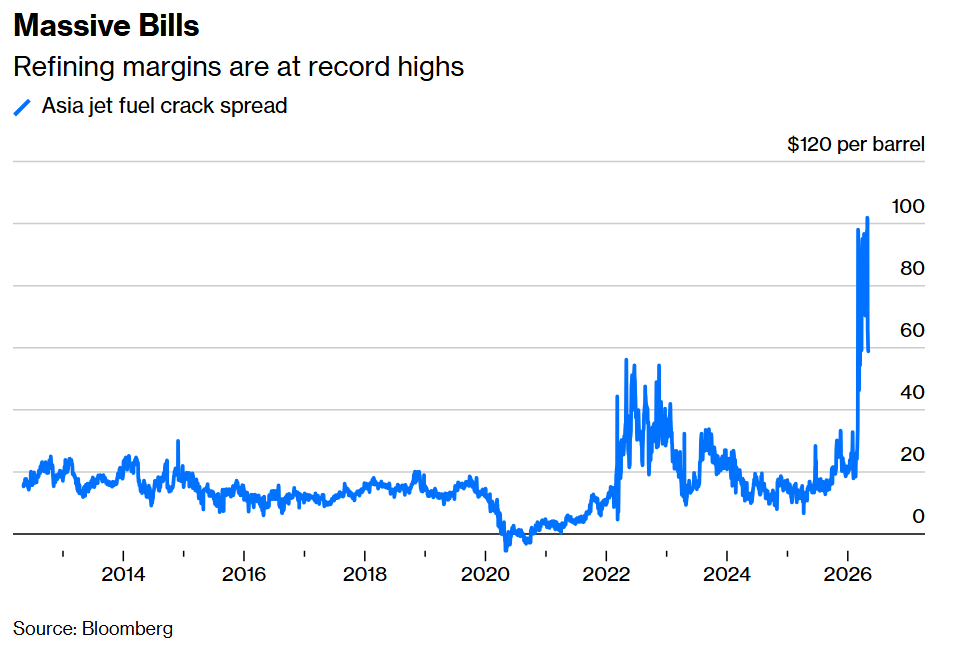
- Fuel Crunch | Jet-fuel costs are putting Asian budget carriers at risk, wrote columnist Juliana Liu.
-
- US Smog | Blaming Asia and Mexico for US smog is absurd, wrote columnist Mark Gongloff.
FUNCTIONS FOR THE MARKET
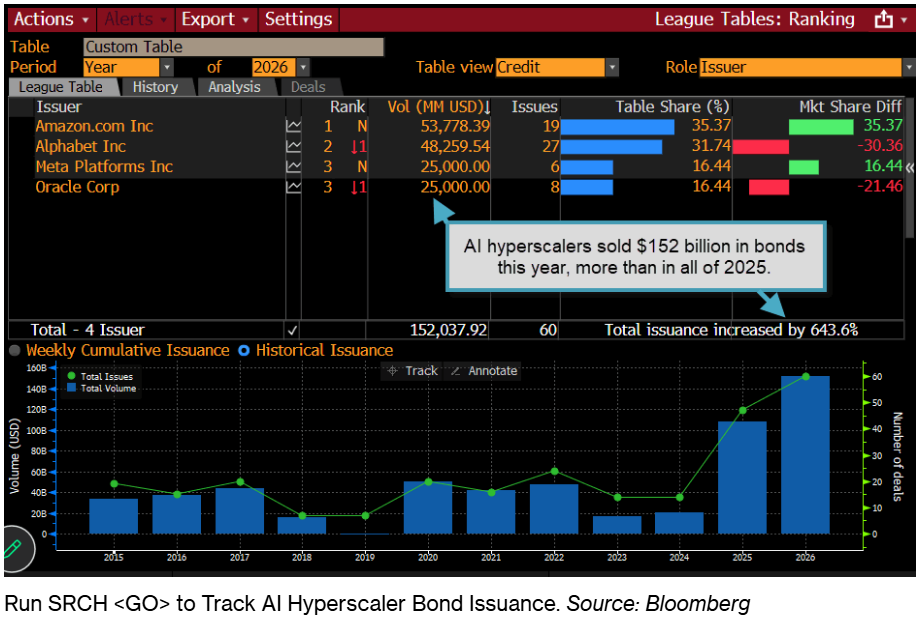
AI Hyperscalers | Investors are showing fatigue after artificial-intelligence hyperscalers sold $152 billion of bonds this year, more than during all of 2025.
- Credit spreads widened as much as 25 basis points for long-dated Oracle Corp. bonds over three months and 20 basis points for long Meta Platforms bonds.
- Meta sold $25 billion of dollar bonds at higher spreads in April than last October.
- Alphabet saw a more modest increase in premiums as it raised $17 billion in a euro and Canadian dollar offering.
- Use Bloomberg’s SRCH, LEAG, FIW, CHRT, PXGD and ASKB tools for credit analysis.
Written by: Tim Quinson — With assistance from Lisa Pham @Bloomberg
The post “US Tech Stocks Still Dominate European Funds: ESG Investing” first appeared on Bloomberg