
UK long-term borrowing costs jumped to a 28-year high as worries intensified over local government elections and the impact of soaring energy prices on the economy.
The yield on 30-year gilts surged as much as 13 basis points to 5.78%, the highest since 1998. The selloff swept across bonds of all maturities, with 10-year notes topping 5.10% as markets reopened from a public holiday on Monday.
While bond investors around the world have signaled their discontent with faster inflation and potentially higher interest rates, the UK stands out as the most extreme example. The combination of Britain’s messy political landscape, with unpopular Prime Minister Keir Starmer likely to face a leadership challenge, feeble economy and strained government finances have made it a target for traders looking for a weak link.
“The market has one eye on the fact that Starmer’s days are numbered, and if not numbered then a further move to the left of the political spectrum is inevitable in an attempt to head off support for the Green party,” said Lloyd Harris, head of fixed income at Premier Miton.
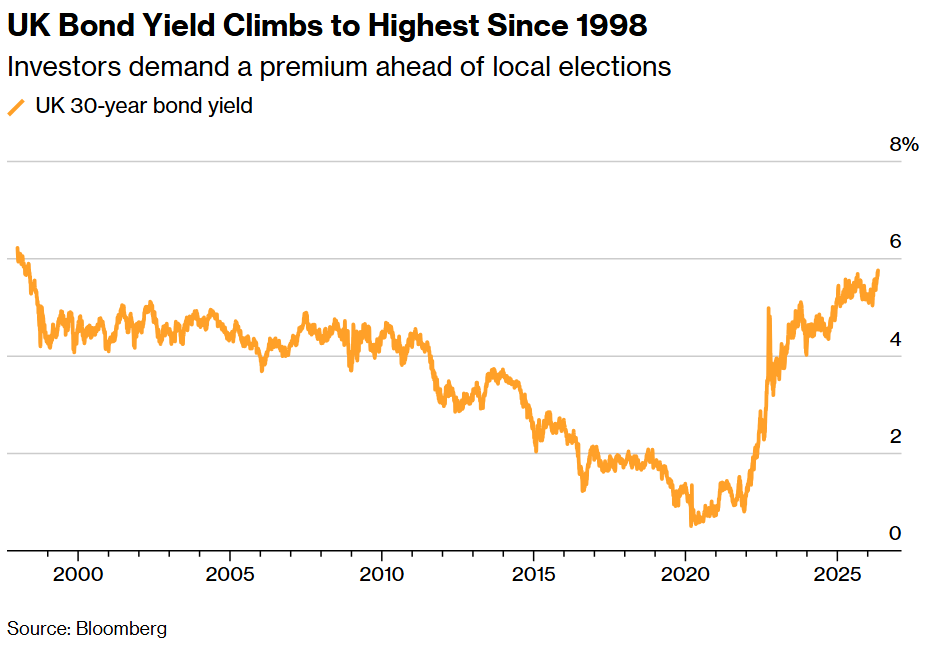
The UK 10-year yield has jumped 70 basis points since the start of the Middle East war, the biggest increase among a basket of developed markets tracked by Bloomberg over that period. The equivalent Italian rate has surged about 50 basis points.
With local elections looming this week, the concern is that the Labour Party is heading for big losses at the ballot box. In the minds of investors, that raises the chances that either Starmer or his replacement would have to boost government spending to win back disaffected voters, which would further pressure the UK’s finances.
On top of that, the UK’s reliance on imported energy has left it vulnerable to an economic shock from the war. With oil prices stuck above $100, the fear is that faster inflation will force the central bank to hike interest rates even further. Markets are now pricing in three quarter-point rate hikes this year, up from two last week.
In the US, bonds yields have also climbed, but to a smaller degree. The rate on the 30-year Treasury hovered around 5% on Tuesday, a level that some call a “line in the sand” that may put a renewed focus on whether investors will tolerate ever-higher levels of government borrowing.
Some have speculated that the traditional buyers of UK bonds, like pension funds, aren’t as active in the market as they used to be, which is also helping to drive up yields. For decades, British defined-benefit pension funds bought long-dated bonds to match against their liabilities, allowing the UK to extend the average maturity of its issuance well beyond peers. Many of those programs are now winding down.
Written by: James Hirai and Georgia Hall @Bloomberg
The post “UK Bond Rout Sends 30-Year Yield to Highest Since ‘98” first appeared on Bloomberg