
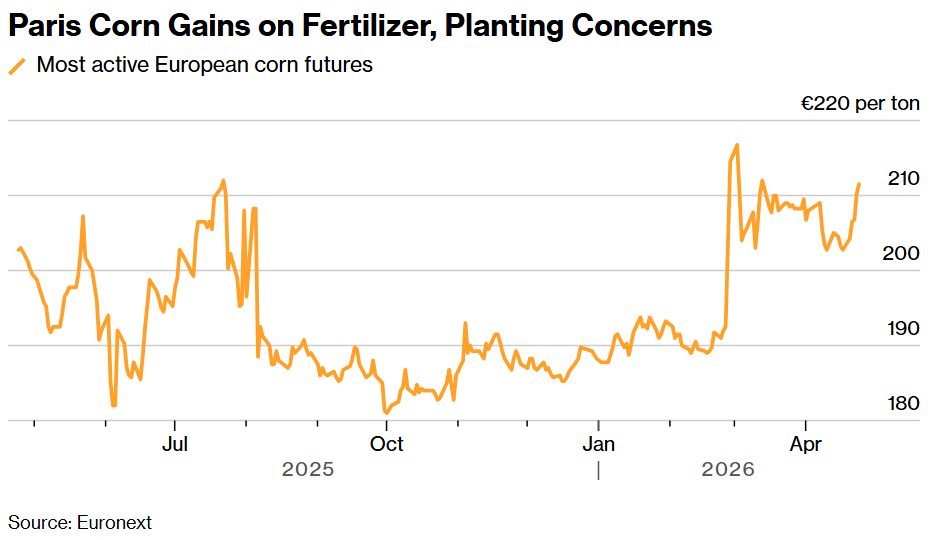
European corn hit its highest level in six weeks as concerns grow that surging fertilizer prices — a result of the war in Iran — may see planting areas drop.
The most active futures contract in Paris rose as much as 1.6%, a fifth consecutive day of gains, and was set for a weekly advance of around 5%, the biggest in two months.
The Middle East conflict has resulted in the effective closure of the Strait of Hormuz, a critical waterway for global energy and fertilizer trade, driving up input costs for farmers worldwide. As a result, growers are scaling back fertilizer use or shifting to crops that are less input-intensive. In France, the European Union’s top corn grower, there are concerns the area under the crop may shrink as much as 15%.
“Farmers and traders globally are getting increasingly worried about availability of fertilizer, and we are starting to see prices appreciate as a result,” Richard Buttenshaw, executive director of grains and oilseed at Marex, said in an email.
Meanwhile, wheat prices slumped as the market weighed a slightly improved weather forecast for areas under the hard red winter variety. Futures initially rose as much as 1.1%, hitting the highest level since June 2024, before slumping as much as 1.6%.
As May approaches, rainfall is expected to return to parts of the crop’s western growing region, including Kansas, Nebraska, and Colorado, according to weather analysis from Aura Commodities. Still, “it is unlikely to significantly improve overall conditions, as the moisture may arrive too late to have a meaningful impact,” Jake Wade, a senior meteorologist at the firm, said in an email.
Wheat’s reversal marks the end of a week of profit taking, according to Mike Verdin, senior markets consultant at CRM AgriCommodities. “In what has become a bit of a weather market for wheat, when every change in the forecast can make a difference to crop prospects, it is always tempting to take some profit while it is there,” he said in an email.
Written by: Eleanor Thornber and Ben Westcott @Bloomberg
The post “Paris Corn Hits Six-Week High as Fertilizer Concerns Mount” first appeared on Bloomberg