
The International Monetary Fund and World Bank are historically beacons of free trade, capitalism and financial market wisdom. But at their spring meetings, the emerging theme has a contrarian vibe: Investors are underestimating the economic damage from the Iran war.
Across public panels, private dinners and other meetings on the sidelines of this week’s events in Washington, the growing consensus is that the impact of the conflict on the global economy is likely to get significantly worse before it gets better — even if a lasting peace is negotiated soon.
The world is witnessing more than just another shock, according to government officials and other participants who spoke in the opening days of the talks. What’s likely to take root, they caution, is structural change involving higher costs, longer trade routes and a denser cloud of geopolitical uncertainty that will mean a world with a slower growth potential.
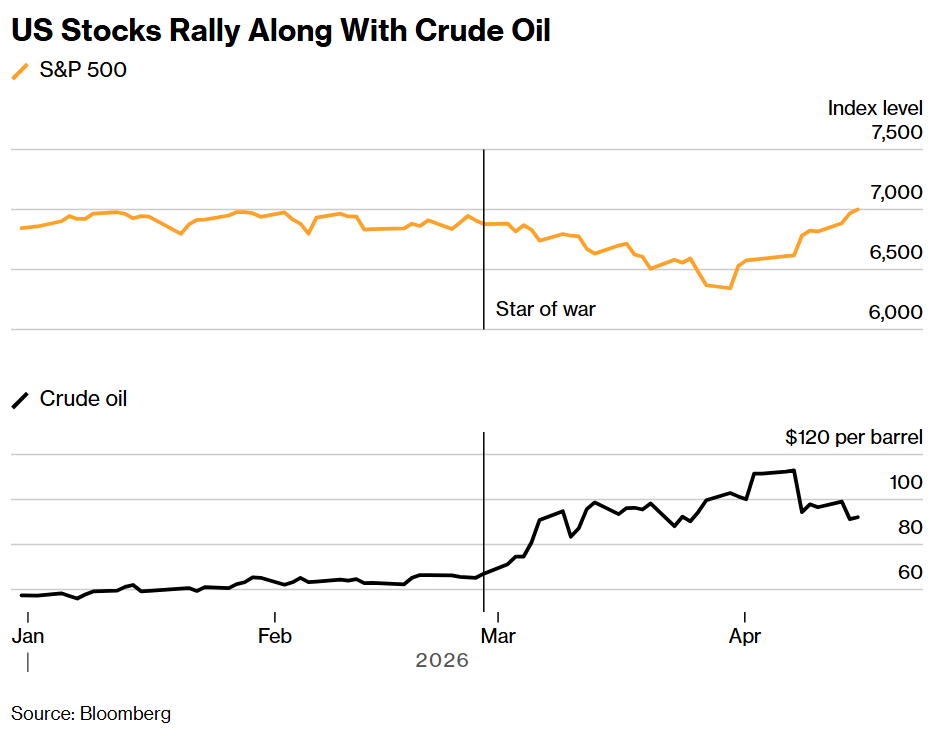
“What we are seeing is the tip of the iceberg,” Ali bin Ahmed Al Kuwari, the Qatari finance minister, said at the IMF on Wednesday as US equities flirted with record highs and oil prices stayed below $100 a barrel.
Al Kuwari, whose economy has suffered heavy damage to its liquefied natural gas exports, laid out a one- to two-month scenario where the current energy price shock shifts into shortages for some governments that “won’t have enough energy to light up their countries.”
A food crisis stemming from a fertilizer crunch won’t be far behind, he warned. Qatar, he reminded the audience, is the source of almost one-third of the world’s helium, which is needed to make semiconductors. “You’ll see huge economic impact as a result of this war,” Al Kuwari said. “It’s not going to be far away.”
Trump administration officials have called for calm and restraint, especially from central bankers adopting a wait-and-see approach to the need for interest rate increases to counter inflation pressures. The short-term pain now will be worth the benefit longer term of ending Iran’s nuclear threat, according to the US.
Temporary Shock
US Treasury Secretary Scott Bessent sought to portray the conflict and resulting price surges as temporary and indicated he expects soaring energy costs to fall as quickly as hostilities end.
“This war will end. I don’t know whether it’s three days, three weeks, three months, but it will end,” Bessent said during a CNBC forum on Wednesday, adding that “markets live in the future.”
Such optimism is a hard sell among many of those attending the IMF and World Bank meeting just a few blocks from the White House.
What Bloomberg Economics Says…
“The US is looking for an exit from Iran and markets are betting they will find it. That might be right, but only if hurdles on control of the Strait of Hormuz, Iran’s nuclear programme, and conflict between Israel and the Hezbollah militia in Lebanon can be cleared.”
—Tom Orlik, global chief economist. For more, click here.
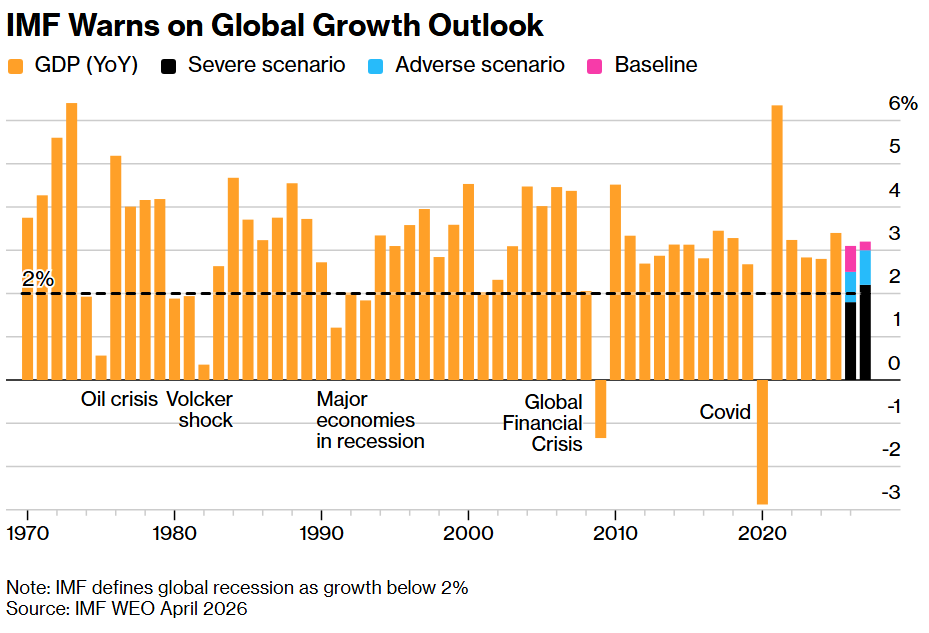
After downgrading its forecast and predicting the slowest growth the world has seen since the pandemic on Tuesday, the IMF’s chief economist, Pierre-Olivier Gourinchas, foreshadowed more downgrades to come.
A new US blockade of the Strait of Hormuz and other developments meant the fund’s “adverse” scenario, which calls for 2.5% global growth down from the 3.3% predicted before the war, now seems increasingly likely, he told reporters.
“Every day that passes and every day that we have more disruption in energy, we are drifting closer towards the adverse scenario,” Gourinchas said. A similar warning about Europe’s growth path came from European Central Bank President Christine Lagarde.
Behind the growing concerns is the feeling that a war that has lasted six weeks so far will cast a much longer shadow over the global economy even if the US and Iran negotiate an end soon.
“Don’t think of this as one month more of pain. Think of it as longer than that, because it will take time for the supply system to settle down, even assuming that there’s no more fighting and therefore no more structural damage to energy installations,” World Bank President Ajay Banga said Tuesday.
While oil prices have soared, the full extent of the pain from what the International Energy Agency has called the biggest energy shock the world has ever seen has yet to be felt.
Though the Strait of Hormuz has effectively been shut for six weeks, the last of the cargoes that left the Persian Gulf ahead of the war are only now reaching their destinations.
“March was a very difficult month for the world in terms of energy, in terms of the economy, and April may well be even worse than March,” Fatih Birol, the IEA head, told reporters on the sidelines of the spring meetings.
Stock Rally
Amid such gloom, the question perplexing many at the meetings in Washington is how US equities markets in particular have so quickly recovered from their initial wartime losses. The S&P 500 hit a new record high on Tuesday as the IMF was downgrading its global growth forecast.
On Wednesday US stocks remained near lofty heights amid mixed signals of a possible ceasefire extension and continued slow traffic through Hormuz.
To some at the meetings, the answer is simple. “Markets are underestimating the gravity of the situation,” said Alexis Crow, who advises corporate clients around the world as chief economist at consultancy PwC US.
Crow and others argued that’s because markets aren’t recognizing the disruptions the war will have on supply chains.
Many market participants don’t want to get caught on the wrong side of the a Trump “TACO” — a reference to a pattern that “Trump always chickens out” from aggressive moves when markets respond disapprovingly.
For investors this week, there’s a another popular acronym at play — FOMO — as signs of easing tensions in the Middle East, combined with optimism over artificial-intelligence technology and corporate earnings in the US, have pushed skeptics to abandon their caution.
“It’s difficult for investors to avoid the fear of missing out,” said Matt Maley, chief market strategist at Miller Tabak + Co.
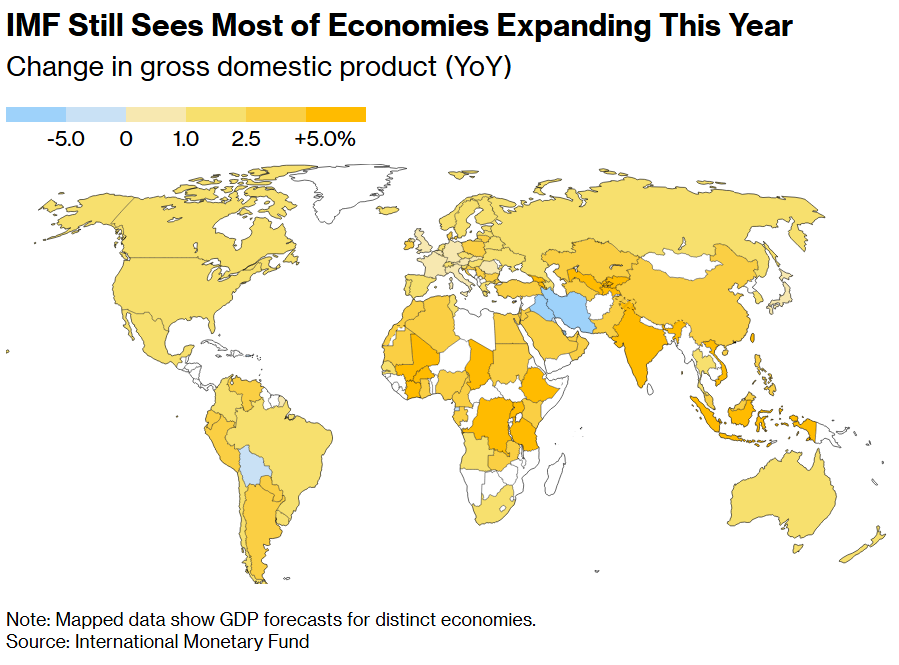
IMF Managing Director Kristalina Georgieva said another reason for the market’s optimism is the relative health of the US economy and its smaller exposure — as a oil exporter — to the energy shock. “But I can tell you, that is not the story of the rest of the world. In the rest of the world, already there is a lot of pain,” she said.
Georgieva was asked bluntly, should markets be more wary? “I would argue, yes, because what we see in supply chain disruptions is already quite significant,” she responded.
There are also questions in Washington about just how resilient the global economy can continue to be after the shocks of tariffs, the pandemic and Russia’s war in Ukraine. Those have led to rising debt levels and the depleted capacity of many governments to respond to another crisis in an increasingly fragmented world.
“No one knows how close we are from the breaking point but economic, financial and social resilience is not infinite,” Pierre Cailleteau, who leads investment bank Lazard’s sovereign advisory team, said in an interview.
While the IMF and World Bank have both stressed they are ready to respond to a crisis, there are already calls for them to do more.
In the fund’s corridors, concerns about the severity of the crisis spread while some warned how markets and some policymakers were underestimating the impact. The big worry: a chain reaction triggered by the energy shock that spreads to global financial markets, a person familiar with the discussions said. The question remained how to craft the right messaging without injecting panic, the person added.
Speaking on behalf of the G-24 group of developing economies on Tuesday, Nigerian finance and economy minister Olawale Edun called for both the IMF and World Bank to mobilize more resources.
The crisis, he pointed out, was hitting the developing world at a time when the US and other rich countries had abruptly scaled back their foreign aid and many poor countries were paying more to service their debt than they were getting in either aid or foreign direct investment.
Rebecca Patterson, a JPMorgan and Bridgewater Associates veteran who is now a senior fellow at the Council on Foreign Relations, said what many investors are missing is that the impact of the current energy shock is likely to look a lot like the effects of the Covid pandemic.
Like the health crisis that infolded across the world starting in 2020, “there is rolling contagion,” she said.
“Asia felt the disruption to energy supplies first, and now Europe is starting to feel it,” Patterson said of the Iran war’s fallout. “The US is next, as the last ships to the US from the Gulf are about to arrive.”
Written by: Shawn Donnan and Jorgelina Do Rosario — With assistance from Beril Akman, Jorge Valero, Geoffrey Morgan, Daniel Flatley, and Francine Lacqua @Bloomberg
The post “Markets Are Too Blasé on War’s Economic Toll, Policymakers Warn” first appeared on Bloomberg