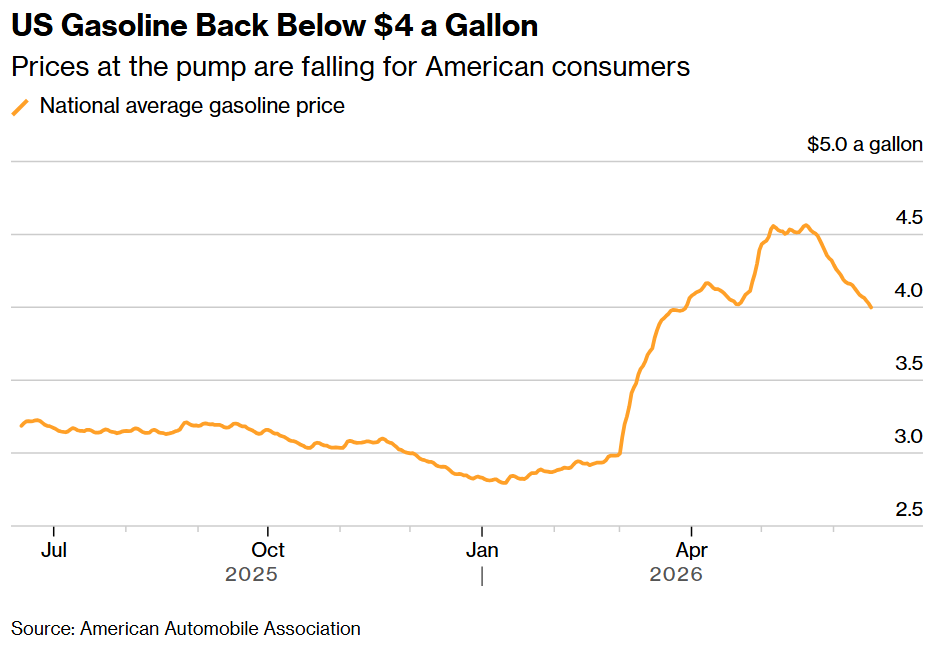
US gasoline prices dipped below $4 a gallon for the first time since March, providing welcome relief to consumers after a historic global supply disruption sent fuel costs soaring for months.
National regular unleaded gasoline averaged $3.999 on Thursday, according to the American Automobile Association. The swing down in prices comes as the US and Iran signed an interim deal to end the war and reopen the Strait of Hormuz.
“From the narrow perspective of gasoline retail prices, this is a ‘win,’ albeit only relative to the high prices that were created by this conflict in the first place,” said Neil Crosby, head of research at market intelligence and analytics platform Sparta. “The hard work of creating a lasting peace deal is still ahead.”
Pump prices have retreated from their May peak above $4.50 a gallon, helped by a decline in global crude prices. Oil has come under pressure, sliding below $80 a barrel, due to a combination of record US exports, a sharper-than-expected slowdown in Chinese demand, and a steady trickle of shipments through the strait.
Still, at $3.999 a gallon on average, prices remain well above where they stood before the war, and aren’t expected to return to those levels until next year, experts say.
With many Americans dependent on their cars for daily necessities, they had little choice but to absorb the higher fuel costs so far. The result was higher inflation and a squeeze on household budgets that spilled into the broader economy, as money spent at the pump left less available for discretionary purchases.
Politically, lower pump prices represent a relief for the White House and US President Donald Trump, who has repeatedly said that prices will fall after the war. With midterm elections approaching, Democrats have seized on the cost of gas and wider inflation while running against Trump’s Republican party.
The White House has also employed a wide range of policy levers to limit rising costs, including waiving the Jones Act and drawing down the Strategic Petroleum Reserve.
The challenge for the White House now is to make the gradual decreases in prices feel relevant for voters, said Ryan Cummings, chief of staff at Stanford University’s Institute for Economic Policy Research and a former staff economist on the Biden Administration’s Council of Economic Advisers.
If prices remain below $4 a gallon on July 4th weekend, when Americans hit the road en masse, that’ll make for a somewhat easier sell, he said.
Still, even if voters aren’t actively thinking about the price of gas when they head to the polls for midterms, they’ll remember the spike at the pumps, he said – and it’ll be challenging for Trump to deflect blame.
For now, traders are focused on the pace at which inventories are replenished to gauge whether further price declines are on the horizon. US gasoline stockpiles are at their lowest seasonal level in more than a decade.
Meanwhile, in states including California, Michigan and Maine, the average gasoline price remains above $4 a gallon.
“Prices are still much higher than before the conflict and will not return to those levels quickly,” said Yigit Dogan, an oil products analyst at Energy Aspects Ltd.
Written by: Will Kubzansky and Jack Wittels @Bloomberg
The post “US Gasoline Prices Fall Below $4 as Iran Pressure Eases” first appeared on Bloomberg