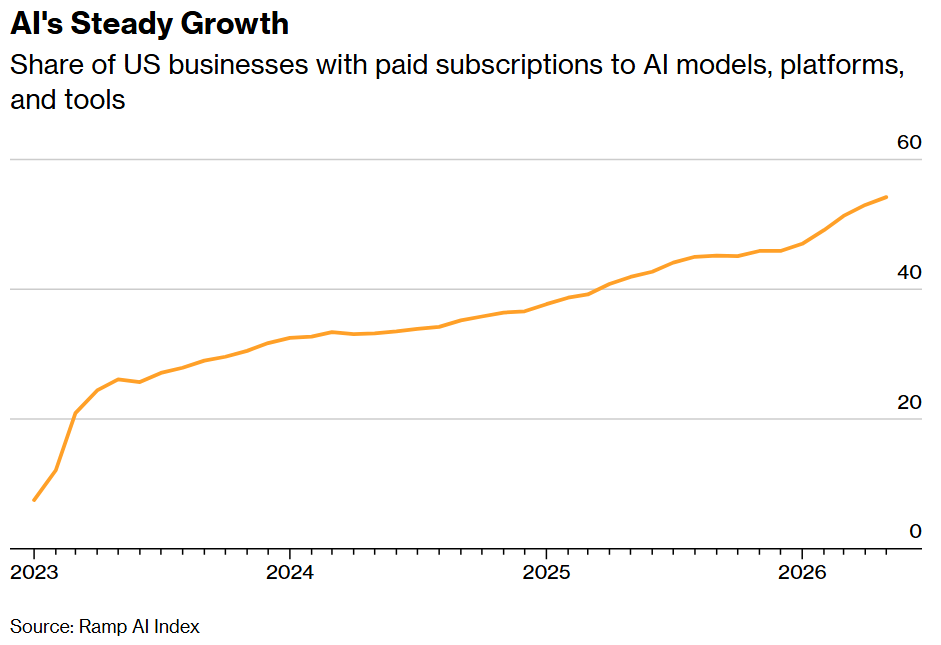
Silicon Valley spent much of the past few years feverishly pushing consumers and businesses to inject artificial intelligence into every corner of their lives. Now AI developers want their customers to pay more for the technology they actually use.
A growing number of tech firms have begun to introduce usage-based pricing options for their AI services rather than simply charging a flat subscription fee. As a result, the heaviest users are set to incur additional costs each time they ask an AI chatbot or agent to produce a slide deck, draft an email or debug a complex piece of code.
Leading AI labs have been spending tens if not hundreds of billions of dollars on chips, data centers and talent to develop and run their models. The shift to a pricing model more commonly associated with metered-power or pay-as-you-go phone contracts may lead to more selective use of a technology that consumes huge amounts of electricity and other resources.
But it’s riled parts of Corporate America, forcing businesses to confront their heightened spending on AI and take stock of the return on that investment. The shift carries echoes of when on-demand services like Uber Technologies Inc. cut back on their subsidized offerings. There’s a risk of widespread sticker shock that causes more customers and firms to rethink how much AI is really worth to them, just as some of the top AI startups race to make their stock market debuts.
The business model for AI chatbots and agents is still relatively new and evolving.
In 2023, months after ChatGPT kicked off the generative AI craze, OpenAI and rival Anthropic PBC began introducing paid subscription plans to monetize their chatbots. The two firms started with premium offerings for users that cost $20 per month. Later, they added additional tiers running as high as $200 a month, with the promise of getting expanded access to their models.
OpenAI, Anthropic and other AI firms also offer enterprise options meant for teams, with greater security guardrails, data controls and customer support. The pricing for these options varies, but typically involves charging organizations a fixed monthly rate for each employee – or “seat” – with access to an account through the plan.
OpenAI, in particular, has also begun to roll out an advertising-supported option for users, borrowing the playbook that online companies like Meta Platforms Inc. and Alphabet Inc.’s Google have long relied on to offer free services to billions of people.
While AI developers continue to offer tiered subscriptions, some are beginning to rethink the wisdom of allowing virtually unlimited access to their AI models for a fixed price.
Anthropic shifted to billing business customers based on their actual AI usage, The Information reported in April, at a time when demand for its services was surging. Anthropic offers varying amounts of user credits with each tier of their paid subscriptions; after reaching that limit, the individual or company must then pay as they go.
The expense depends on the task, duration and the model used. On Anthropic’s website, the firm estimates that it costs $10 for every 1,000 web searches performed by its Claude chatbot. Managed agents cost 8 US cents for each hour of active runtime, Anthropic says, a figure that may add up if hundreds of employees deploy fleets of agents at all hours, simultaneously.
OpenAI customers have puzzled over new usage limits for its AI software coding agent. And Microsoft Corp.’s GitHub coding tool recently frustrated users by rolling out a new usage-based system that takes effect after hitting a certain monthly allotment. Some complained of burning through their monthly quota in as little as a day.
The flat-fee model made sense in the early years as a simplified and more affordable cost structure for businesses, many of which may have been unsure about how much to incorporate chatbots into their daily workflows and how much to spend on an unproven technology.
In late 2025 and early 2026, AI hit an inflection point. Anthropic, OpenAI and others made significant advances in building AI agents that can write and debug code for software engineers, sometimes for hours at a time. From there, AI startups began pushing harder to introduce agents capable of streamlining a wider range of tasks in other sectors, including finance. Meanwhile, OpenClaw went viral in certain quarters, showing the promise and peril of an AI digital assistant using a person’s computer to book travel, field emails and manage calendars.
Suddenly, some of the heaviest AI users were running swarms of agents for hours at a time. Businesses also began encouraging their employees to use as many tokens — a unit of data processed by AI models — as possible, even setting up internal leaderboards ranking staffers by this metric. The practice, commonly referred to as tokenmaxxing, effectively rewarded staffers for maximizing AI usage, regardless of whether that activity led to greater productivity or business value.
By default, having an AI agent to automate a task is more computationally intensive than simply asking a chatbot to spit out a couple paragraphs of text — and enlisting an agent to work for hours on end even more so. AI developers could choose to continue subsidizing that additional cost, with the aim of further entrenching their technology inside more businesses, but there are risks to that approach.
Anthropic and OpenAI, two of the world’s leading AI developers, are both racing to go public as soon as this year, putting more scrutiny on their expenses and path toward profitability. The companies have proven that AI can be useful for certain valuable business tasks, such as coding. Now they need to show they can make enough money from customers to offset their immense spending on chips, data centers and talent.
Executives at OpenAI have acknowledged that the industry’s pricing model would need to change as the technology evolves, and suggested that customers may eventually pay for AI more like they do for utilities.
“It’s possible that in the current era, having an unlimited plan is like having an unlimited electricity plan,” Nick Turley, OpenAI’s head of ChatGPT, said in a podcast interview earlier this year. “It just doesn’t make sense.”
Likewise, OpenAI’s Sam Altman said the company imagines a future “where intelligence is a utility, like electricity or water, and people buy it from us on a meter.”
GitHub, meanwhile, framed its decision as an attempt to “better align pricing with actual usage.”
“Today, a quick chat question and a multi-hour autonomous coding session can cost the user the same amount,” the company said in a blog post. “GitHub has absorbed much of the escalating inference cost behind that usage, but the current premium request model is no longer sustainable.”
“Usage-based billing fixes that,” GitHub added.
The combination of growing AI adoption, tokenmaxxing-style initiatives and shifting pricing has led to a rude awakening for some businesses.
Walmart Inc. has capped staffers’ use of an in-house AI agent that helps with workplace tasks. Uber Technologies Inc. is limiting each employee’s monthly spending on certain AI coding tools to $1,500 per tool. And there has been growing criticism of tokenmaxxing as a misguided and costly status symbol for the industry.
“Companies have been correctly pushing employees to embrace AI, and rising token costs are a feature, not a bug,” said Matt Kropp, chief technology officer of Boston Consulting Group’s BCG X division, which helps clients implement AI. “That said, few companies know yet how to budget for AI, and employees are still learning how to use these tools effectively, so there is definitely waste happening.”
In tech circles, more people are now discussing the need for better model routing systems that would essentially match users with the right model for the job at hand. For many tasks, people may not necessarily need the most expensive, top-of-the-line models.
“As token budgets take on a larger part of operating expenses over time, model routing is the inevitable conclusion,” said Aaron Levie, co-founder and chief executive officer of Box Inc. “Soon you will be able to peel off individual use cases and send them to lower cost models once the quality is sufficient for the task.”
Customers may reduce their overall spending on AI or else shift more of that spending to more affordable services, forcing the companies to rethink how much they can realistically charge.
There are already signs of competitive pressures bearing down on the biggest US AI services, with OpenAI considering significant cuts to token prices in anticipation of similar cost reductions from Anthropic.
A shift to token-based subscriptions that makes customers more attentive to pricing could also benefit Chinese open-weight AI platforms such as DeepSeek and Alibaba Group Holding Ltd.’s Qwen chatbot. These tend to consume less computing power than US models as they engage a smaller proportion of an AI system’s “neural network” to generate a response. This is one reason why those companies are able to offer lower prices for their services.
At the moment, the Chinese models remain behind the best offerings from American rivals, but they are likely more than good enough to siphon off demand for many routine tasks if and when professionals start to look for more affordable alternatives.
Written by: Seth Fiegerman @Bloomberg
The post “How Meter Pricing Is Testing the Economics of AI” first appeared on Bloomberg