Ahead of reporting their second-quarter results, private credit managers acknowledged a sobering reality: The redemption wave engulfing the $1.8 trillion market was unlikely to abate swiftly.
Now, as the last half of 2026 gets underway, direct lenders are realizing just how relentless that pressure can be.
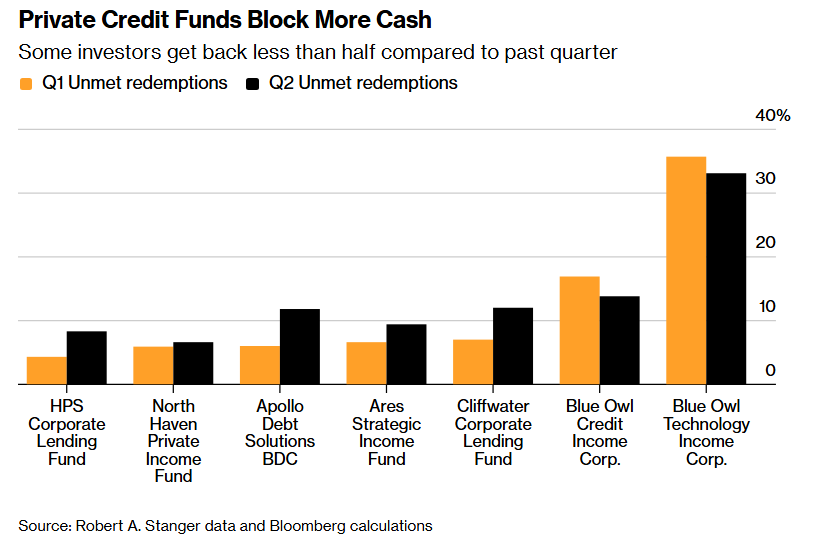
More often than not, second-quarter exit requests have exceeded those of the prior three-month period. The latest round has left more than $14.5 billion of investor capital trapped at over a dozen funds, compared with just $8.6 billion that shareholders were able to get back, according to Bloomberg estimates and data from Robert A. Stanger & Co. That effectively means funds are locking up roughly $1.70 for every $1 an investor reclaims.
Many in the industry suggest the latest batch of redemption requests in part reflects backlogged demand from investors blocked by the 5% withdrawal caps imposed by several funds in the prior quarter. That cycle — which largely stems from anxiety over concerns about asset quality, in particular exposure to the AI-disrupted software sector — is expected to remain elevated while the jam clears, industry participants say.
“We did expect redemptions to pick up in the second quarter as investors rotate out of private credit,” and into tangible assets such as real estate and infrastructure, said Michael Covello, executive managing director at Robert A. Stanger. “We expect to have up to eight quarters left of the redemption queue clearing while flows are still suppressed.”
Blue Owl Capital Inc. on Thursday showed the challenges in swiftly turning around the redemption pressure once a large backlog grows.
The private credit giant reported that investors in its roughly $34 billion Blue Owl Credit Income Corp. asked to pull 18.8% of shares in the second quarter, while those in the smaller Blue Owl Technology Income Corp. looked to redeem 38.1%, levels only slightly lower than the prior period and still outsized relative to major rivals.
That’s even as executives stepped up efforts to engage with clients over the past three months, flying around the world trying to educate investors, according to a person with knowledge of the matter.
Barclays Plc analysts led by Peter Troisi echoed the sentiment on backlogs, writing in a report last week that new requests to claw back shares actually decreased in the second quarter among funds they analyzed as investors with unfulfilled first-quarter demands likely carried over their requests.
Among the slew of fund managers seeing demands climb was Ares Management Corp., which last month curbed withdrawals from its Strategic Income Fund for the second consecutive quarter after requests rose to 14.4%. Investors had asked to redeem 11.6% in the prior period.
Morgan Stanley’s $7 billion private credit fund also limited redemption demands at 5% after investors sought to yank 11.6% of their shares, surpassing submissions made in the first quarter. Apollo Global Management Inc. capped requests from its largest non-traded private credit fund for retail investors, after shareholders wanted to pull 16.8%, similarly exceeding the prior period.
Some were forced to limit redemptions for the first time: Blackstone Inc. restricted withdrawals from its $79 billion flagship private credit fund, BCRED, at 5% after investors sought to pull 10% of the shares. In the previous quarter, the vehicle went to unusual lengths to meet investor demands to cash out 7.9%, tapping its own senior executives to help fund the withdrawals with their cash.
There were also some outliers. Goldman Sachs Group Inc. was able to meet all redemption requests across both quarters and said demand declined in the most recent three months. An Oaktree Capital Management private credit fund saw redemption requests drop by nearly half in the second quarter.
Amid the continued surge, some fund managers noted another trend: Some of the demand influx is coming from outside the US.
For example, Ares reported that nearly half of the second-quarter withdrawal requests for its Strategic Income Fund came from smaller institutions and family offices based mostly outside the US — a cohort that represents less than 1% of its shareholders.
Apollo detailed a similar geographic disparity with its Apollo Debt Solutions vehicle, where it said domestic withdrawal requests settled at 4.3% while offshore redemption demands climbed to 12.5%. Meanwhile, Blackstone reported that while overall repurchase requests rose in the second quarter, they decelerated near the end of the offer period, with onshore demand below prior quarter levels.
By one account, it may be a case of the more you ask for.
“A common practice to get out of these funds is to ask for more than you actually want, when you expect to get less,” said Erik Kratz, chief investment officer at Arena Private Wealth.
He recalled a past client who transferred a private real estate investment trust to him when public REITs were struggling following an interest rate adjustment. The fund had restricted investor withdrawals the previous quarter.
“I wanted to reduce the position by 50% but asked for 100% each quarter for two quarters and got there faster,” he said.
Written by: Olivia Fishlow and Hannah Webster — With assistance from Rene Ismail @Bloomberg
The post “Private Credit Keeps $14 Billion Trapped in Bid to Outlast Storm” first appeared on Bloomberg