Highly-indebted companies are increasingly ditching private credit loans for cheaper capital in the bank loan market, a shift underscoring the stark realities of higher-for-longer interest rates.
Corporate America’s effort to limit its interest burden is showing up in refinancing data from JPMorgan Chase & Co. and KBRA DLD. Companies with private debt are refinancing in the syndicated market about three times more often than firms with syndicated loans are tapping private credit, the data show.
The shift comes as the two worlds constantly jockey for business, with the competitive edge routinely swinging between them. Companies tend to pay more to borrow privately, but can also usually close loans faster and with more certainty in that market, making the debt attractive in times of turmoil.
On Wednesday, pharmaceutical company Catalent Inc. refinanced private loans from Ares Management Corp. and Blue Owl Capital Inc. into $4.1 billion of term loans in dollars and euros. In doing so, it cut its borrowing costs by about 225 basis points.
Insurance underwriter Fidelis Partnership is working with Morgan Stanley to refinance about $2 billion in direct loans, and KKR & Co.-backed software business Accuris is slated to price a $700 million leveraged loan next week that’s taking out direct lenders.
Syndicated loans are growing more popular because borrowing costs are climbing and show little sign of falling soon. But even though credit is getting more costly, companies are still able to borrow, showing markets remain orderly.
“To the extent companies can lower the overall cost of capital, I think that’s leapfrogged the other variables and become the most important component,” said Sinjin Bowron, portfolio manager and head of liquid credit strategies at Beach Point Capital Management.
Wall Street banks refinanced nine deals worth $4.5 billion from the private loan market in the second quarter, compared with three deals worth $1.3 billion being taken from the syndicated loan market to direct lenders, the data show.
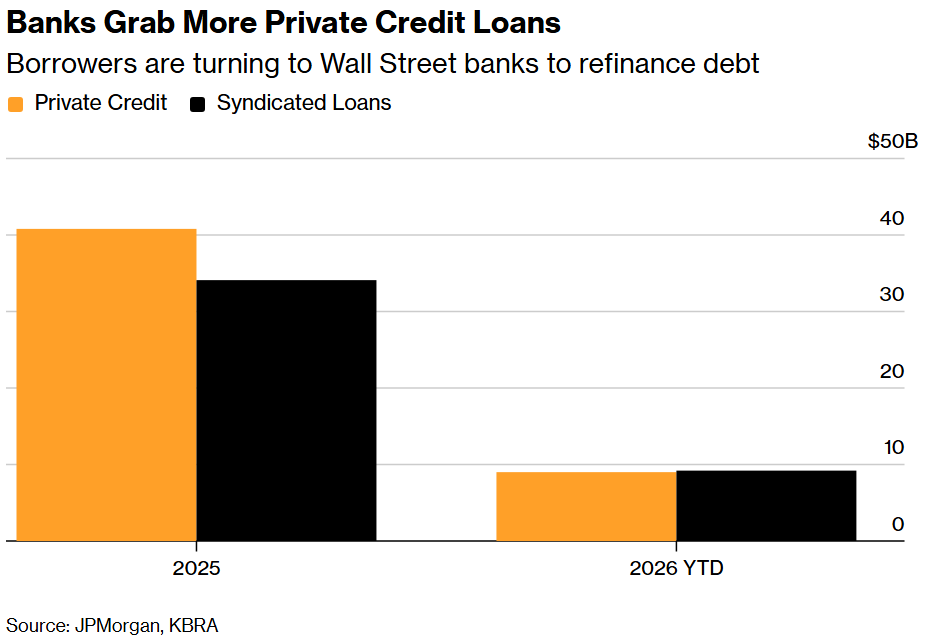
That’s helped give banks an edge on the year so far. Through mid-July, bank-led deals lured away from private credit had climbed to $9.2 billion, while roughly $9 billion in syndicated loans had been refinanced with direct lenders.
In the whole of 2025, banks took $34.1 billion of deals from private markets, compared to $40.8 billion of deals that went the other way.
Firms may also be concerned about private credit lenders’ shrinking levels of capital. Investors for much of the year have been looking to pull money out of funds known as business development companies, and their asset levels broadly declined in the first quarter.
Many of the firms are marking down their portfolios, with the Blackstone Secured Lending Fund having reduced its net asset value by the most in six years in the second quarter. There are some signs of the sector having stabilized, but the pain isn’t necessarily over.
Banks may be taking advantage of that weakness. Commercial and industrial loans on their books grew at an annualized rate of 14.2% in the second quarter, according to seasonally adjusted data from the US Federal Reserve. In last year’s second quarter, that growth was just 4.4%.
The head of the Office of the Comptroller of the Currency said explicitly in January that its efforts to relax post-crisis rules for leveraged loans would help banks better compete with private credit.
The net outflows at perpetual BDCs have “allowed some banks to compete more aggressively in commercial lending given less deployable capital at BDCs,” Barclays Plc analysts Peter Troisi and Ishika Goyal wrote in a Tuesday note.
Despite banks clawing back some market share, not all their deals are passing muster. Baker Tilly tapped Deutsche Bank AG to refinance north of $2 billion in private credit in the syndicated-loan market, but the accounting and consulting firm dropped those plans earlier this week after discussions with investors failed to garner a palatable price for the company and prospective buyers of the loan.
Collateralized loan obligations, the largest buyers of loans, have become more selective in their investments, at the same time that direct lenders have tightened their terms, according to a report from KKR.
In some instances, speculative-grade borrowers are shifting more borrowing into the junk bond market. Ancestry.com Inc.’s $2 billion deal last month saw the genealogy business increase a bond sale to $950 million from $450 million, while reducing the loan portion to $1.05 billion from $1.75 billion.
High-yield bonds may become pivotal for private equity-backed borrowers as investors across private and public markets become less tolerant of risk. Junk bonds can offer fixed yields to companies concerned about short-term rates rising.
“Sponsors will use the high-yield market to a much greater degree to refinance the 2028 maturity wall they have to deal with,” Jeremiah Lane, KKR’s co-head of global leveraged credit, said in an interview.
| What to Watch |
|---|
|
Written by: Aaron Weinman and Rachel Graf @Bloomberg
The post “Private Credit Squeezed By Bank Refinancings: Credit Weekly” first appeared on Bloomberg