US stocks swung wildly Monday, with the S&P 500 Index erasing what had been a steep drop as investors pushed into dividend-heavy shares, Big Tech slump and worries flared about President Donald Trump’s Wednesday tariff announcement.
The benchmark equities gauge, after tumbling as much as 1.7%, was up less than 0.3% by 2:35 p.m. in New York, thanks to end of quarter and monthly rebalancing and as traders embraced companies promising regular payouts to shareholders, like consumer staples firms, energy producers and utilities.
Treasuries were little changed as stocks rebounded from their lows. Gold held at a new record high above $3,100 an ounce, signaling continued worries that Trump’s trade policies will deal another blow to markets and upend the world economy.
The Dow Jones Industrial Average rebounded a 0.8% gain. But the Nasdaq 100 Index, which dropped as much as 2.5%, was down 0.4%, while a Bloomberg gauge of the “Magnificent Seven” big tech stocks slid around 0.7%. Nvidia Corp. and Tesla Inc. lead those losses, though both came off their session lows after retail traders plowed about $1 billion in inflows into the two, according to Emma Wu, a global quantitative and derivatives strategist at JPMorgan Chase & Co.
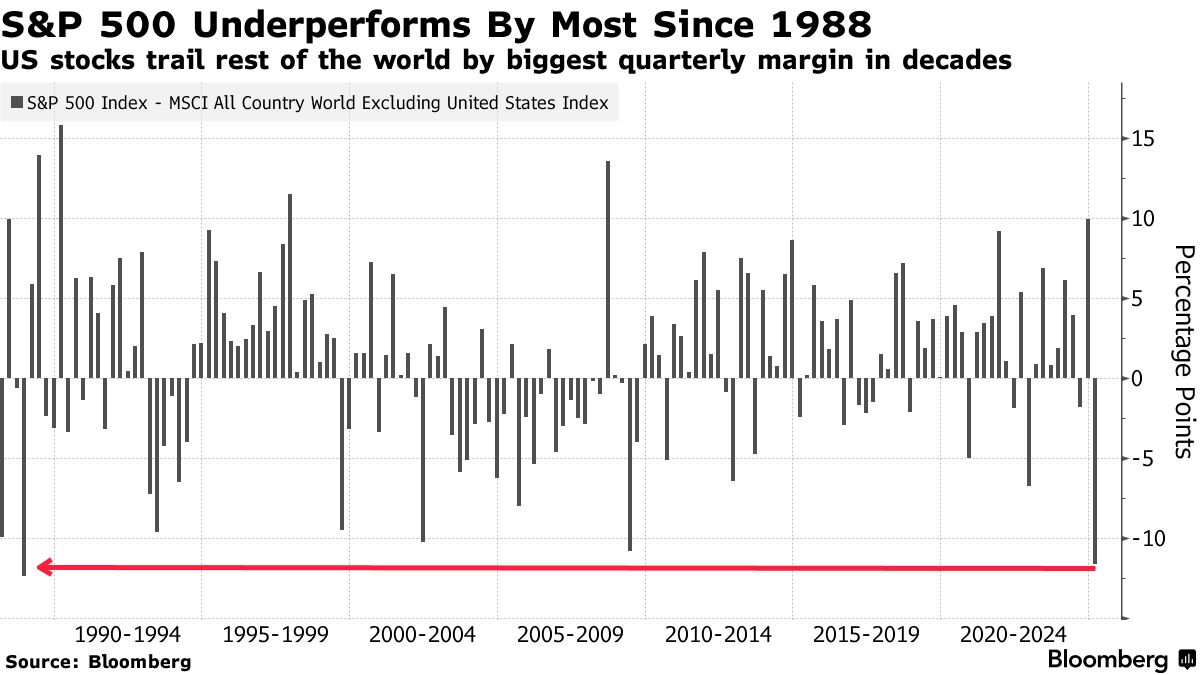
The equity slide — which eased as the session wore on — caps a tempestuous start to the year as escalating concerns about a trade-war fueled recession, with the S&P 500 on track for its worst quarter compared with the rest of the world since the 1980s.
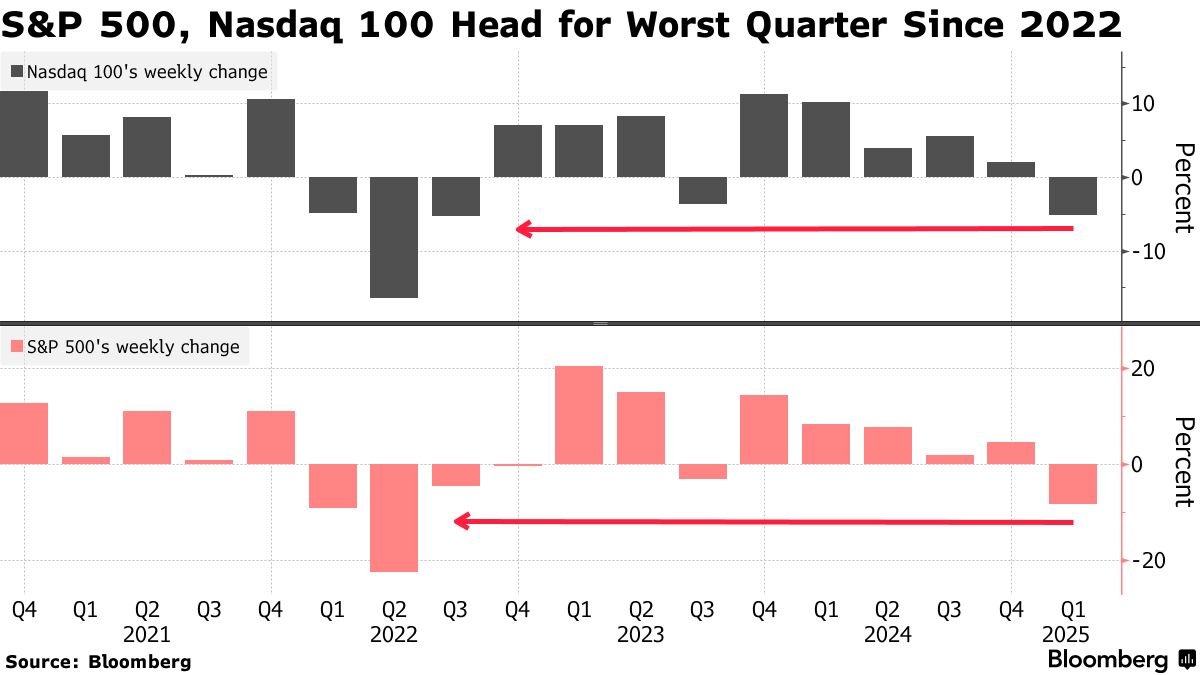
Traders are on edge two days before Trump plans on Wednesday to announce sweeping levies on all of America’s trading partners. On the final session of a brutal first three months of the year, the S&P and Nasdaq 100 are on pace for their worst quarters since 2022. Goldman Sachs Group Inc. now sees a 35% chance of a US recession, echoing similar warnings from JPMorgan Chase & Co. and Moody’s.
“Everyone is so consumed with all of the pain the Mag 7 stocks have faced, but this is a huge buying opportunity,” said Eric Beiley, executive managing director of wealth management at Steward Partners, who is snapping up shares of Nvidia, Alphabet Inc. and Arm Holdings plc. “But investors will stay defensive until we get more clarity on tariffs.”
Wall Street’s chief fear gauge — the Cboe Volatility Index — jumped above 22 to top the 20 level that starts to raise concerns for traders. About 51% of S&P 500 stocks were lower. Shares of consumer companies that need shoppers feeling flush enough to spend were among the worst performers, with United Airlines and Delta Air Lines getting pummeled. Auto stocks took another dive, with Ford Motor, General Motors and Stellantis all lower, with tariffs exacerbating worries over the impact on global trade and hits to industry profits.
The S&P 500 has shed more than 5% this year, trailing the MSCI All Country World Index excluding the US Index’s more than 6% gain. That’s the widest gap in any quarter since 1988, according to data compiled by Bloomberg. It’s an unprecedented reversal after the S&P 500 entered 2025 coming off two consecutive years of 20% gains, the first time that’s happened this century.
The policy shifts ushered in by Trump — which has also included aggressive moves to slash spending and the size of the federal workforce — came after the AI-fueled stock rally over the past two years had left positioning stretched, valuations pricey and the market vulnerable, with concentration in the S&P’s tech sector hovering near the highest on record.
With uncertainty particularly elevated, investors have been looking for safety amid concern that rising import prices and diminished trade could worsen inflation and slow growth. The equal-weight version of the S&P 500 and the Dow are performing better than the regular S&P index this year, a combination that since early 1990 has only happened 26% of the time.
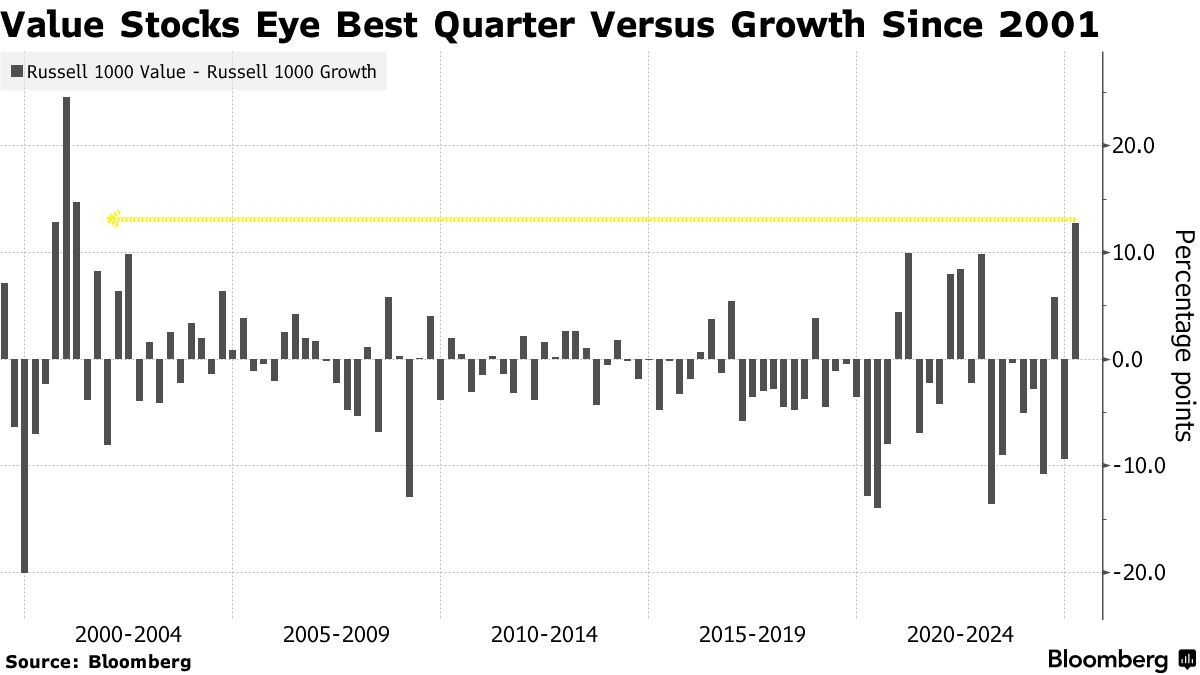
The Russell 1000 Value Index has trounced its growth counterpart by nearly 13 percentage points in the first quarter, according to data compiled by Bloomberg. If that holds through Monday’s close, it would be the widest quarterly gap since 2001.
Wall Street forecasters are sounding the alarm on US equities before the tariff announcement, with Goldman Sachs Group Inc.’s David Kostin cutting his S&P 500 target for a second time this month. He sees the benchmark ending the year around 5,700 versus his previous estimate of 6,200 — implying a gain of just 2% by year-end from Friday’s close — on a higher recession risk and tariff-related uncertainty.
The trading desk at JPMorgan Chase & Co. remains “tactically bearish” due to policy uncertainty and doesn’t foresee a so-called “Trump put” happening anytime soon since it likely has a strike price below 5,000, according to the team led by Andrew Tyler, the firm’s head of global market intelligence.
Others tempering their outlooks include well-know stock bull Ed Yardeni of Yardeni Research. Last week, Barclays Plc’s Venu Krishna warned weakening growth will continue to curb equity gains in 2025, forcing him to cut his year-end S&P 500 target to 5,900 from 6,600.
“More pain and volatility will continue,” said Patrick Fruzzetti, portfolio manager at Rose Advisors. “There is way too much back-and-forth on tariffs from the Trump administration. We need a consistent message from Washington, or else more investors will flock to safety.”
Written by: Jess Menton @Bloomberg
The post “US Stocks Erase Losses as Trump’s Tariffs Keep Markets on Edge” first appeared on Bloomberg