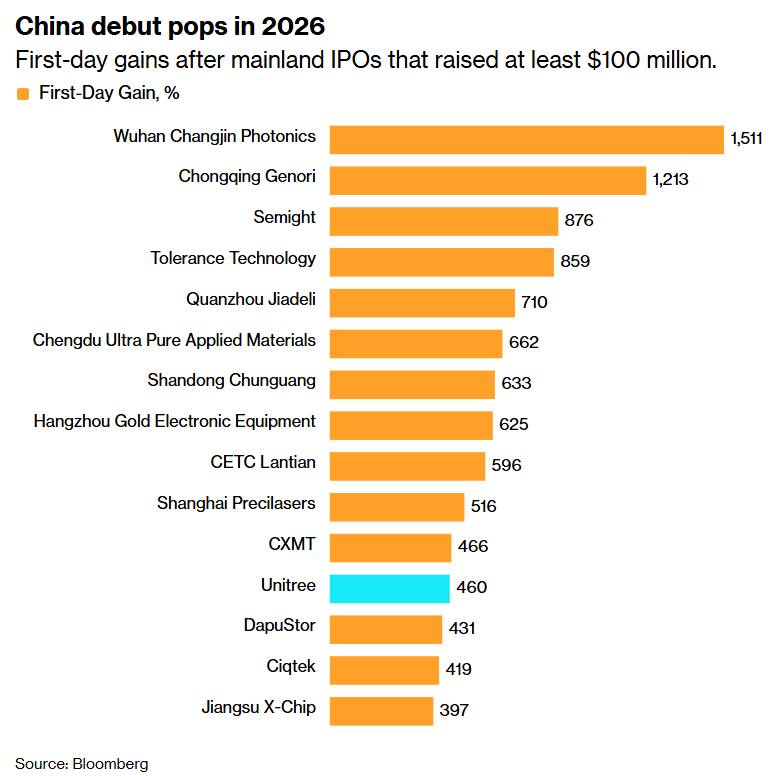
Unitree Robotics shares surged 460% in their Shanghai trading debut after the company raised 6.1 billion yuan ($904 million) in an initial public offering, becoming the first listed humanoid robot maker in mainland China.
Shares of the Hangzhou-based company, officially known as Yushu Technology Co., rose by as much as 629% to 1,100 yuan from the IPO price of 150.8 yuan, before paring some gains. The closing price gave Unitree a market value of 342 billion yuan, putting it ahead of recently listed technology companies including MetaX Integrated Circuits Shanghai Co. and Moore Threads Technology Co.
Embodied artificial intelligence is emerging as one of the most closely watched frontiers in the global AI race as Beijing steps up support for strategic technologies ranging from semiconductors to humanoid robots. Unitree’s offering is tapping into growing investor appetite for physical AI companies as attention shifts beyond foundation models and into real-world AI applications.
“Unitree’s debut surge signals strong appetite for China’s embodied AI sector,” said Ian Ma, an analyst at Bloomberg Intelligence. “IPO proceeds should accelerate AI development and commercialization. The strong listing may also provide a favorable valuation read-across for Ubtech and other upcoming IPOs of other Chinese robotics rivals.”
In a sign of the demand, Unitree’s retail order book exceeded the 7.07 trillion yuan of bids generated by memory-chip giant CXMT Corp. in its blockbuster offering last month.
One reason behind the massive oversubscription rates is that regulators remain cautious about the valuations at which companies sell new shares to the public, requiring firms to have some comparison against peers in China and globally. Authorities have been known to discourage richly priced IPOs in an attempt to protect individual investors from losses. When markets are buoyant, that can lead to companies getting smaller cash infusions than investors are willing to commit.
The enthusiasm also underscores growing expectations that deployment of humanoid robots is beginning to accelerate.
“The mass-production inflection point appears close,” JPMorgan Chase & Co. analysts including Tim Huang wrote in a note, adding that the investment case for China’s humanoid-robot industry rests on accelerating commercialization, supply-chain localization opportunities and growing policy support.
JPMorgan forecasts global humanoid robot shipments will rise to 60,000 this year and 1.75 million units by 2030, compared with 18,000 units in 2025. The bank sees China accounting for more than half of global demand.
Unitree is among the companies that are expected to benefit if such growth materializes. The company shipped more than 5,500 humanoid robots last year, ranking first globally, according to its prospectus. Cumulative sales of its quadruped robots exceeded 33,000 units. Revenue surged to 1.7 billion yuan in 2025 from 393 million yuan a year earlier, while net profit reached 278 million yuan and gross margin exceeded 60%.
Founded by Wang Xingxing, Unitree became one of China’s best-known robotics startups after its humanoid robots appeared at the country’s annual Spring Festival Gala.
Unitree’s IPO valued the company at 35.89 times sales, according to the company’s prospectus. That compares with ratios of about 20 for industry peers listed in Hong Kong such as UBTech Robotics Corp. and Shenzhen Dobot Corp. Analysts at Nomura initiated coverage with a price target of 370 yuan.
“There’s clearly no fundamental basis for the share price surge,” said Vey-Sern Ling, managing director at Union Bancaire Privée It is driven by retail hype. “Valuations are sky-high and the outlook is uncertain given the early stage of development and adoption of humanoids.”
Investors are increasingly focusing on world models and software systems that serve as the “brain” of humanoid robots rather than hardware performance alone, he said.
The robot maker said it plans to use approximately 4.2 billion yuan of the IPO proceeds to fund embodied AI model development, humanoid robot research, new product programs and manufacturing expansion projects.
The IPO also drew attention because of the strategic investors backing the company. About 20% of the offering was allocated to strategic investors including AI startup DeepSeek, a Tencent Holdings Ltd.-affiliated investment vehicle, and investment arms of major state-owned enterprises such as China National Petroleum Corp., China Southern Power Grid Co. and China Telecom Corp.
DeepSeek received a 2.31% stake allocation with a lockup period of three years. The collaboration allows Unitree to draw on DeepSeek’s AI strength to develop embodied-intelligence models for its humanoid robots. Tencent-linked investors also subscribed to the offering while agreeing to collaborate on robotics intelligence models and deployment scenarios.
Unitree’s successful listing could also build momentum for other Chinese robotics companies pursuing IPOs, including Leju Robotics and Deep Robotics. Another humanoid robot developer, Shanghai AgiBot Innovation Technology, has already begun preparations for a Hong Kong listing, according to local media reports.
As the mainland’s first listed humanoid robot maker, Unitree’s debut may serve as a barometer for how investors view the commercial prospects of embodied artificial intelligence. Whether that optimism proves warranted will depend on how quickly humanoid robots move from showcases and pilot projects into daily use.
While pilot deployments are increasing and shipment forecasts point to rapid industry growth, many industry participants remain cautious about the pace of adoption, arguing that widespread commercial use will still depend on advances in AI models and real-world training data.
“As the best-known company in the humanoid robotics sector, Unitree still faces questions over the maturity of its business and commercial operations,” said Shen Meng, director at Beijing-based investment bank Chanson & Co. “But buoyed by policy support and strong enthusiasm for new listings, A-share investors have shown greater willingness to place high expectations on technology IPOs such as CXMT and Unitree.”
Here are more analysts’ views on Unitree:
Nomura (Frank Fan, Donnie Teng)
Morningstar (Kangyuxiao Li)
Written by: Bloomberg News
The post “Unitree Robotics Surges 460% After $904 Million Shanghai IPO” first appeared on Bloomberg