President Donald Trump said he plans to order a cut in US prescription drug costs to bring them in line with other countries, spurring a drop in pharmaceutical shares worldwide.
Trump said drug prices will be cut by “59%, PLUS!” in a social media post on Monday.
Over the weekend, Trump vowed to sign an executive order in Washington to institute what he called a most-favored nation policy, mandating that Americans pay no more than people in countries that have the lowest price and promising a 30% to 80% cut in drug prices.
While he didn’t provide details on how the plan would be implemented, investors grappled with the potential implications for the world’s largest pharmaceutical market.
Shares in US drugmakers dropped before the official open on trading in New York, with Eli Lilly & Co., Pfizer Inc., Bristol-Myers Squibb Co. and Merck & Co. Inc. all down. European drugmakers including Novo Nordisk A/S, Sanofi SA and AstraZeneca Plc slid, missing out on a broader market rally, while in Asia, the pharmaceuticals subgroup in Japan’s Topix Index posted its biggest one-day loss since August.
A renewed push to lower drug prices may have an “enormous” impact on the sector’s revenues, said Stephen Barker, an equities analyst at Jefferies Japan Ltd.
That’s because Medicare, the US government-funded program that offers health insurance for people age 65 or older, and Medicaid, which covers low-income citizens, collectively account for about 40% of US drug sales, he said.
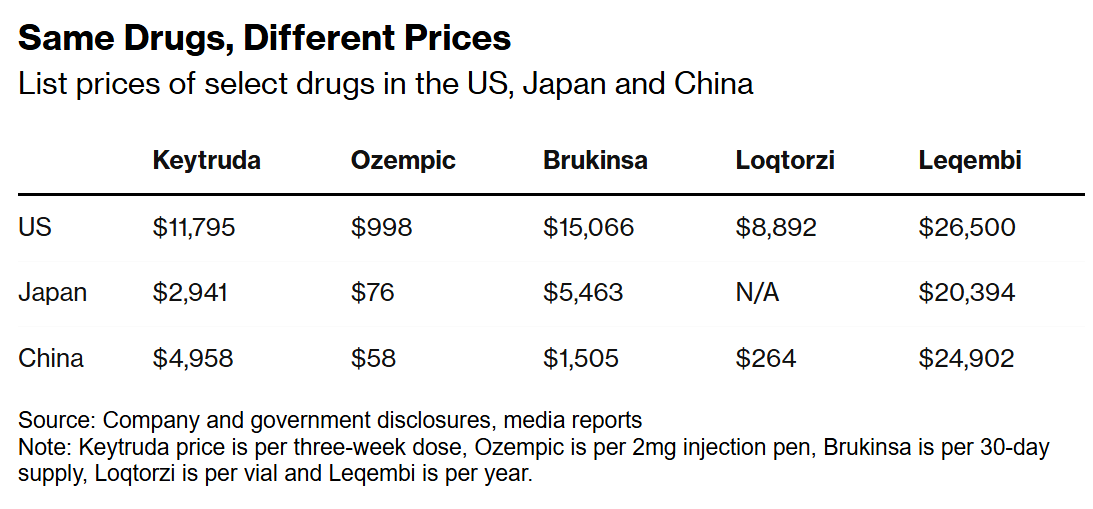
Americans pay the most in the world for medicines, funneling billions of dollars a year into an industry that says it depends on the US money spigot to drive growth and the development of breakthrough therapies.
Trump doesn’t discount that theory, but said it meant that “the ‘suckers’ of America” ended up bearing those costs “for no reason whatsoever.”
He said he wants the US “pay the same price as the Nation that pays the lowest price anywhere in the World.” Predicting that pharmaceutical prices could drop in the US, Trump also said prices would likely “rise throughout the World in order to equalize and, for the first time in many years, bring FAIRNESS TO AMERICA!”
The US government already negotiates prices for some of the highest-cost medicines used in Medicare health insurance under the Inflation Reduction Act, which passed in 2022 under former President Joe Biden, with more slated to be added every year. The first two rounds of drug price negotiations haven’t included physician-administered drugs, but the next round might.
When Trump issues his executive order on Monday at 9 a.m., investors say they are looking for more information on the potential limits on the price policy. Questions include whether it would apply only to government programs such as Medicare or Medicaid, if it would be limited to certain drugs or categories of drugs, or if the White House sees a way to apply this more broadly.
Investors say they are most worried about blockbuster drugs in Medicare Part-B and drugs serving large Medicaid populations, according to Jared Holz, a health-care strategist at Mizuho Securities USA LLC.
Billionaire hedge fund manager Bill Ackman suggested Trump might have been inspired by an idea he floated on X in March, when he said the best way to reduce US drug prices “is to make it illegal for drug companies to sell the same drugs abroad for lower prices than they sell them for here.”
In his first term, Trump proposed a Medicare pilot program for drugs with no low-cost generic competition that are given in doctor’s offices, saying he wanted to bring prices in line with countries like France and Japan where they cost dramatically less.
That plan, which would have phased in over three years, aimed to ensure Medicare paid the lowest price offered to a group of 22 nations.
The effort was struck down in federal court after drug companies challenged it, claiming the administration hadn’t properly carried out the rulemaking process. The Biden administration didn’t appeal that finding, and instead pursued legislation that led to the Inflation Reduction Act.
Trump’s plan likely only affects the drugs up for price negotiations under the IRA, said Evan Seigerman, head of health-care research at BMO Capital Markets.
“Importantly, the government has no power to set prices in the commercial market,” and potentially faces resistance from Congress to implementing legislation beyond what can be done via the executive order, Seigerman said.
Written by: Rachel Cohrs Zhang, Derek Wallbank, and Hadriana Lowenkron — With assistance from Kanoko Matsuyama, Amber Tong, and Gerry Smith @Bloomberg
The post “Trump’s Vow to Cut US Drug Prices Drags Pharma Stocks Lower” first appeared on Bloomberg