For years, a strong earnings season has given Wall Street something to fall back on. But the crumbling artificial-intelligence trade has ripped away that support.
Companies in the S&P 500 Index just delivered a second-consecutive quarter of profit growth in excess of 30%, defying fears rising costs would slow earnings. Instead of rallying, the index slumped, signaling strong results alone aren’t enough to protect mounting anxiety around the AI trade.
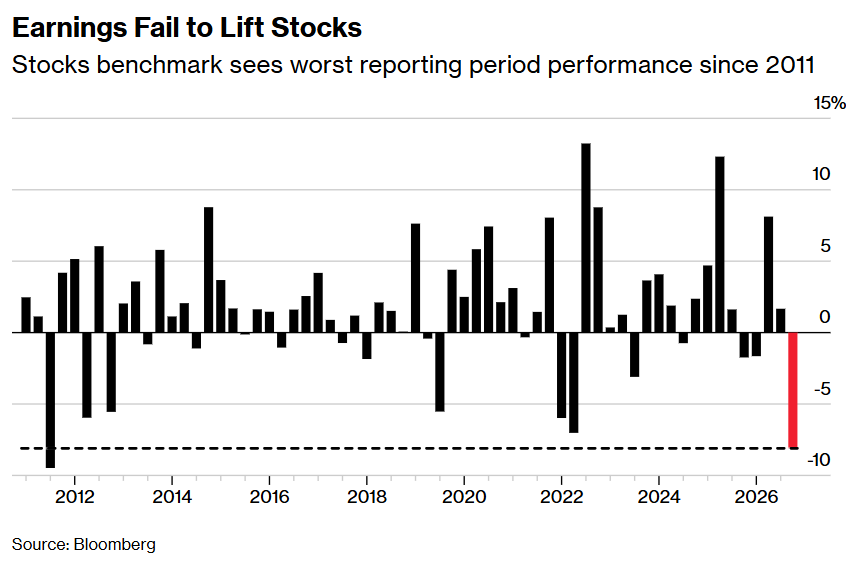
Between JPMorgan Chase & Co.’s results that kicked off the announcement season in October and Walmart Inc.’s report on Thursday that marked its unofficial end, the S&P 500 slumped 8.1%, posting its worst earnings-season run since 2011. The index fell another 3.7% Friday and entered correction territory, down 12% from its recent high on Oct. 6.
The strong earnings cycle was not enough to support the stock market as a Democratic sweep of US midterm elections raised the prospect of tighter regulation of data centers, threatening a central pillar of the artificial intelligence boom — not to mention the S&P 500’s future profit growth. The shock ouster of Nvidia Corp. founder Jensen Huang also rattled nervous investors.
“There’s a lot of anxiety,” said Daniel Farley, chief investment officer at US Bank Wealth Management. “Earnings growth will continue but just not as good of a rate. I think the market is going to continue to struggle with that.”
Upside surprises were smaller than in prior quarters, data compiled by Bloomberg Intelligence show. Firms are also returning less to shareholders. Data from 22V Research LLC show 53% of S&P 500 earnings were spent on dividends and buybacks, the lowest such reading since at least 1990, as far back as data go.
Concerns that earnings growth has peaked haven’t disappeared. They’ve merely been delayed to 2027.
Here are five things we learned as firms reported third-quarter results.
Investors concerned about tech companies’ overspending on AI were quick to sell if third-quarter results didn’t meet expectations. Google-parent Alphabet Inc., Facebook-owner Meta Platforms Inc. and Amazon.com Inc. all slumped after third-quarter reports showed negative free cash flow, heightening concerns about how much they were spending on AI.
“The mood is more cautious than optimistic,” said Marta Norton, chief investment strategist at Empower. Companies are spending a lot on AI infrastructure and their ability to monetize those investments is still a ways off, she said. “It doesn’t feel like it was an earnings season on the tech side that really impressed people.”
Investors have responded by slashing their tech exposure. Respondents to BofA Securities’ global fund manager’s survey cut their net exposure to the sector to the lowest level since 2006.
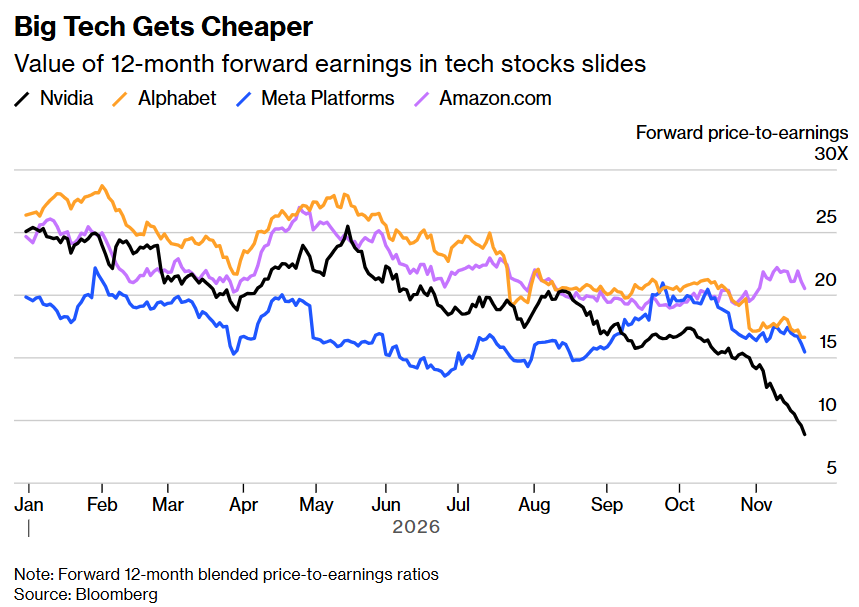
The sharp declines shrank the tech sector’s valuation on a price-to-earnings basis by more than 40%, which is among the “most severe valuation resets in nearly three decades,” according to Keith Lerner, chief investment officer and chief market strategist at Truist Advisory Services Inc. But cheaper valuation “does not make the sector risk free,” he warned.
Take Nvidia Corp., whose valuation has plummeted even as its earnings continue to grow. Strong third-quarter results and a positive outlook were not enough to convince investors to reenter the stock as the cloud of Huang’s ouster and his relationship with an alleged Chinese spy continues to hang over the company.
“Everyone is feeling a little burned and is wary of committing,” said Chris Grisanti, chief market strategist at Mai Wealth Advisors LLC.
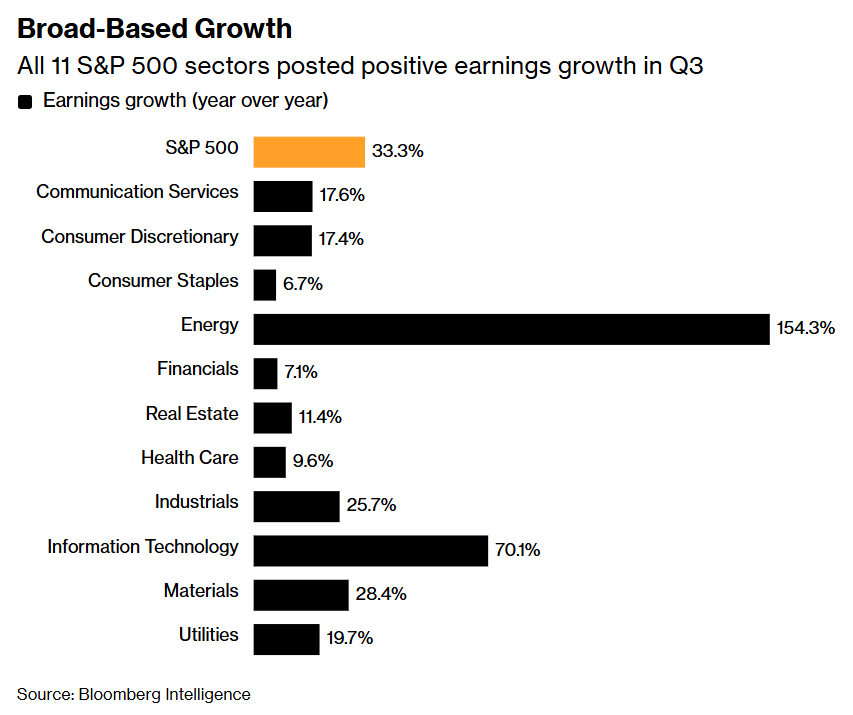
For the first time since 2021, all 11 sectors of the S&P 500 recorded earnings increases, according to data from Bloomberg Intelligence. Healthcare stocks snapped a two-quarter streak of losses as the sector’s largest firms, including UnitedHealth Group Inc., reported lower-than-expected costs in the third quarter.
Gina Martin Adams, chief market strategist at HB Wealth Management LLC, said this period of synchronous earnings growth is likely to be fleeting.
The top-performing S&P 500 Energy index rose 36%, boosted by high prices from the Iran war. Refining stocks including Marathon Petroleum Corp. and Valero Energy Corp. have doubled in price this year. However, the sector will struggle next year to match its current earnings growth levels and share price gains if oil prices drop, Martin Adams said.
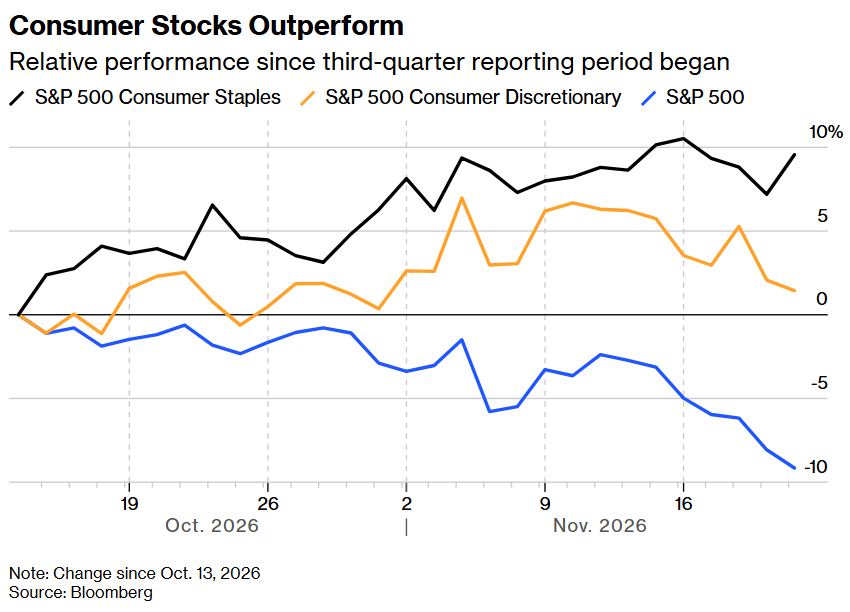
Companies reported better-than-expected bookings on airlines, cruises and at restaurants, easing Wall Street’s worries about a slowdown in consumer spending. Americans have also bought a million more turkeys ahead of Thanksgiving this year compared with 2025, a point Walmart Inc. executives highlighted while raising guidance Thursday.
All of that spending was a surprise at a time when consumer sentiment has been trending lower on rising inflation, said Mai Wealth Advisors’ Grisanti. “People complain all the time about how expensive everything is but the planes are full and the restaurants are full.”
Spending on big-ticket items like cars and houses has eased as inflation has put upward pressure on interest rates. Shares in both Ford Motor Co. and General Motors Co. slipped after the carmakers narrowed their full-year guidance and analysts raised concerns about the 2027 outlook.
Homebuilders including DR Horton Inc. and NVR Inc. both dropped after missing expectations for the quarter and as analysts warn the pair and their peers are facing a tough 2027.
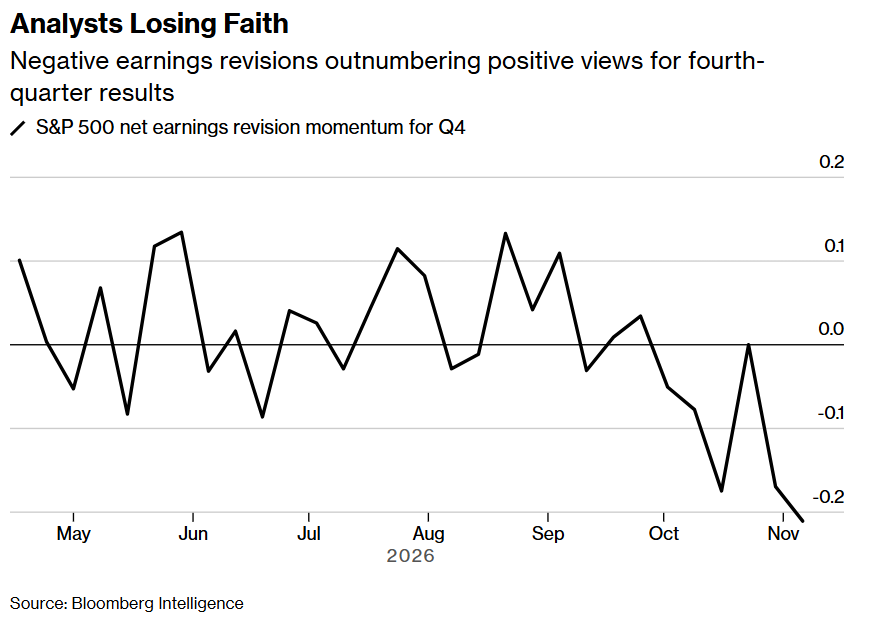
Analysts have aggressively squeezed their expectations for the next round of earnings, lowering their expectations for the fourth quarter at the fastest rate this year in the first week of November.
An earnings slowdown next year is becoming the consensus view on Wall Street. Strategists from Goldman Sachs & Co. LLC, Wells Fargo & Co. and Ned Davis Research all cited decelerating earnings through 2027 as an equity market risk.
Wells Fargo’s Ohsung Kwon’s target of 8,200 for the S&P 500 in 2027 held as a Street low for less than a day before Ned Davis’ Ed Clissold predicted the index would only reach 8,000.
That forecast implies a roughly 16% gain from the S&P 500’s current level.
“We’re talking about moving from great to good,” said US Bank Wealth Management’s Farley. “At 16% to 18%, that’s still earnings growth that can drive a market forward.”
In Europe, a robust season drove the benchmark Stoxx 600 back to a record high. Earnings surpassed expectations to nearly match the growth seen in US peers for the first time in years.
Profits at MSCI Europe constituents jumped 33% in the third quarter, the most since early 2022, according to data compiled by Bloomberg Intelligence.
Energy and technology stocks posted the biggest increase in profits from a year earlier, helping lift the Stoxx 600 to an all-time peak by mid-November.
“Europe has begun to make a pretty compelling case as an addition to investments in the US,” said Richard Flynn, managing director at Charles Schwab UK. “Europe is fairly balanced, and while earnings growth is comparable, there’s a lot of potential in Europe for investors who want to further diversify their global investments.”
Company executives have underscored resilient demand and continued capital spending expectations while broader AI adoption is fueling cost efficiencies, according to an analysis by Barclays Plc.
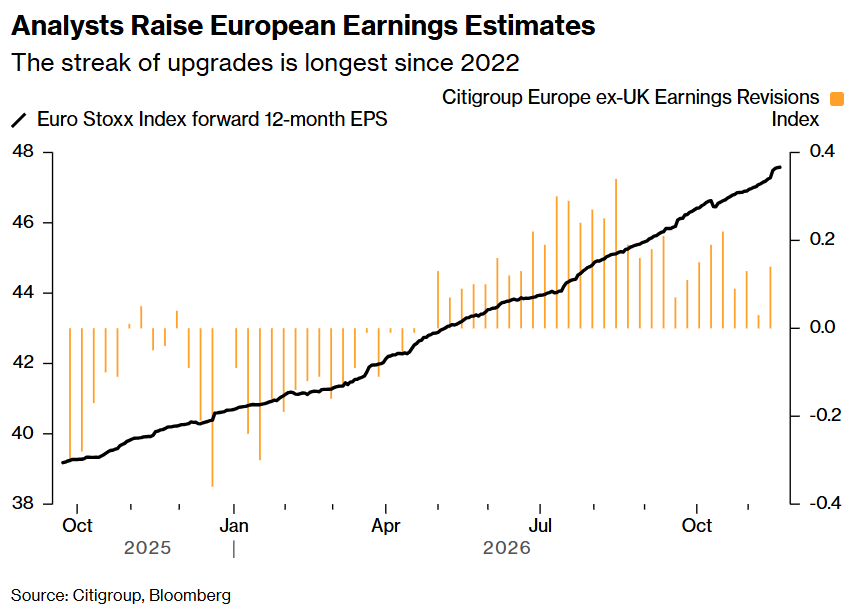
A Citigroup Inc. index also shows more analysts are continuing to upgrade rather than downgrade European profit estimates in the longest streak since 2022. Some strategists, including at UBS Global Wealth Management, are favoring European stocks over the US next year.
Written by: Geoffrey Morgan and Sagarika Jaisinghani @Bloomberg
The post “Strong Earnings Prove No Match for the Crumbling AI Trade” first appeared on Bloomberg