Couples are cutting wedding budgets and delaying the event altogether in a sign that a sinking stock market and recession fears are causing a pullback on big purchases.
Wedding planner Alyssa Pettinato said that four of the 15 couples she’s working with in the New York area have recently trimmed what they plan to spend on their luxury nuptials. Last week, one couple told her to slash $75,000 from their $400,000 Manhattan wedding set for later this year.
“They told me: ‘We don’t have the money because we’re hemorrhaging in our portfolio right now,’” said Pettinato, owner of Alinato Events. “There’s a lot of volatility, and people don’t know how to plan.”
In Dallas, clients are cutting guest lists about 25% on average to keep costs down, said Stephanie B. Evans, owner of Wedding Event Design. Couples are saying they want to be “really cautious” about spending, she said.
Budget cutbacks and deferrals on a milestone event underscore how wary US consumers are after watching the S&P 500 Index tumble in recent weeks as President Donald Trump ignited a trade war, which has raised the risk of an economic slowdown and higher prices.
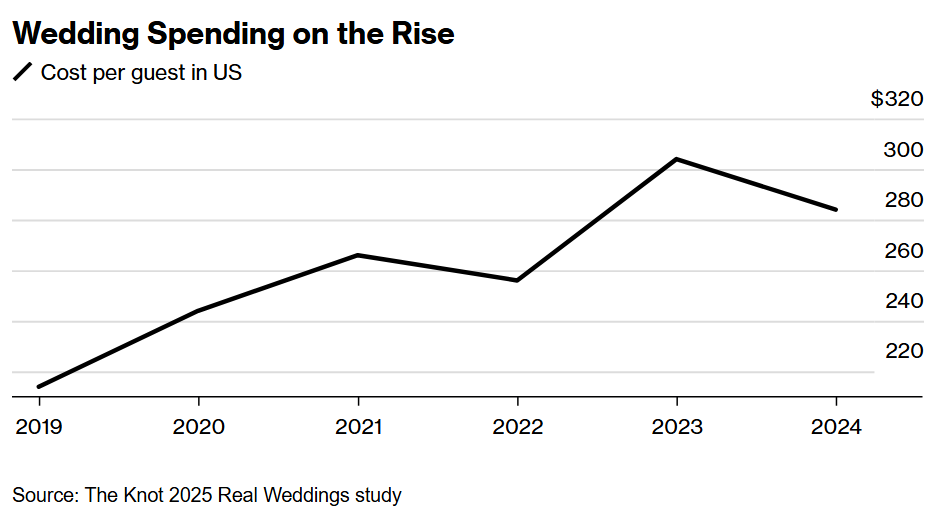
Weddings are an economic engine that fuel small businesses, like florists and photographers, and benefit big hotel chains and airlines. Industry revenue hit roughly $65 billion in the US last year, according to Grand View Research. The average wedding cost $33,000 in 2024, an 18% jump from 2019, according to a report from The Knot, an industry publication.
In the aftermath of the financial crisis more than 15 years ago, the average spend on weddings fell 8% over a two-year period to $26,000 in 2010, survey data from The Knot shows. Sarah Klingman, founder of Mostest, an event-planning platform that offers couples access to professional planners, is looking at those figures to help plan for what’s to come.
The lesson? It’s cutbacks, Klingman said, “but not a collapse.”
The US election coincided with the start of engagement season, which typically begins around Thanksgiving and lasts through Valentine’s Day in February. That timing led clients to be more cautious due to uncertainty around Trump’s trade policies and the economy, according to Evans, the wedding planner from Dallas. In recent weeks, some anxious couples have told her that they want to cut back on their wedding to save for longer-term investments such as purchasing a home.
Trump’s tariffs could make nuptials more expensive. China accounts for 90% of the US bridal gown market, according to the National Bridal Retailers Association. Levies on Chinese-imported gowns rose to almost 170% this month, the group recently said on its website.
A lot of bridal decor on Amazon.com and Etsy.com also comes from China, and the affordable prices have enabled a maximalist wedding style in recent years, said Mostest founder Klingman. If the trade war makes such decorations more expensive, it’s likely to underpin a shift to a more minimalist aesthetic, she said.
Expecting a more frugal customer, Klingman has tweaked her marketing from “bring your dreams to life” to keeping “planning affordable – with human help and transparent pricing.”
Tariffs are also likely to push up the cost of flowers, most of which are imported. A lot of the vases, tape and ribbon that adorn arrangements are also imported from China and might become too costly.
Cameron Hardesty, chief executive officer of Poppy Flowers based in Charlottesville, Virginia, expects florists to reduce the use of vases and opt for what’s known as a “floral meadow” arrangement in which flowers are anchored in foam and covered with moss. She expects her business and the industry to shift some vase sourcing to the US and potentially Mexico.
Hardesty is also seeing a shift in her business. Many customers are waiting longer to book arrangements, wanting to hold onto their cash until they have to make a decision, she said. But the financial anxiety has also brought Hardesty new wealthy clients. She recently notched two $30,000 bookings – a first for her company. They like her pricing, which she says is helped by directly sourcing from farms in Ecuador.
“High-income households are looking for a good deal – more now than they were even a month ago,” Hardesty said.
The trade war may also help some companies by pushing more couples to shift purchases to the US. In Detroit, Mehreen Buksh, founder of Miraj Events, works with South Asian and Middle Eastern clients who typically purchase their bridal outfits from abroad. Now more clients are considering buying their wedding attire closer to home in Detroit, Chicago and New York.
Jesse Reing, founder and CEO of Events by Jesse based in New York, has seen more fiancés push back the big day to 2027 to have more time to save money. Meanwhile, some vendors are starting to add clauses to their contracts stipulating their right to increase prices in the future, she said.
Regardless, “it’s still my job to make sure all of their dreams are coming true,” Reing said about her clients.
Reing, who is set to wed this year, tried to make her own dreams come true by front-loading her decor purchases from Amazon and Temu in January to avoid potential tariffs. That strategy comes with a downside.
“My house has been crazy for months.”
Written by: Jeannette Neumann @Bloomberg
The post “Stock Rout Has Couples Taking Axe to Wedding Budgets” first appeared on Bloomberg