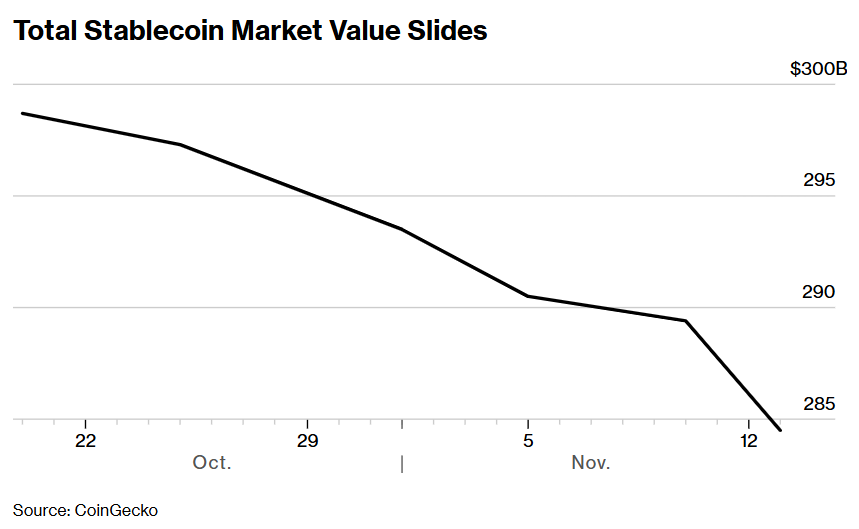
Stablecoins once gave traders a way to ride out crypto selloffs without taking their money out of the industry. Now the market for those dollar-pegged tokens is shrinking at its fastest pace since Terra-Luna collapsed in 2022.
Over the past 30 days, the sector’s market value has shrunk by around $12 billion while bellwether Bitcoin tumbled to a roughly four-month low, according to data compiled by researcher Kaiko. Tether’s USDT and Circle Internet Group Inc.’s USDC, the two largest fiat-linked tokens, accounted for 90% of the decline.
The dollar-pegged tokens caught on as crypto exchanges adopted them as a substitute for dollars in trading. Traders could sell volatile coins, keep the proceeds ready for their next trade or move them between exchanges at a time when most banks refused to work with crypto platforms. Now holders are converting the tokens back into traditional currencies like the dollar and cashing out.
“Capital seems to be leaving crypto, not moving between tokens,” said Anastasia Melachrinos, head of research at Kaiko. “USDT and USDC shrank at the same pace, about 4% each, with no depeg. It seems that holders are cashing out to dollars across the board rather than fleeing one issuer.”
Trading this past weekend showed how low liquidity can impact prices, especially with the 24/7 nature of the market. Bitcoin tumbled around 8% on Saturday in New York in a few hours as automated margin calls and forced liquidations sent the price to the lowest since July.
The majority of the stablecoin market-value decline has taken place on the Ethereum blockchain, where most exchanges and decentralized-finance liquidity live, according to Kaiko — which means it’s tied to trading capital rather than payments. The decline is “concentrated on exchanges, with USDT and USDC exchange balances down about $26.7B since April,” said Sean Rose of Glassnode, another researcher. “That points to less stablecoin capital sitting on trading venues.”
Some market observers speculate that investors may be looking to move capital into the IPO of artificial-intelligence giant Anthropic PBC, which should begin public trading this week.
“Weekly US Bitcoin ETF data reveals the exact same institutional cash-raising pattern seen around SpaceX’s debut,” Tagus Capital wrote in a substack article last week. “Now, ahead of next week’s blockbuster Anthropic IPO, with Hyperliquid perpetuals valuing the company near $1.8trn (over 25% above its $1.4trn filed range) and roadshow demand pointing to a capital raise up to $100bn, Bitcoin ETFs are repeating that script with three straight weeks of heavy outflows.”
Bitcoin’s drop of more than 20% over the past month has gathered pace in recent weeks. Unlike the abrupt crashes that have punctuated previous crypto downturns, much of the preceding decline unfolded during relatively subdued trading before liquidations accelerated in recent days.
The steady erosion is adding to a sense of exhaustion across a market confronting a growing list of obstacles, from the record hack at Binance and renewed political uncertainty following Democratic gains in the US midterm elections to rising Treasury yields and a stronger dollar.
The Binance hack has revived questions about the security of trading platforms at a time when the industry is struggling to rebuild investor confidence. Meanwhile, Bitcoin’s retreat is particularly frustrating for investors who had expected mainstream adoption to provide a more durable foundation for prices.
Total stablecoin market value peaked at $312.6 billon on April 17, and is now around $284 billion, according to Glassnode.
“For context, the 2022–23 drawdown was roughly 35%, but that was driven largely by the collapse or wind-down of smaller stablecoins and USDC outflows, while USDT continued to grow,” Rose said. “This time, both USDT and USDC are contracting.”
Written by: Olga Kharif @Bloomberg
The post “Stablecoin Market Shrinks Most Since Terra-Luna’s 2022 Crash” first appeared on Bloomberg