President Donald Trump’s tariffs announcement on April 2 devastated financial assets, wiping out some $6 trillion in market value from US stocks in just two trading days. Wall Street’s “smart money” — hedge funds and other professional investors — dumped equities, and strategists urged clients to flee.
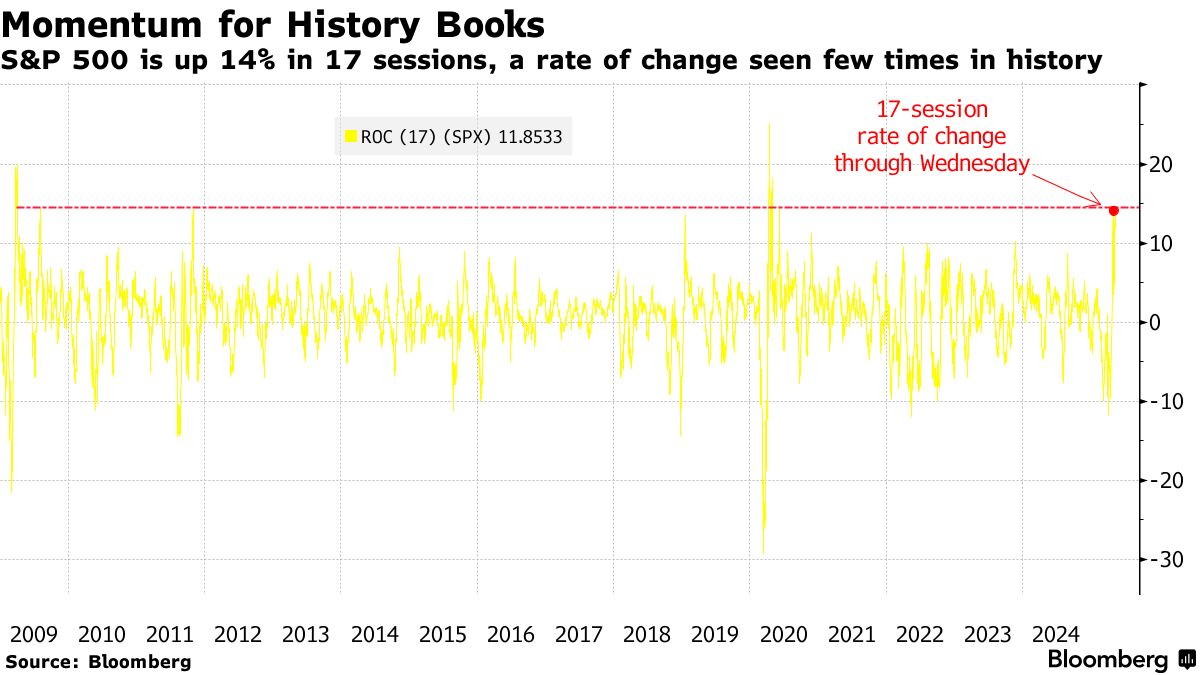
But the so-called dumb money, embodied by retail traders, didn’t see things that way. To them, the stock market was suddenly on sale, meaning it was time to buy, not hide. And it turns out they were right, as Trump reversed himself a week later and paused most of his levies on April 9, sending the S&P 500 Index soaring 18% since then.
“It’s the big institutions that are causing the massive selloffs,” said Michael Antonelli, a market strategist for Baird Private Wealth Management. “Retail is just scooping it up every two weeks, and eventually, the selling pressure ends — scooping, scooping, scooping.”
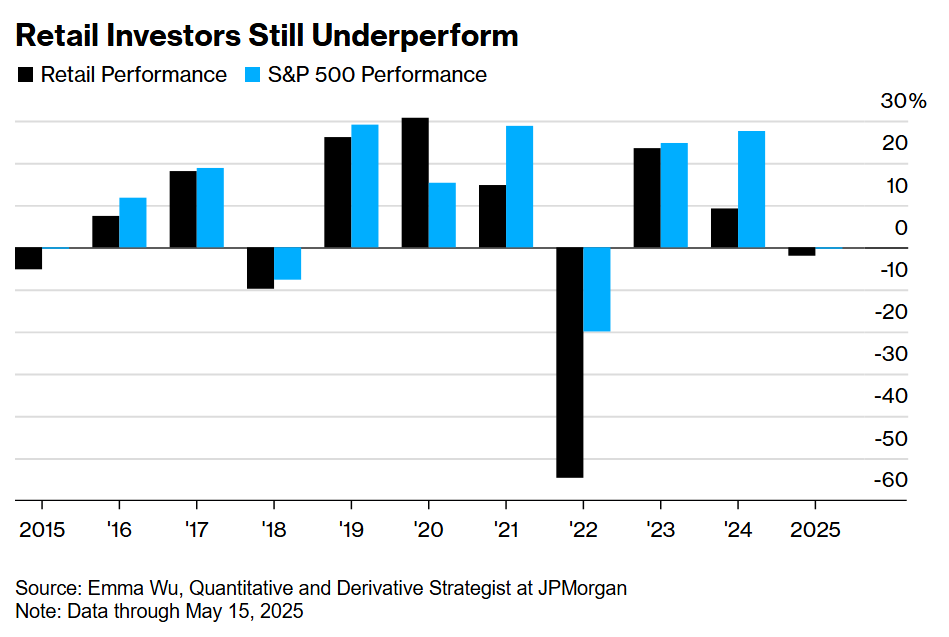
Individual investors snapped up equities at a record pace throughout the stock-market churn, as the S&P 500 dove to the cusp of a bear market and then rallied to basically flat for the year in a month. The dip-buying earned retail traders a roughly 15% return since April 8, the day before Trump’s tariff pause, as they plowed a net $50 billion into US stocks, based on data from JPMorgan Chase & Co. quantitative and derivative strategist Emma Wu.
“In the face of daunting headlines, retail investors showed the power of diamond hands while the pros flinched,” said Dave Mazza, chief executive officer of Roundhill Investments. “In a market dominated by fear, the small-but-steady buyer is winning.”
“While this may be counterintuitive, retail isn’t constrained by benchmarks or answering to uneasy clients, so they plowed ahead and the bought the dip, which worked once again,” he added.
Retail has believed in this market for a while. Bank of America Corp.’s individual-investor clients were buyers for 22 consecutive weeks through Friday, the longest streak in the firm’s history going back to 2008, according an analysis by BofA strategist Jill Carey Hall. By contrast, US equity positioning among systematic rules-based funds hovers in the bottom 12th percentile, based on the latest data from Deutsche Bank AG’s Parag Thatte going back to 2010.
Stocks are now trading like the rout never happened. The S&P 500 is roughly 4% away from an all-time high, while the Nasdaq 100 Index swung from a bear market back into a bull market. The enthusiasm is building as economic tensions between the US and China ease and the White House appears to be softening its approach to trade negotiations. Dip-buying was on full display again Thursday, with stocks closing 0.4% higher after falling at the open — notching a fourth-consecutive day of gains.
“There are so many instances where retail has ended a selloff because they have to be in the market,” Baird’s Antonelli said. “They have to retire.”
For Meyer Davidoff, the turmoil was a chance to buy more shares of his “long-term winners,” such as Blackstone Inc., Walmart Inc., Amazon.com Inc. and Nvidia Corp. Although the volatility wasn’t easy for the 33-year-old co-founder of small health-care company Invictus Pharmacy to stomach, he said his focus was on the long-term trajectory of the US economy.
“I was absolutely fighting demons and self doubt day-to-day, but I sort of just tucked away my phone and didn’t bother selling anything,” Davidoff said. “I’m gloating right now, and I feel even more optimistic now that the tariffs have been pushed off. It gives us a chance to breathe and plan ahead.”
For Colin Cento, a hospitality consultant and private chef, the buy signal was when television networks and Wall Street investors were warning of doom scenarios in unison. Then billionaire hedge fund manager Bill Ackman began to criticize Trump’s tariffs, and he was confident it was time to snap up more shares.
“Everybody knows you buy the dip,” he said. “The market always comes back. When I thought that there were going to be a couple days where we were going to hit a circuit breaker in the market, I was ready. My wife and I saw it and said, ‘Oh, we are going to buy so much.’”
Cento said his confidence in the stock market’s invincibility came from living through the Covid pandemic, when the S&P 500 bottomed on March 23, 2020, and then rebounded roughly 75% over the next year, one of the best 12-month periods ever for the index. Other investors in his age group have a similarly powerful belief in stocks despite the risks in front of them posed by Trump’s trade vacillations.
“I was looking at my like triple-levered QQQ and I was a little nervous for a while, but I’m strong in my convictions and I doubled down and rode it all the way back up,” said 30-year-old Matthew Tagle, who has a bit more experience with the market through his job as a wealth associate at a financial firm. “I definitely will shave off some money to go to Europe, but outside of that, this is strictly long term.”
The penchant among young investors to keep buying during market weakness is understandable. Anyone under the age of 40 has experienced nothing but bull markets in their adult lives, including the 11-year span from the depths of the global financial crisis in 2009 through Covid, the longest on record. This year, however, has still been challenging. Despite a winning April for mom- and pop-investors, the group is down about 2% through May 15 while the S&P is roughly flat, per JPMorgan’s figures.
Still, the confidence of retail investors has been rewarded by the market’s strength. The bear market following the Covid crash five years ago lasted just 33 days, the shortest on record. The inflation scare of 2022, during which the S&P 500 lost 19% in a year, was followed by two consecutive years of returns eclipsing 20%. And through late July 2024, the S&P 500 went 356 days without a 2% decline, the longest streak since 2007, according to Bloomberg Intelligence data.
This year, retail investors were one of the primary drivers of the rally in the last week of April, JPMorgan’s Wu said, as institutional activity and CTA positioning remained subdued. From April 28 through 29, the market share controlled by individual investors reached 36%, the highest level ever in the JPMorgan’s data.
Retail investors comprise roughly 19.5% of US equity-trading volume in 2025, according to Bloomberg Intelligence head of market structure Larry Tabb, up from 17% a year ago. Although the figure is below the 24% peak hit during 2021’s meme-stock stock mania, it’s well above pre-pandemic levels.
That degree of stock market consistency runs counter to the perception of retail investors swinging to extremes with each fad, according to Douglas Boneparth, president of the financial planning firm Bone Fide Wealth.
“It’s either the YOLO trader in meme stocks and zero day options, or someone who is dollar-cost averaging into the S&P 500,” he said. “The reality is the vast majority of investors are between these two points.”
Written by: Alexandra Semenova — With assistance from Elena Popina, Matt Turner, Carmen Reinicke, and Philip Sanders @Bloomberg
The post “Smart Money Loses to Retail Crowd That Bet on Stock Rebound” first appeared on Bloomberg