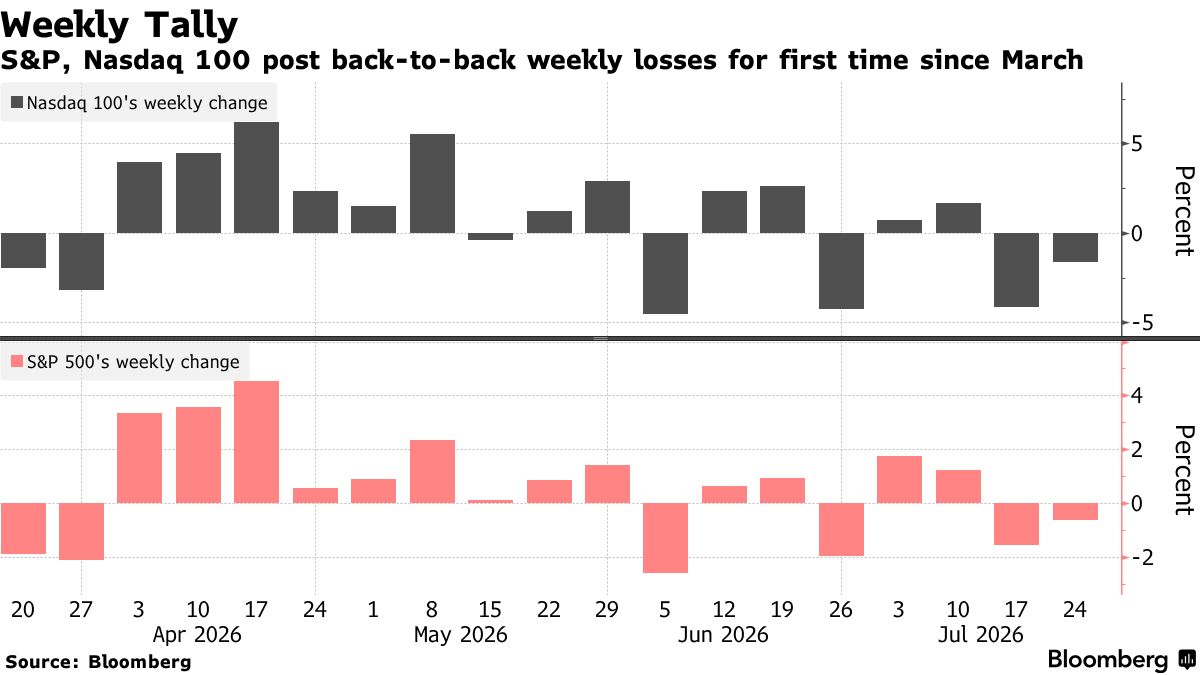
The Nasdaq 100 Index tumbled Friday, capping its first back-to-back weekly loss since late March as it was dragged down by the oil-price spike and a selloff in the tech stocks that once surged on the back of the AI investment boom.
The technology-heavy gauge dropped 1.15% after Intel Corp. reversed an initial advance to slide 7.89% despite a blockbuster revenue forecast. The S&P 500 Index eked out a 0.0497% gain, enough to leave it with a 0.6% loss on the week. The Dow Jones Industrial Average rose 0.5%.
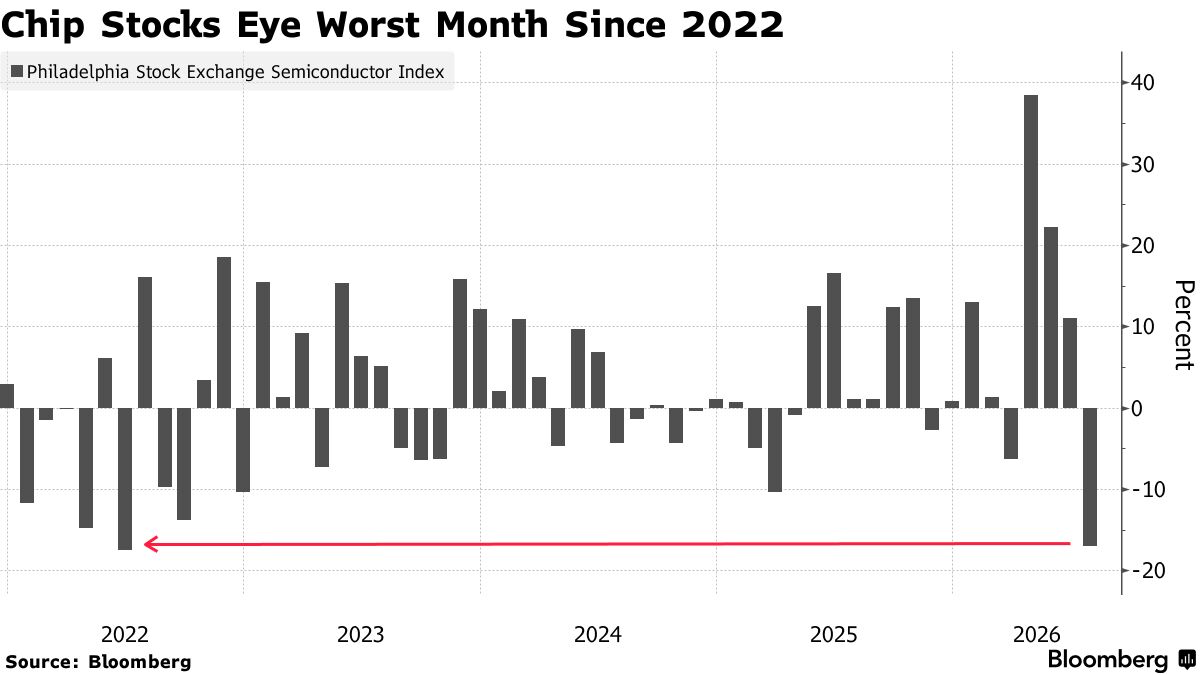
The Philadelphia Stock Exchange Semiconductor Index dropped another 4.25% Friday, capping a nearly 17% decline in July that’s put it on track for its worst month since June 2022. A basket tracking retail traders compiled by Goldman Sachs Group Inc. saw its largest monthly drop since April 2022. SanDisk Corp. — among the best performers in 2026 — slumped 10.79% Friday, the biggest S&P decliner.
Traders are now looking ahead to next week’s Federal Reserve meeting and bracing for what is set to be the busiest week of second-quarter corporate earnings releases. Equities were headed for weekly losses under the pressure of rising oil prices, which is threatening to reaccelerate inflation and has boosted bets the Fed could raise interest rates as soon as next week.
“This week was so confusing for the stock market because of the hostilities in the Middle East — but that’s not new and it’s been going on awhile,” Scott Ladner, chief investment officer at Horizon Investments, said by phone. “What has changed, however, is a spike in bond yields after fears about inflation and the path of rates spooked traders when crude prices spiked. Next week could be kinder to stocks — only if earnings support high stock valuations.”
Stocks have been clocking roller-coaster swings as traders sort through clashing figures on Big Tech earnings that sent jitters through the artificial-intelligence trade, geopolitical conflict in the Middle East — which briefly pushed crude prices over $100 a barrel — and renewed trade threats as President Donald Trump rebuilds his tariff wall with new levies on 60 economies.
The Nasdaq 100’s 7.1% drop in July would be its worst since March 2025, when worries about Trump’s looming tariff announcement dragged down stocks.
Trump threatened new tariffs on products from the European Union in retaliation to the bloc’s $1 billion (€890 million) fine of Alphabet Inc.’s Google.
Next week more than a third of stocks in the S&P 500 by market value will report results, the busiest stretch this earnings season. Investors will get a closer look at how AI-related spending is reshaping the tech industry when Microsoft Corp. and Meta report after the closing bell next Wednesday, followed by Amazon.com Inc. and Apple next Thursday.
“AI capex spending is accelerating quickly, with Alphabet now seeing negative free cash flow, and that’s sparked fears that more companies may use debt issuance to fund all of this spending that may create balance sheet concerns,” John Cunnison, chief investment officer at Baker Boyer Bank, said by phone. “Now investors need to see the payoff from AI to profits sooner rather than later, or else they’ll continue to question lofty valuations.”
Tesla Inc. fell 2.08%, after plunging nearly 15% on Thursday after reporting a profit tumble. Alphabet Inc. rose 0.645% after dropping 7.1% a day earlier, as an increase in its capital-expenditure outlook fanned fears about the sustainability of AI spending.
Nvidia Corp. fell 0.920%. Meta Platforms Inc. declined 1.80% while Apple Inc. rose 3.53%, after a basket of the Magnificent Seven companies wiped out $797 billion in market value on Thursday. A basket of Mag Seven shares was flat Friday, though its weekly 5.7% drop was its worst since early June.
An equal-weighted version of the S&P 500 — a proxy of market breadth — advanced 0.361%, with nearly 360 stocks rising in the benchmark while about more than 140 fell.
On Friday, 10 of the 11 S&P sectors rose, led by gains in real estate and materials while tech was the biggest laggard. Digital Realty Trust Inc. jumped 11.01% — among the best S&P 500 gainers Friday — after TD Cowen raised the recommendation on the real estate technology company to buy from hold, citing record demand strength for data centers.
CH Robinson Worldwide Inc. fell 9.25% — among the worst stocks in the S&P 500 — after a Dallas jury issued an advisory verdict against the freight broker and two other defendants in a lawsuit related to a trucking accident. The verdict awarded compensatory damages of $604 million.
Executives so far have been expressing optimism about future earnings despite a growing list of worries around geopolitics, the Fed’s interest-rate path and the payoff from massive AI investments. Tenet Healthcare Corp. soared 17.17% — its biggest gain since February — after the hospital operator boosted its profit guidance for the full year, following better-than-expected results in the second quarter.
Meantime, American Express Co. fell 4.30%, its biggest drop since April, after the credit-card issuer reported second-quarter revenue and net card fees that came in just below expectations.
Written by: Jess Menton @Bloomberg
The post “Nasdaq 100 Tumbles as Oil Spike, AI Jitters Hit Tech Stocks” first appeared on Bloomberg