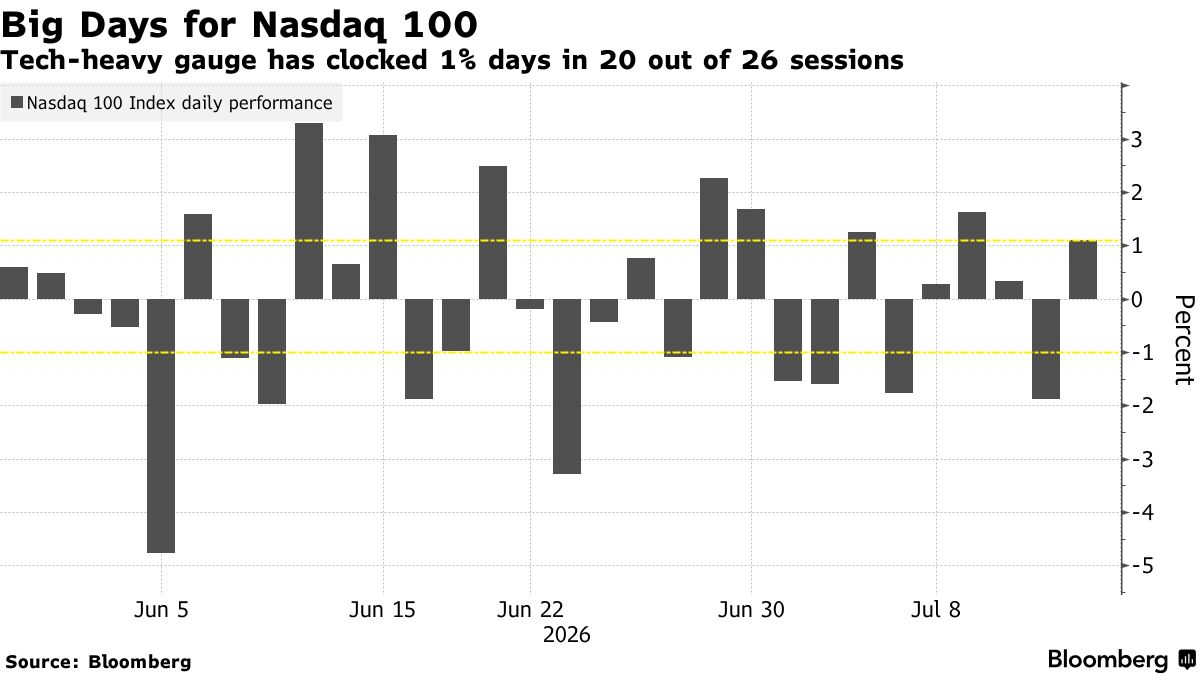
Only during major crises have tech stocks been this volatile.
For 20 of the past 26 trading days, the Nasdaq 100 Index — a key industry benchmark — has seen a daily gain or loss of roughly 1% or more as it lurched sideways, with the 1.1% gain on Tuesday the latest such move.
Sharp swings of that magnitude, it turns out, are extremely unusual. Since 2000, that’s only happened during periods of severe market stress: when Covid hit in 2020; during the bear market of 2022; the Global Financial Crisis of 2008-2009; and, before that, during the dot-com bubble — a period that many see as an worrisome parallel to the current artificial-intelligence boom.
Dave Lutz, equity sales trader and macro strategist at Jonestrading Institutional Services LLC, said the recent turns reflect a skittishness as investors wait for earnings reports, clarity on the interest-rate outlook and developments in the US-Iran war that’s been flaring anew.
“Lack of active participation seems to be exasperating the quant impact on the market,” he said. He chalked it up to a “herd mentality, driven by quants and factors, combined with an unusually large number of active accounts on the sidelines.”
Lutz flagged more than 30 daily moves this year for the VanEck Semiconductor ETF (ticker: SMH) and the iShares Expanded Tech-Software ETF (ticker: IGV) of at least 4%, which is more than the two had seen during the previous seven years.
Some of the swings have been affected by rotations between semiconductor companies, which rallied sharply from the end of March through mid-June, and beaten up software stocks. The two sectors have represented opposite poles of the market’s sentiment toward AI, with bullishness on the technology often lifting the chip companies profiting from the investment and hammering software firms at risk of being rendered obsolete, and vice versa when doubts about AI flare.
The volatility also speaks to the relatively narrow group of companies behind much of this year’s rally: Just 10 stocks powered the Nasdaq 100’s roughly 20% rally in the first half of this year, led Micron Technology Inc., Advanced Micro Devices Inc. and Intel Corp.
Last week, BTIG Chief Market Technician Jonathan Krinsky noted that the Philadephia Semiconductor Index, known as the SOX, had at least 15 up-or-down moves of at least 3% in the prior 30 trading days, a streak last seen in 2000, the year the Internet bubble collapsed.
“There have been an increasing number of warning signals over the last month, many of them rhyming with the March 2000 peak,” he wrote in a note. He called the the SOX’s swings an “ominous” signal.
Written by: Felice Maranz — With assistance from Neil Campling @Bloomberg
The post “Nasdaq 100 Sees Crisis-Level Volatility in Echo of Dot-Com Bust” first appeared on Bloomberg