Insurers controlled by billionaire sports mogul Mark Walter, now under scrutiny for loaning more than $20 billion to other parts of his empire, have in recent years increasingly leaned on a source of low-interest financing set up to help US homebuyers.
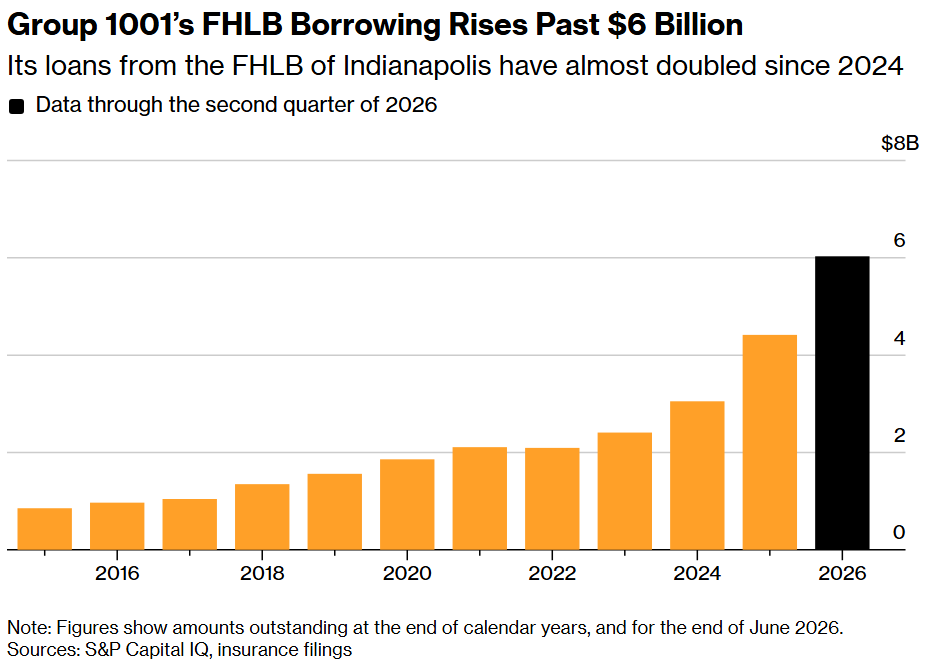
Walter’s two biggest insurers — part of a unit dubbed Group 1001 — owed more than $6 billion to the Federal Home Loan Bank of Indianapolis at the end of June, according to industry records. That’s a 36% jump from six months earlier and roughly double the outstanding balance at the start of 2025.
Congress created the FHLB system to keep mortgage lending alive through the depths of the Great Depression, providing the industry with a steady source of low-cost funding. But in recent decades, it has become a magnet for financial ingenuity, attracting a long line of borrowers eager to tap that money for purposes that may have little to do with offering new home loans. It’s now well known that insurers are jumping on that trend, especially as investment firms take them over and look to boost returns.
Still, Group 1001’s borrowing is climbing faster than many other insurers, and it’s going further than peers toward maximizing its use of available funding.
“This is a pure and simple case where the taxpayers are subsidizing funds that are given to insurance companies,” said Cornelius Hurley, a former independent director on the board of the FHLB of Boston. “The fact they can take the balance sheet assets at any moment to get liquidity is just a gross abuse of the system.”
Walter, the chief executive officer of Guggenheim Partners, helped pioneer the reshaping of the insurance industry alongside Wall Street stalwarts such as Apollo Global Management Inc. As dealmakers gained influence over firms or their assets, they steered policyholder premiums into more complex or unusual bets. That included going deeper into private credit and sports franchises. Guggenheim even lined up hundreds of millions of dollars of insurance money for a loan to superstar LeBron James.
Walter’s business empire, which includes insurers Delaware Life Insurance Co. and Clear Spring Life and Annuity Co., is facing a federal probe by the US Justice Department and Securities and Exchange Commission. At the heart of that inquiry is more than $20 billion of loans on the insurers’ balance sheets that should have been labeled as supporting affiliates but — until this year — weren’t.
It’s unclear how that money was ultimately used, and authorities haven’t accused the insurers, Walter or his TWG Global holding company of wrongdoing. A representative for Group 1001 declined to comment.
Walter’s insurers don’t offer home loans directly to individuals, but they do invest in mortgage securities that the FHLB will accept as collateral for the loans.
The FHLB of Indianapolis “monitors and assesses the financial condition of its members, including the collateral pledged to secure advances,” according to a spokesperson for the branch. “All member advances are over-collateralized by eligible mission-related assets, which predominately include real estate-related loans and securities, and agency and US Treasury securities.”
Most of the pledged collateral to the broader FHLB system is tied to mortgage-related securities, according to a study by its overseer, the Federal Housing Finance Agency.
Walter’s insurers put up about $8 billion of collateral as of midyear, filings show.
The FHLB system began with a simple approach: Lenders could bring mortgages to regional FHLBs, post the debts as collateral and get more cash “advances” to keep lending. In the 1930s, insurers were a major source of home loans. Firms can remain members even if they later close those operations.
Nowadays, the 11 regional FHLBs are a key part of the financial landscape, using implied government backing to raise money cheaply and then pass it along at interest rates lower than what many members can get elsewhere, especially on short notice. Advocates argue that provides stability during bouts of turmoil.
At times, the FHLB system has attracted scrutiny for having turned into a lender of last resort to troubled institutions, pushing it further away from its roots in housing finance. But such borrowing doesn’t necessarily signal strain, and savvy operators have often sought it out as another way to lock in greater spread from accessing low-cost funding and reinvesting it at higher rates.
While rules carefully govern what collateral is accepted, members can plow the advances into almost anything. That’s attractive to insurers looking to leverage portfolios of staid assets. The total amount insurers borrowed from the system has tripled since 2013, and their holdings of residential mortgages grew significantly as well.
Apollo’s Athene insurance unit and Walter’s insurers are at the leading edge of that trend. Athene was the second-biggest borrower in the entire FHLB system at the end of last year, behind regional bank Truist Financial Corp.
Delaware Life, which is much smaller, ranks lower nationally but was the third-biggest borrower at the Indianapolis FHLB behind Old National Bank and Merchants Bank of Indiana.
Delaware Life’s borrowing stands out from the crowd by another metric.
The firm typically uses 90% or more of its capacity for borrowing from the FHLB, according to insurance records. Its outstanding advances at the end of 2025 represented about 97% of what it was then eligible to draw, the documents show. At the time, Athene was using 76% of its capacity.
Average credit use among life insurers at that point was 41%, and lower still for property and casualty insurers, according to an April research note by S&P Global. One reason is that many executives prefer to leave much of their FHLB borrowing capacity untouched in case of emergencies.
Written by: Weihua Li and Sridhar Natarajan — With assistance from Noah Buhayar @Bloomberg
The post “Mark Walter’s Insurers Ramped Up Borrowing From Home Loan Bank to $6 Billion” first appeared on Bloomberg