Treasury Secretary Scott Bessent’s championing of a Federal Reserve facility Japan can use to boost the yen comes with the benefit of protecting the US bond market from excess sales.
The Foreign and International Monetary Authorities Repo Facility enables overseas central banks to use their Treasury holdings as collateral to access dollars, rather than sell the bonds on the open market to raise cash. It was created during the pandemic in 2020 to allow counterparties to raise liquidity without overly disrupting the Treasuries market.
Japan confirmed it bought yen on Friday and would use the facility in the future, according to Finance Minister Satsuki Katayama in a statement. In a social media post, Bessent said he supported the move and would encourage the facility to be upsized.
“The FIMA Repo Facility is an important backstop,” he said.
The Japanese are the largest foreign owners of Treasuries with over $1.1 trillion of holdings, according to the latest data from the US Treasury. That likely makes Washington wary of Japan selling off holdings to fund intervention, given the US bond market is already under stress on doubts about the Fed’s ability to fight inflation and concerns about the country’s fiscal outlook.
For Philip McNicholas, Asia sovereign strategist at Robeco in Singapore, Japan’s use of the facility would be preferable for the US given the current bond market environment.
“It would allow the Japanese Ministry of Finance to build a net short position and boost yen demand without having to sell Treasuries outright, limiting the impact on the US Treasury market,” he said.
The 30-year Treasury yield finished July at a 19-year high, and the 10-year benchmark was at the highest since early last year. Yields fell across maturities on Monday as oil prices declined on optimism over US-Iran peace talks.
The repurchase facility has a usage limit of $60 billion per counterparty per day, though this can be changed by a Fed subcommittee, according to documentation on the central bank’s website. An expansion of this would provide further credibility for interventions, wrote Societe Generale’s Stephen Spratt and Reo Sakida in a note Monday.
“Japan’s substantial stock of short-dated assets mean repo borrowing could be repaid through maturing securities, which keeps a potency to intervention as there is no need for dollar buying later,” they said. SocGen sees limited broad impact on Treasuries, according to the note.
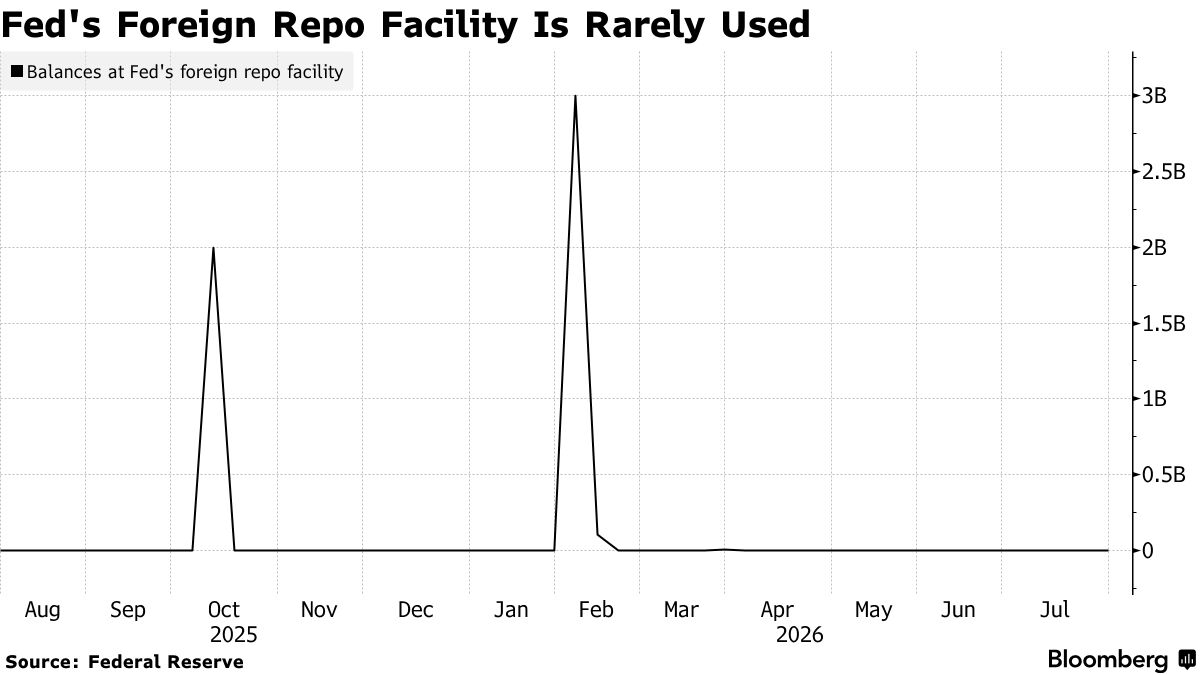
The central bank’s facility rarely sees usage. Balances averaged about $6 million in the week through July 29, according to the latest Fed data. The last time it was used in any size was for $3 billion at the beginning of February.
Homin Lee, a senior macro strategist at Lombard Odier in Singapore, also sees a limited impact, given that the facility was designed precisely for that purpose.
“FIMA is the obvious choice if Tokyo and Washington DC hope to minimize the impact of Japan’s yen support efforts on the US Treasury market,” Lee said. “Whether or not Japan resorts to this is a different question, but the logic for utilizing this tool is straightforward if Japan wants to keep at this FX intervention for a while.”
Written by: Cormac Mullen and Matthew Burgess — With assistance from John Cheng and Alex Harris @Bloomberg
The post “Japan’s Use of Fed Repo May Ease Pressure on Treasury Market” first appeared on Bloomberg