President Donald Trump shocked Wall Street when he called to bar big investors from the US housing market. Six months later, the effort ended in a compromise that still offers the biggest landlords plenty of ways to grow.
The deal, encoded in broader housing legislation that became law Saturday, ostensibly prohibits institutional investors — defined as those that already own 350 or more homes — from buying single-family houses. But the ban, under the heading “Homes Are for People, Not Corporations,” includes plenty of exceptions.
Big landlords such as Invitation Homes Inc., Pretium and Blackstone Inc.’s Tricon Residential can still buy rental houses so long as they make significant renovations or give tenants an opportunity to buy the properties at some point in the future. Institutions can also buy and sell homes to each other and acquire properties developed solely for renting, a model known as “built-to-rent” that has emerged as the industry’s preferred path to growth.
“The law doesn’t exclude institutions from the housing market,” said David Howard, a lobbyist for single-family landlords. “It creates guidelines, but there’s still enough room to allow institutions to remain active.”
The legislation hasn’t left the industry unscathed. In particular, it may frustrate the smallest of the big landlords, many of which need to grow to improve their bottom lines. There are some 30 firms that own between 1,000 and 10,000 single-family rentals, according to data firm SFR Analytics.
The law also creates stiff penalties for investors that violate it, and the measure could pave the way for states to pass buying bans that could prove more stringent. Meanwhile, the mere threat of a prohibition on corporate-owned single-family rentals chilled new investment, and that market will likely take time to recover.
The bipartisan bill, the 21st Century Road to Housing Act, automatically became law after 10 days passed without Trump signing it. While he has railed against institutional homebuyers, Trump ultimately refused to endorse the law until Congress passed a more divisive bill he championed requiring stricter voter identification.
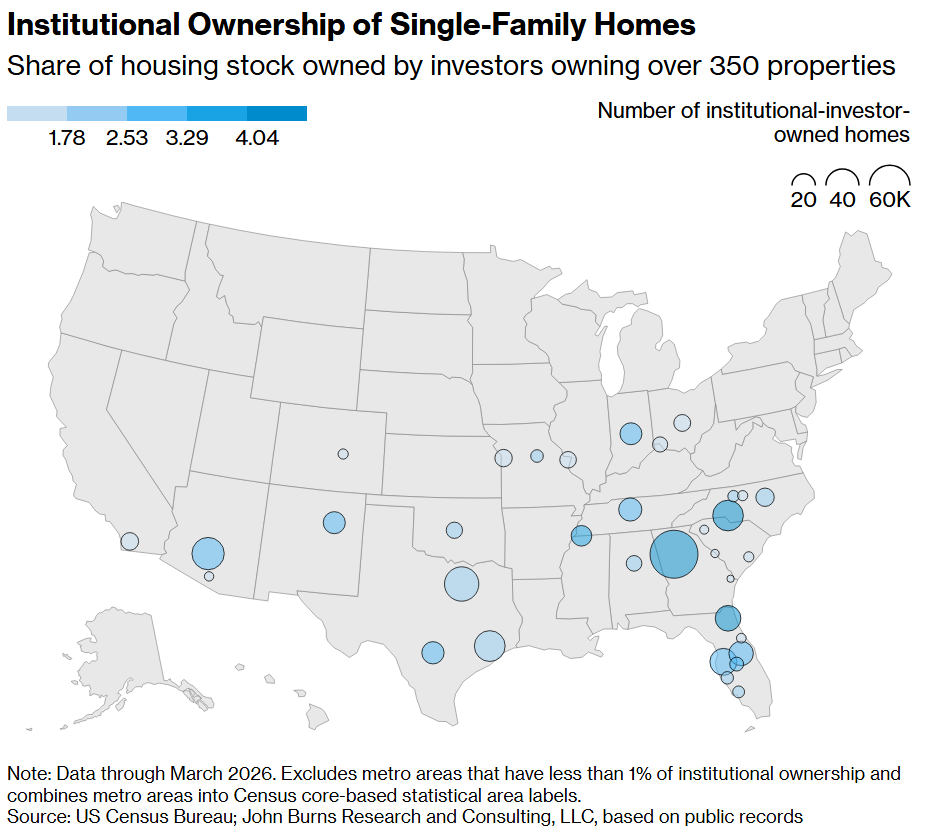
Wall Street landlords have become a bipartisan target since they emerged after the US foreclosure crisis, hoovering up single-family residences in the US at bargain prices and, according to critics, preventing ordinary Americans from trying to buy their first homes. Sun Belt cities such as Phoenix and Atlanta proved the most attractive destinations because they offered opportunities to acquire large numbers of homes at discounts.
From the beginning, the largest landlords argued that they represented a tiny share of the US housing stock. Firms owning more than 1,000 houses represent 3% of the single-family properties available for rent nationwide, according to a study from the Urban Institute.
Still, they made for a convenient scapegoat in an expensive housing market, even after they slowed purchases drastically when interest rates spiked in the middle of 2022.
Trump entered the fray in January of this year, at a time when his administration was focused on addressing a broader affordability crisis ahead of midterm elections. In an executive order, the president vowed to take “decisive action to stop Wall Street from treating America’s neighborhoods like a trading floor.”
Shares of single-family rental owners plummeted, and investors stopped considering new acquisitions while they waited to see where Trump’s initiative would land. The low point for the industry came in March. That’s when the Senate passed a version of the housing bill that included a measure affecting the business of building new homes specifically to rent them out that drew fire from homebuilders.
The final law threads a needle, according to Drew Flahive, president of alternative asset manager Amherst, which has about 50,000 homes in its portfolio of single-family rentals. It prohibits large landlords from buying move-in ready homes on the open market — a type of purchase that’s unpopular with voters — while allowing strategies such as built-to-rent that help address US housing shortages.
“The last thing anyone wants to do is make housing more unaffordable,” Flahive said.
Even with the exceptions, the law creates challenges for big landlords. Amherst laid off more than 100 employees after the prospect of an outright ban spooked capital providers earlier this year. It will likely take a year or two for capital providers to get comfortable with the law and commit new money acquiring rental homes, Flahive said.
State and local regulation remains another question. As of the middle of last year, lawmakers in about two-dozen states had proposed regulations to limit institutional investors in the housing market, according to an American Enterprise Institute report. Trump’s support for a ban is likely to resonate with Republican lawmakers in places like Georgia, whose capital has a high share of corporate-owned single-family rentals, and Michigan, where lawmakers passed a partial ban on the practice.
“The political issue is going to remain as long as affordability is strained,” said Lance Lambert, chief executive officer of housing market research firm ResiClub.
Written by: Patrick Clark and Dina Katgara @Bloomberg
The post “Corporate Landlords Targeted by Trump Now Poised for Growth” first appeared on Bloomberg