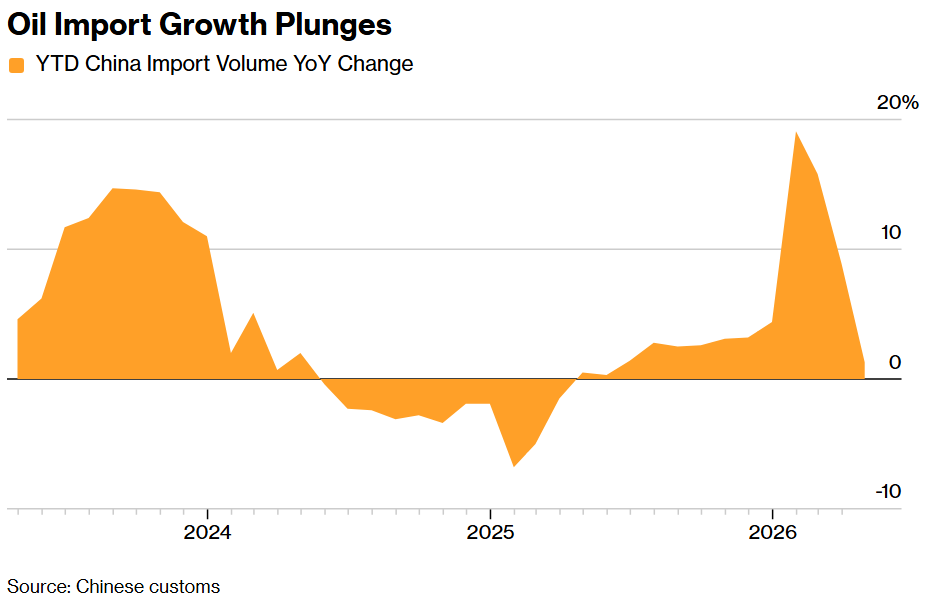
Chinese imports of crude oil are set to drop to levels not seen since the pandemic, as the war in Iran reveals the extent to which demand has disappeared and may not be coming back.
Inbound shipments could fall to an average of 10.9 million barrels a day this year, according to London-based consultancy Energy Aspects Ltd. That would be the weakest since 2022, when the economy was stricken by lockdowns to prevent the spread of Covid-19. China’s daily imports averaged 11.6 million barrels in 2025, a figure inflated by the government’s drive to buttress energy security by hoarding crude.
Tehran’s chokehold on the Strait of Hormuz caused imports to drop steeply in April to the lowest since July 2022. But compared to other big oil importers, the country has weathered the shock exceptionally well, primarily by cutting refinery runs and curbing product exports without needing to scout for alternative barrels.
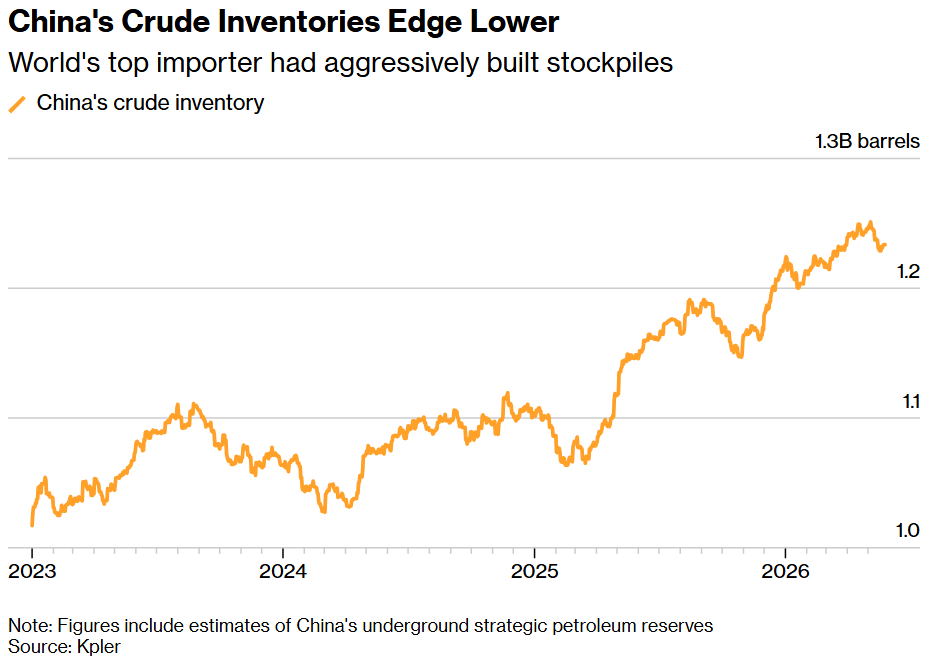
China’s muted demand marks a sharp shift for global markets. Over the past two years, its aggressive stockpiling absorbed much of the world’s surplus oil and helped support prices. But with Brent crude largely holding above $100 a barrel since the US and Israel first struck Iran, China no longer has the appetite. Transport in the country is increasingly electric, and its vast refining and petrochemicals industries simply have too much capacity relative to demand.
“Last year, almost all of China’s growth in crude oil imports came from stock-building,” said Erica Downs, a senior research scholar at Columbia University’s Center on Global Energy Policy. “Combined with the plateauing, if not peaking, of gasoline demand, this suggests that the era in which China was the most important driver of global oil demand growth is coming to a close.”
Traders say Chinese demand for Saudi barrels, including those that can bypass Hormuz, has fallen sharply, and buyers are unusually relaxed about finding alternatives, even as the conflict verges on its fourth month. Earlier this week, Sumit Ritolia, modeling and refining manager at analytics firm Kpler, said China’s seaborne crude imports have collapsed to 6.5 million to 6.6 million barrels a day, the lowest since 2016.
While China has begun to draw on its brimming stockpiles to help manage the energy shock, the bigger shift is in demand. State refiners cut runs to record lows last week. Gasoline and diesel sales both fell more than 15% in April from March.
The upshot is that refiners can cut throughput by nearly 2 million barrels a day without significantly tightening the domestic market for oil products, said Energy Aspects analyst Jianan Sun.
Beijing’s stock-building has masked the country’s real demand, said Michal Meidan, the head of China energy research at the Oxford Institute for Energy Studies. She estimates the country’s actual requirement for crude at 10.4 million barrels a day.
Chinese refiners can sustain run cuts of 10% for several months, and if domestic production is maintained at current levels and imports via pipeline are maximized, then the country’s seaborne purchases could fall as low as 7.2 million barrels a day without materially damaging product supplies, she said.
The question for oil traders is whether the war is a blip and normal service will eventually resume. The hope is that, once flows normalize in the Persian Gulf, falling prices will coax China back, and return the buyer of last resort to the market. Columbia University’s Downs is skeptical.
“As new-energy vehicles continue to penetrate the vehicle fleet and more oil demand growth is avoided and imports fall, I would expect that the incentive to maintain large stockpiles would become less pressing,” she said.
By launching a gold-clearing system in the next couple of months, Hong Kong is set to secure first-mover advantage in a push to become Asia’s preeminent hub for bullion trading.
Australia’s red meat industry expects strong beef demand in the US and Southeast Asia will largely offset the impact of a new 55% tariff by major customer China, which could come into effect as soon as mid-June.
Copper traders are once again scouring the world for metal to send to the US, as renewed speculation about import tariffs revives a trade that’s upended the $300 billion-a-year market.
(All times Beijing)
Thursday, May 28
Friday, May 29
Saturday, May 30
Sunday, May 31
The post “China’s Declining Appetite for Oil Laid Bare by Iran War” first appeared on Bloomberg