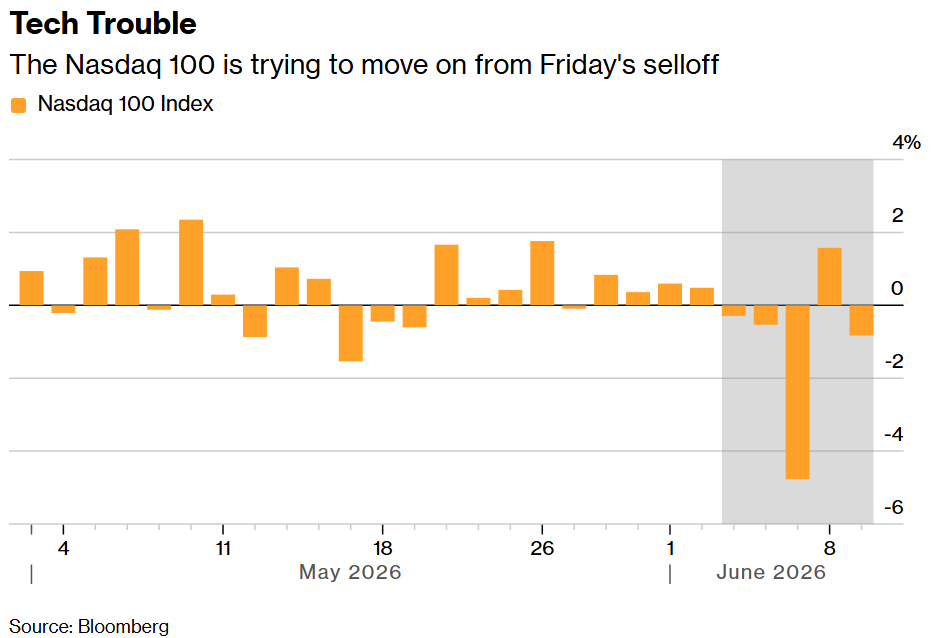
Friday’s technology-driven selloff was a “wake-up call” for investors, according to Wells Fargo & Co., which said it has highlighted the risks of piling into the artificial-intelligence trade.
As a result, analyst Ohsung Kwon said the “sugar rush” behind the recent stock surge is likely over, leaving him “unenthused” with equities. Even so, in his view, the selloff — which saw the Nasdaq 100 Index and S&P 500 Index both plunge — was positioning-led rather than fundamental and likely will mean a slower rally, not the start of a sustained retreat.
“With the war still going on and Hyperscalers raising capital to fund capex, we believe the narrow ‘buy semis’ trade will return,” Kwon wrote in a note to clients on Monday. “But the ‘sugar high’ rally is now likely over, and we expect the speed of rally to slow. Own AI, sell calls.”
Kwon’s comments echo other strategists who have seen the recent pullback — which rekindled on Tuesday — as a warning sign.
JPMorgan Chase & Co. cut their near-term view to “tactically cautious,” noting investors may continue selling some of the AI-related companies that lead the recent rally. Meanwhile, Bank of America Corp. warned investors to exercise caution as an increasing number of “bear market signposts” point to an approaching top. On Tuesday, tech stocks dragged the market lower again, with the Nasdaq 100 slumping about 2%.
For Kwon, the stock market still has room to run. But the long-time AI bull said it is crucial for traders to understand what the risks are going forward, given several bear cases that could derail an advance.
One of the major risks is whether the flood of debt-fueled spending on AI will stall if the big tech companies don’t start seeing an adequate return on their investments.
“Supply chain inflation means they’ll have to pass through elevated costs to AI labs to maintain their ROI at a time when end users are questioning their return on AI usage,” Kwon wrote.
Another relates to supply and demand. While the latter currently outstrips the former today, capacity is predicted to double every year over the next five years, which will lead to a more balanced market.
“If supply/demand starts to become more balanced, we expect capex to slow,” Kwon said. “But we’re currently only in an early, text-based phase of AI.”
Written by: Joel Leon @Bloomberg
The post “AI Selloff a ‘Wake-Up Call’ for Investors, Wells Fargo Says” first appeared on Bloomberg