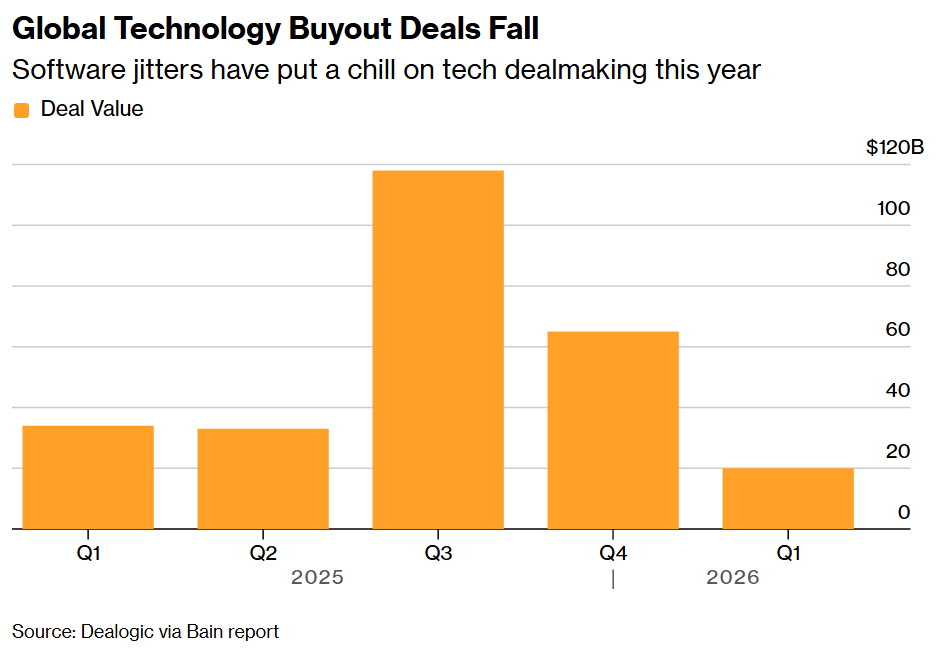
The value of private equity technology deals has plunged since the end of last year as investors have grown more cautious about what companies are worth in the age of artificial intelligence, according to a Bain & Co. report.
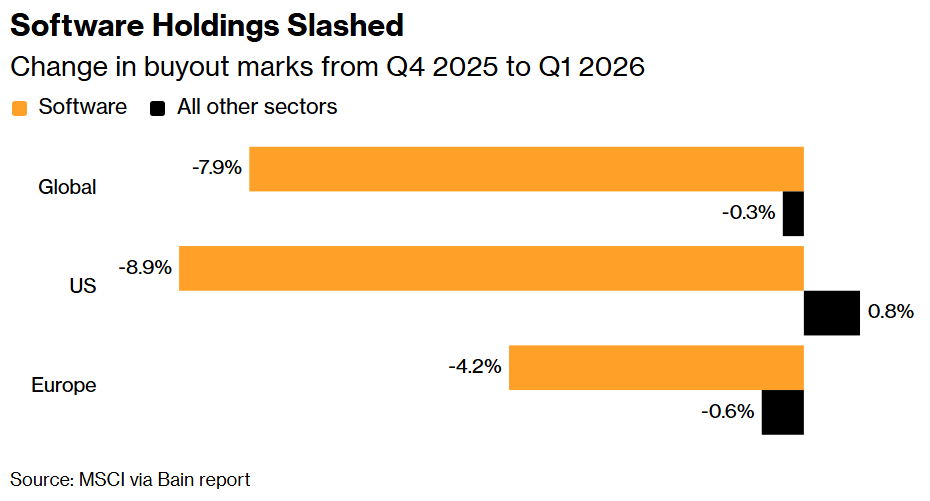
Global buyout deal value fell 70% to $20 billion in the first quarter as fewer large deals were completed, Bain said in the report, which analyzed data from Dealogic. Valuations of software companies fell about 8% in the period, compared with a decline of 0.3% for all other sectors.
Private equity firms have struggled for several years to sell assets at higher prices than what they paid and return capital to investors, and AI’s threat to disrupt software companies, in particular, has exacerbated those woes.
Coming into the year, the industry had shaken off President Donald Trump’s trade wars only to be hit by the so-called SaaSpocalypse meltdown in software-as-a-service investments, concerns about private credit and oil price spikes driven by the Iran war, Rebecca Burack, head of Bain’s global private equity practice, said in an interview.
“We’re a bit in a groundhog day dynamic for the second year in a row,” she said.
“We still don’t believe there’s anything fundamentally broken about the market,” Burack said, noting that the economy has continued to expand despite the shocks. The stock market is strong, debt is freely available and private equity firms have plenty of dry powder, she said.
“We don’t have a capital problem,” Burack said. “We have more of a confidence problem.”
Buyout firms need to adjust to the threat posed from AI by figuring out how protect existing investments and evaluate new ones with the technology in mind, Bain said in the report.
Private equity has made little progress in clearing the exit backlog that has built up in recent years, according to the report. The industry continues to struggle with record-low distributions as a percentage of net-asset value, and a growing number of companies are “essentially trapped in portfolios,” the report said.
Holding periods for assets have stretched to six to seven years, from three to four years during the heyday of private equity, Burack said. Historically, the industry required about 5% earnings growth per year over the holding period to earn a 2.5 times return, but now it is about 12%, she said.
Higher quality assets are finding buyers, but older assets with questions about future performance and high valuations remain a challenge to sell.
Even continuation vehicles — increasingly popular transactions that enable private equity firms to move companies from an existing fund to a new one — are facing pressure as limited partners scrutinize those deals, Bain said. A majority of assets in buyout portfolios were acquired in 2021 or earlier.
Investors need more stability around the economic environment to do deals, Burack said.
“You can get great deals done and create quite a lot of returns for your investors in many, many different economic scenarios, but you need to know what economic scenario you’re planning within,” she said. “You need to know what game you’re playing.”
Written by: Allison McNeely @Bloomberg
The post “AI Fears Spur 70% Plunge in Private Equity Tech Deal Value” first appeared on Bloomberg